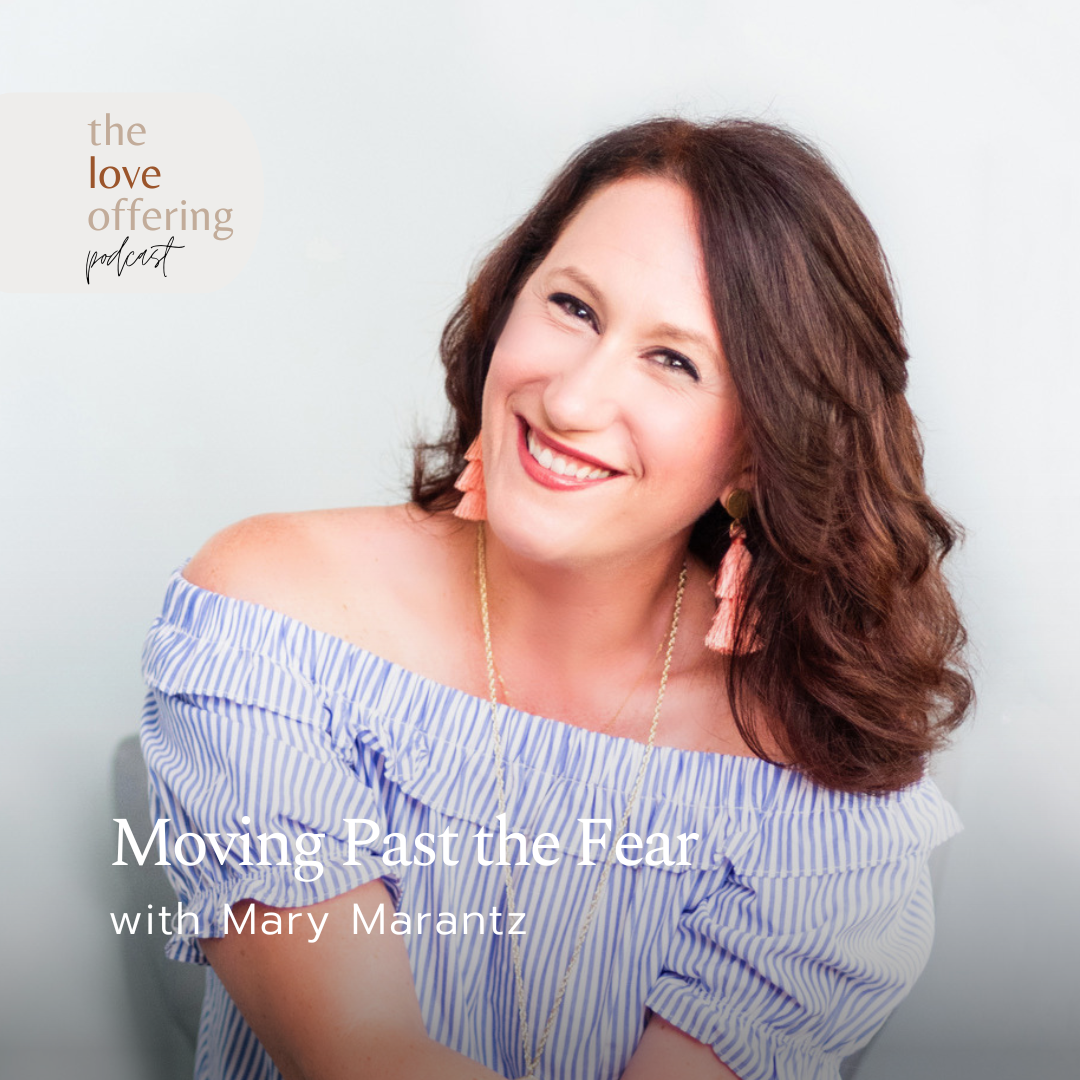
Have you ever found yourself thinking…
“It’s all been done.”
“What if I start and fail?”
“What if my voice doesn’t matter?”
“What if it’s already too late?”
If so, you’re not alone—and this week’s episode of The Love Offering podcast is one you can’t miss.
I had the absolute joy of sitting down with author and speaker Mary Marantz to talk about her brand-new book, Underestimated. In it, she speaks directly to the fears and excuses that keep us stuck in place—silent, small, and sidelined from the calling God has placed on our hearts.
Together, we talk about how to move from stuck to start, how to quiet the inner critic (and the outer ones too), and why your voice does matter in this world.
Mary shares not only the wisdom she’s gleaned but also practical, grace-filled steps to help you finally quit playing small and step into the story God has written just for you.
🎧 Listen now to the episode → HERE
You are not too late. You are not too much. And you are certainly not underqualified.
Let’s stop sitting on the sidelines and start walking in faith—one small, brave step at a time.
Cheering you on,
Rachael
Summary
In this episode of the Love Offering Podcast, host Rachael Adams welcomes back Mary Morantz, author of ‘Underestimated’. They discuss overcoming fear, self-doubt, and perfectionism, sharing personal stories and insights on how to move from feeling stuck to taking action. Mary emphasizes the importance of community and recognizing the lies that fear tells us, encouraging listeners to embrace their creativity and trust in God’s plan. In this conversation, Mary Marantz discusses the themes of overcoming fear, the importance of hidden seasons for personal growth, and the necessity of innovation in a world that often feels saturated. She emphasizes the significance of taking small steps towards achieving larger goals and the role of purpose and love in driving individuals to take action despite their fears. The discussion is rich with personal anecdotes and practical advice for listeners looking to move forward in their own lives.
Takeaways
Mary Morantz’s book ‘Underestimated’ addresses fear and self-doubt.
Fear often tells us lies that keep us stuck.
Community plays a crucial role in overcoming personal challenges.
Recognizing the voice of fear is essential to moving forward.
Creating something is better than creating nothing, even if it fails.
Fear is predictable and often uses the same tactics.
We need to cut fear off mid-sentence to regain control.
Mary’s journey from a trailer in West Virginia to Yale is inspiring.
The importance of trusting others and allowing community support.
Fear can be boring and repetitive, needing new material. We often wait for confirmation that may never come.
Fear can be predictable and boring, and we must get fed up with it.
Hidden seasons are crucial for honing both craft and character.
Excellence is about love for the work, not perfectionism.
Our unique stories can add value to conversations that seem saturated.
Small, tough steps can lead to significant changes over time.
Our brains can be retrained to embrace challenges instead of avoiding them.
Purpose is often found in the intersection of our gifts and our stories.
We must show up as we are, without the need for perfection.
The work we do is not just for ourselves, but for others who may benefit from it.
Chapters
00:00 Introduction to Love Offering Podcast
00:27 Welcoming Mary Morantz: Overcoming Fear and Self-Doubt
03:10 Mary’s Journey: From Humble Beginnings to Yale
06:49 Identifying Lies of Fear
10:27 Creating vs. Failing: The Fear of Inaction
16:09 The Role of Community in Overcoming Fear
21:34 The Ongoing Battle with Fear
24:20 Overcoming Fear and Embracing Growth
28:39 The Power of Hidden Seasons
34:12 Innovating in a Saturated World
39:28 Taking Small Steps Towards Big Changes
45:00 The Importance of Purpose and Love
Transcript (AI Generated)
Rachael Adams (00:01.666)
Welcome to the Love Offering Podcast. I’m your host, Rachel Adams, author of Everyday Prayers for Love, learning to love God, others, and even yourself. Each week we dive into meaningful conversations about how to live out the greatest commandment, living God with all of our heart, soul, mind, and strength, and loving our neighbors as ourselves. Whether through inspiring stories, practical tips, or biblical truths, I hope to encourage you to love boldly, live faithfully, and reflect God’s love in your everyday life.
Today, I’m so excited to welcome Mary Morantz again to the show. Mary is the author of Underestimated, a field guide for anyone stuck in fear, self-doubt, or perfectionism. If you’ve ever thought, what if I fail? What if I’m too late? What if I don’t matter? This episode is for you. Mary helps us to move from stuck to start, reminding us that God can use even what feels small or broken to make a lasting impact.
Well, hello, Miss Mary, welcome back to the show.
Mary Marantz (00:56.985)
Hello. my gosh, Rachel. Thanks for having me back I’m gonna tell you something which is the absolute truth and that is you know So as we’re recording this it’s the week after the launch of underestimated and so of course launch week was full of interviews But so has this week It has been just jam-packed and I saw your name on Friday afternoon And I said to myself over and over if I can just get to Rachel on Friday afternoon I know it’s gonna be this oasis of like peace and just feeling safe in the midst of doing a lot of shows with people I was meeting for the first time So you don’t know it, but I’ve been looking forward to you for a long time.
Rachael Adams (01:34.798)
Well, same. You know, you are a dear friend to me and someone that I admire the way that they live out their public ministry, but also I’ve got to experience life with you. Your private ministry, so to speak, and you really are authentically who you are and really see people for who they really are and call out gifts in them. And that’s something I so admire about you. And we are, I think, very kindred in our feelings of maybe some insecurity or the playing is small and like the self doubt and the fear and all the things that we’re talking about today. And I mean this with all my heart that I could be your avatar for this book. Maybe I was, was I?
Mary Marantz (02:14.367)
Yeah. You know what? So the four actual avatars for this book were all coaching clients of mine, but 100 % I could see that. it is for sure for not just the person who struggles with fear. That part’s true for everybody, and it is for everybody. But the most bullseye target reader is the hard story person who something in their story made them feel like it wasn’t safe to trust anyone, including themselves. Yeah.
Rachael Adams (02:39.796)
So good. Yeah. So a little bit of backup. If people don’t know who you are, you’ve written dirt, you’ve written slow growth. Yes. Why did I struggle with that? I said it very slowly.
Mary Marantz (02:47.951)
Growth equals strong roots, there it is. You know what, it’s quite a mouthful. It’s quite a mouthful. And I’ll tell you what, don’t have a title like that for one of your books unless you are ready for life to make you live that out. Slow growth equals strong roots, but it’s worth it.
Rachael Adams (03:01.87)
Mm, that’s the truth. Yeah. Yeah. OK, so give us the dirt on you. For those that don’t know, you give us the dirt to start.
Mary Marantz (03:10.187)
Yeah, well, I love that you’re calling it dirt because that’s very appropriate. The 32nd sort of elevator pitch of Mary that is the plot of my first book, Dirt, is that I grew up in a single wide trailer in rural West Virginia on top of a mountain called Finwick Mountain. I really like to emphasize that single wide part of the trailer because Rachel, a lot of times people can hear trailer and they think a really nice double wide with a permanent foundation.
And basically any kind of stock photo you have in your head of run down dilapidated trailer in West Virginia, that was it. If you want the actual picture, you can go to the bookdirt.com. It is on the cover of that book. My dad’s a logger, eight generations deep in our family. We’re loggers. My dad barely, my dad and my mom barely graduated high school. They got married when she was 17. My dad started working in the woods when he was 12. My mom was 15 when she came home and there was a note from her mom that said, you’re old enough to take care of yourself now. Good luck. And so fast forward in that story and I end up at Yale for law school, which is like not really the normal outcome we expect with a story like that. But Rachel, on the other side of the coin, it is also at the very same time an underdog trope we’ve become very familiar with. This humble beginnings, especially humble Appalachian beginnings turned the Ivy League. It’s like we’ve seen that movie. I’ve read that book. And so to say that that kind of a start in life and that kind of an outcome. Put an underdog complex chip on my shoulder would be one of the under statements of the century. And so I, you you would think getting into the number one law school, I joke it’s like Willy Wonka and his golden tickets, like you’re good. Contrary to what Reese Witherspoon would have you believe Yale is the number one law school in the country.
Mary Marantz (04:58.799)
There’s actually a very fun Easter egg in Legally Blonde because Warner’s more successful older brother is at Yale. So that’s their little nod to that. Yeah, so you think that would be it like how much more do you need to feel like, okay, I’m good, but it didn’t. It actually kicked off 20 more years of feeling like I needed to prove people wrong and kind of have this next sugary sweet hit of a good thing that happens to me in order to feel the same amount of good. Like I had to have greater and greater things happen in order to feel the same amount of good. And so I say in dirt and I pull that passage into underestimated. What if success is where the real trouble begins? What if we get everything we ever wanted and we still, when we tuck ourselves in at night and the cool cotton sheets with just us in the darkness settled in, we feel like a walking, waking imposter. We whisper to our thin epidermis, what could you possibly still be screaming for? You have everything you ever wanted.
And so, you know, I walked around that first year, especially at Yale, feeling like I had a hole in my heart. I say it was like a root canal the size of a chest wound. And every time the air hit just right, it would send all of these exposed roots, you know, roaring, screaming back into full life. So I tried to backfill that hole in my heart with gold stars and brand name labels and accolades and achievements and resumes. Until finally, you know, I, you know, I treated God like this Pez dispenser with the sugary sweet highs, keep the candy coming God. I didn’t really care how anemic my faith had become or how I was really starving on the inside until finally, you know, years into that, it became clear it was not a filling, but an extraction that I was going to need the most.
Rachael Adams (06:33.806)
I can’t wait to continue today’s conversation, but we’re going to take a brief break to hear a word from today’s sponsor. And when we come back, we’re going to start to talk about Mary’s book, Underestimated.
Welcome back. am talking with Mary Marantz and we are chatting about her newest book, Underestimated. so Mary, in your book, you write about the lies fear uses to keep us stuck. So what are some of the most common lies that you’ve battled? And you mentioned some of them, but I want to hear more. And what finally helped you to begin to recognize and challenge them?
Mary Marantz (07:11.349)
Yeah, so there is a time a couple of years ago, Rachel, where I was doing a bunch of, you know, I coach women in addition to being an author and a speaker. I coach women who want to do those things. And I was doing a bunch of coaching calls and one after another after another, especially even this one particular day. It was eerie how the same one liners were coming out of their mouths for different things they were working on. Did they did not know each other, you know, and it was just like it was was it was actually like creepy you know, like just how predictable it was becoming. And I felt fear was winning in their lives. And I felt like fear was doing that in my life as well. And so I, you know, without any kind of introduction, I just got on my phone on Instagram and I was like, it’s all been done. It’s all been done better. It’s all been done by somebody the world actually wants to pay attention to. I can’t start until it’s perfect. I can’t start until I am perfect. What if I start in the critics come? What if they say, who does she think she is? What if I don’t have the perfect blueprint? What if I don’t know every step in the staircase?
What if I fail and I prove everyone who said I could never do it that they were right about me all along? What if I don’t have the bandwidth? What if I can’t stay consistent with it? What if everybody else that I’m supposed to be taking care of gets mad at me because I’m going after my own dream? What if my voice doesn’t matter? What if I don’t really matter? What if it’s already too late? And I just said, fear’s not your friend. Start anyway. Start now.
And that video kind of took off because, you know, it’s sort of like playing bingo right there. You know, it’s just like up, down and diagonally. We can probably check off all the boxes. And that was like one of the first glimmers of this book. And it led me to this epiphany moment. I’ve been calling it like two dots connecting in my brain, like this high that every writer is chasing where you see something connect that’s never quite been connected before. And it was what if fear attacks creatives in particular?
And by that I don’t mean like you’re really good at painting or basket weaving, but that you are putting things into the world and calling them good. What if he attacks us in particular because it itself is jealous that it’s not creative at all? Short of being able to throw its voice to sound like us, because if it sounded like Morgan Freeman, we could catch it every time. And to be able to shape shift into all these different faces, these masks it can put on. So it’s a really slippery enemy, but not a very creative one.
And this is kind of like the deeper underlying that like, you know, not every podcast is necessarily gonna get, but I feel like people here will. And that is if we think about it as like one of the first character traits we learn about God, one of the first ones we’re ever shown is that of creative, of creator. And we being made in his image are therefore inherently creative as well. It would make sense that the opposite of that, the enemy of that, the absence of that would not be creative at all.
Rachael Adams (09:59.342)
Oh, that’s good. And I mean, we know the devil Satan, he is the father of lies, but every one of those, my bingo car would be full. I mean, every one of those I have said, and actually I think I may have said one of those right before we hit record. And so I know that we’ve got to replace it with with God’s truth. And I’m so thankful that you are dispelling those lies with truth.
Rachael Adams (10:27.53)
One of the most powerful lines from your book says, when faced with the choice between creating nothing and creating failure, we choose nothing. So why do you think so many of us get stuck here and how do we break free?
Mary Marantz (10:41.675)
Yeah, so I first wrote those lines in Slow Growth Equals Strong Roots. And it was talking about like, you know, for most overachievers, which I would call myself for, you know, poster child level overachiever, for most overachievers, they usually feel, you know, pretty rotten unless they’re out there, you know, achieving. But ironically, when it comes to something they really that’s really important to them that they really feel called to do and it feels like I may try this and I may find out I don’t have what it takes kid you know or I might put myself out there and it might not work or I might be disappointed or one of the most popular ones that I hear over and over that’s an entire section in underestimated what if all of this is just a waste of time you know what if it’s a waste of resources what if I took the time and the money and the focus away from my family or my marriage or my home or my ministry or whatever the case may be to do this other you know project that I feel called to like all these things that are already good and they’re already working and they already feel so like they matter so much and they do but what if I take time away from those things to go try and chase this new thing and it was it was just a waste that I have nothing to show for it you know and and I took I feel like I took from these other things that were good and so the way that we start to break free from this as a first line of attack is know thy enemy, right? It is know thy enemy. It is to be able to cut fear off mid-sentence and catch it in the act. Because there’s this saying, Rachel, is, you know, the fish don’t know the water’s toxic because they’re so submerged in it. And so most of the time we’re walking around our days and because of that one gift I mentioned of being able to throw its voice to sound like us it’s really hard to know like the difference between our inner monologue and when we’re just actually being attacked by the enemy of our soul. And I would also argue the enemy of our purpose, the enemy of the good work we’ve been put here to do. And so my, the like major mission and assignment I gave myself in this book was to not only make it like the ultimate Facebook, you know, I’m old enough that I know we had one printed Facebook before Facebook became a real thing. My first year of law school, we got printed actual Facebooks of the people in our class.
Mary Marantz (13:00.719)
And then I was at Yale at the time and so, you know, it started at Harvard. So we were the second school, and well, us and Princeton at the same time, where the like original, you know, OG people to get Facebook. And so anyway, side note back to the book is to make this book kind of like the actual Facebook where I’m not only going to show you like, hey, here’s, here’s an alias fear might put on here’s an alias, you know, it’s like a most wanted but we’re given like a full profile.
I’m not only going to show you all those faces, I’m actually going to teach them to you in a really unexpected way. I’m going to give you a very visceral, visual, unexpected metaphor because what we know is that human beings are wired to learn best and recall best and remember things best by story and very unexpected visual visceral metaphor. The greatest teacher who ever walked the planet taught in story and these really random metaphors when you really think about it like mustard seeds, where did that come from?
Mary Marantz (13:57.295)
You know, why are we talking about wildflowers? I’m telling you, I feel like my life doesn’t matter, whatever. And so because they’re so unexpected, right? So this kind of goes to this idea of Seth Godin and the purple cow that if you’re driving, you know, from Connecticut to California and you’re right in the middle of the country and you’re seeing 10,000 brown cows fly by past your window, you kind of stop paying attention. It sort of all blends into the background. But you see a purple one and you’re like, whoa, whoa, whoa, whoa, what is this? Let me pay attention. Let me not forget this moment.
And so these visual visceral metaphors become that for you. So that when you’re in that, you know, submerged in the toxic water and it just becomes one stream of consciousness, the soundtrack on repeat, it’s able to kind of jolt you out of it to go, wait, I’ve recognized this. I’ve seen this before. Research riptide, Edward Scissorhands problem, the Oliver Twist scenario, the princess and the pea. And so you are able to cut fear off mid-sentence, actually become, you know, sort of wake up from what it’s just lulling you into cut it off mid-sentence, name it, and it sucks all the power out of the room. I was on a podcast called This Changes Everything with Sarah Rice and she said, it’s like when you pull the curtain back on The Wizard of Oz, this great and powerful, terrifying Oz who sends the cowardly lion running, we pull the curtain back and it’s just this little man. And I said, yeah, a snake oil salesman who’s selling us on the grift that given the choice between creating nothing and creating any kind of failure at all, we should choose nothing. And another year goes by, the clock goes on ticking and the world stays worse for our absence.
Rachael Adams (15:28.654)
Yeah, so a little fact about you. I think you know more quotes from movies and books than any other person I know, which is a great quality about you. Something I love.
Mary Marantz (15:33.711)
It’s very possible. Well, listen, I’m a child of the 80s. We were basically raised by the VCR and the television. So it’s just like wired right into, you know, my inner monologue basically.
Rachael Adams (15:49.55)
But it’s something that is so memorable, like you were saying, and even just that visual of now, I’m envisioning Satan as this little man in the Wizard of Oz, like behind this curtain, you know, like to just view him for what he really is. So I’m interested to hear in your own life the role and even in our lives, the role of community to, know, if sometimes it’s hard for us to discern that voice or to even see that we’re living stuck or we’re living in fear, we’re living in self doubt. What role have other people played in your life to call out a gift in you or to help you to move forward in something that God has clearly called you to do?
Mary Marantz (16:32.237)
Yeah, so I’m going to give an unexpected answer as my baseline answer and then we’ll go deeper. And the baseline answer is not enough and and the reason that I say that is not because of other people, it’s because of Mary. So in chapter 10, let me unpack this, in chapter 10 perfectionism is hiding with better PR. That whole chapter kicks off talking about how I am a proud Appalachian. It says you know like a proud Appalachian, an Enneagram four with a Strongwing3 and a child of the 80s walk into a room. No, this is not three separate people. No, this is not some hilarious joke I’m telling. I am all three of these people. All three of these people are me. And together they combine to make me walk around in the world in some pretty hyper vigilant, hyper independent, self-sufficient, turned self-sabotaging ways. And I start to list them off. I’m like, I don’t want you feeling sorry for me. I don’t want you averting your eyes from me and some sort of sympathy shame on my behalfnwhile we’re at it unless specifically asked. don’t want your good ideas, best practices, good suggestions or new ideas. They burn in my ears, run down my throat and taste like condescension. I don’t want you to know, ever know something isn’t working, not even for pride sake, because I would have to worry. You you would worry about me and I would have to worry about you worrying about me. And so I really debated keeping that in. I’m really, really glad that I did. I don’t know who it’s for yet. I haven’t heard from that person in particular yet. But I know that there are a lot of us out there like that. And I didn’t want to include that. I was nervous to include that because it is such a peek behind the curtain to continue that metaphor of just how I think like it’s like a really tricky way. One of the trickiest ways fear will come for us is to isolate us. So that’s why it has not been enough. I have not even wanted to ask people for help. You know, I joke like I’m from the part of Appalachia where we will give you the shirt off our backs, but don’t you dare offer us yours, you know. We don’t want that. We don’t need to have to ask for help, and so I’m not so good at the asking for help part, and I will just add to that, you know, like chapter three of this book, which is self-sabotage as a shot glass, has nothing to do with alcohol. And you know that whole chapter is about becoming the grown-up in the room who can be trusted. That grown-up is you. And I was on a podcast with Don’t Mom Alone actually and Heather said to me, hey, I wonder if now that you’ve done the work through this book in your own life of stretching the capacity so you could be the grown-up in the room who can be trusted that grown-up is you. I wonder what it looks like for you to look around the room at the other grown-ups and decide that now they can be trusted as well. And Rachel, I just wanted to burst into tears. so I feel like just from like that, you know, comment from her, your question here, that question about communities come up a few times. I feel like that’s the next great wild frontier of territory that God wants to work on me with. That’s work with me on whatever. Because, you know, I don’t know that I really realized how much I needed community because of a lifetime of just saying, know, my grandma Goldie was famous for saying, I’ll do it myself. And so in slow growth, I talk about like being the one who always comes through where you feel like everybody’s counting on you and you can’t count on anybody. And the last thing I’ll say on this is how, what a sense of humor God has and how fun and loving and redeeming is he that a book about being the underdog, being looked right over, looked right through not being, you know, invited to the tables, not be, not being welcomed into the fold. I’ve never had a book launch where so many people showed up for me before, where so many women just ran alongside this, like, I’m going to have you on the show. I’m going to send you to send it to my list. I’m going to move my release schedule where we’re going to do IG lives. We’re going to do giveaways. Like I have never been loved on like that before to the point that I said to God, okay, I know it had to be this just like knock the wind out of me in the best way possible, overwhelming, like just wave upon wave of love crashing down on me, or I would have missed it because I do that a lot. But this was the kind of supernatural community that could only be God. So, whoo, me too, me too. And so that’s what I mean. Like it’s not, it’s not been, I’ve not allowed it in enough in the past, but I feel like that’s the next wave for me.
Rachael Adams (21:23.342)
That gave me goosebumps. Yeah, I you love so well and you do that for so many sisters I’ve experienced that from you and to you know, it talks about the Bible talks about it’s more blessed to give than to receive people want to give it back to you, you know, and I think for me in my life and in my belief, my husband speaking belief into me, the woman the women’s ministry leader at my church saying, Hey, Rachel, I think you’re gifted in this way. Would you feel led to write a Bible study and then other women come along side like would you. Yeah, I think you should start a podcast. Like none of these were my ideas. It was just people seeing something in me. And I often think, what if they hadn’t? Where, what, would I have moved on or would I have stayed stuck where I am and continued to underestimate myself and feel like I don’t have what it takes. honestly, I still often don’t think I have what it takes when I’m getting ready to, when I’m getting ready to walk up on stage to a conference and speak in front of a room of women think what In the world am I doing? Truly. That’s the thought that goes through my mind right before I get on stage, which I know is from the enemy, but I don’t know. think we’re, we’re on where it’s a, it’s almost like we need the manna. Like, do you ever feel like this is not just, okay, it clicks once and I’ve got it, or is this a, is this a continuing process?
Mary Marantz (22:57.615)
Oh my gosh, daily, daily, daily, daily. I mean, it’s been comical how fear showed up during the last couple of weeks in particular, know, launch day in particular. Like I woke up thinking, none of this is gonna matter. Nobody’s gonna care about this. Nobody’s gonna pay attention to this. Who’s ever gonna want this? Which is like, just this is what I mean when I say fear is so boring because for the first time in my life, I think I was able to go, oh, fear. That’s just really sad because like I’ve heard a lot of people really want this book. I heard a lot of people really struggle with this. And you know, for this is the first of my three books, I would say, Rachel, that just has that instant. Yes. Like, oh, I need that. You know, yeah, exactly. You know, I say, oh, it’s, you know, chapter by chapter. We’re going through perfectionism, procrastination, people pleasing, imposter syndrome, everything. And people are like, no, no, stop. I need it done. Done. So for fear to be like, who’s ever going to care about this? It’s like, oh, you really need some new material. Like go out on the road, hit up some clubs, practice some new stuff, because this is so boring, fear. You need to work on the routine. And when we look back through history, we see thousands and thousands and thousands of years of history. In the Bible, we see fear using the same broken scripts. You know, who are you to do this? You’re not equipped. You don’t have the gift. Did you hear God right? You don’t have the step-by-step blueprint. gosh, you’ve circled six times, you should just give up. That seventh time is not going to change anything. So, I mean, listen, we want to make, just to be clear, just from scripture, we want to have the blueprints, we want to have the plans, but it doesn’t always mean they’re going to show up the way we think they will. You know, I think about the parable of the talents a lot, right? So the talents are given and then the one who gave them leaves, just goes away doesn’t go, by the way, this is exactly how you should do it. Here’s the blueprint plan for that. And I’m going to be right around the corner in case you want to go, are you sure? Are you sure? Are you sure? And so I think we get stuck a lot of times waiting for that confirmation when really if the talent has been given and the command is to multiply it, then that’s all we need to know for now. know, anyway, that’s a side note. But yeah, I just I got really tired of hearing fear use the same broken scripts on me. And I think that’s kind of the goal of this book. I’ve said a few times. If I can get you as just like bored and like, ugh, like just exasperated with fear and how predictable and boring it is, as you are hearing the same excuses come out of your mouth that have been coming out of your mouth over and over for the last few years of why you can’t get started now, if I can get you that fed up with just how repetitive it is, then I think the good work can begin.
Rachael Adams (25:39.468)
Yeah, me too. And as you’re talking, I’m thinking like there’s two ways to look at this concept in my mind. It’s like we can underestimate ourselves and honestly, other people underestimate us. And I’m, and I guess where I was going is I was thinking about David. mean, David was the youngest of the brothers and you know, even his father was like, you would never want him to be your king There’s no way you could be looking for him when it was God’s anointed And so talk to us a little bit about that. It’s not just us underestimating ourselves the people in our lives do too. So I
Mary Marantz (26:15.787)
Yes, I love that. have often felt, I’ve said I’ve often felt like David. I’ve often felt like David. You know, I kind of like joke. They didn’t just overlook him. They forgot he was there. They’re like, all right, I do have another son, right? He’s out in the field. Hold on, my bad. And so, you know, I heard something once and the person I heard it from attributed it to Malcolm Gladwell in David and Goliath. So I believe this is where it’s from, but I’ve not read it myself from that source.
Mary Marantz (26:44.409)
But regardless, it was that because David was out in the field spending so much time practicing a much smaller targets like wolves attacking the sheep, Goliath was actually a really a much easier target because he was so much bigger. He was much easier to hit because he had been honing. David had been out in the hidden season in the field honing his craft. But something that really has come up for me, as I’ve been launching this book and as I’ve been sort of bringing up the parable of the talents and then separately how I also feel like David is that what occurred to me is that David used his hidden season to work on his craft, but he didn’t use it to work on his character. And so when he gets to his palace moment, he does not have that, you know, I call it like an iron lightning rod of character running right through his backbone to withstand that kind of spotlight, to withstand that kind of, you know, what he’d been trusted with. And so that almost becomes his downfall, right?
And so for me, I anytime it’s going slower than I want it to, when I am in a slow growth equals strong root season and I wish it could be over. Why didn’t I pick overnight is super easy and everything I touch turns to gold. Dang it. What was I thinking? Next time, next time. Why didn’t I pick that? The next time it’s taking longer than I want it to. I am naturally wired to use that time to work on my craft. I want to make sure I’m also using that time to work on my character so that if these things I do feel like I’m being called to ever happen, then I have both of those foundations in place.
Rachael Adams (28:18.942)
Mary that is a good word. Receive that and I’m gonna write that one down for sure. Okay, so we’re gonna take another brief break. Nobody wants to but we’re gonna have to. So when we return we’re gonna have to we’re gonna talk about the practical steps listeners can take to move forward in faith right now. Okay, so you talk about the myth that everything has already been said or done and that our voices no longer matter. So these are some of those lies that we’re kind of returning to. So how would you encourage the woman who just feels like her story is too small or maybe she’s too late?
Mary Marantz (28:53.423)
Yeah, gosh. You know, I think about I would actually like to just camp out, not today, because I need to go camp out for like a several months on that one scripture people always quote of there’s nothing new under the sun. And it’s always I’ve I have personally heard it used by someone who was also a Christian who I’m just going to be a little bit more honest and edgy here had taken entire workshops of ours and passed it off as their own and said to us, well, there’s nothing new under the sun. You know, a sort of justification for doing that, right? And so there is this aspect of, I want to camp out in that scripture because there’s one pass of that where it just really all that the author is saying is like, my life is so boring. You know, I wake up every day and I go and I do this and then I do that. There’s nothing new under the sun in my life. It was, I don’t, I feel like that it’s true that there’s nothing that surprises God, but this idea that nothing could be like innovative or nothing could be new, that it’s all been done in the world. I just don’t know that that’s true because there’s like electricity, you know, and there’s the internet and there’s, I don’t know, rocket ships, whatever. Now we iterate and we stand on the shoulders of giants. I’m not saying that, but
Mary Marantz (30:17.199)
I think this idea of it’s all been done, it’s all been done better, it’s all been done by somebody the world wants to pay attention to, those are actually three different fears. It’s all been done is what if I can’t add to the conversation? What if I can’t move the conversation forward? What if I don’t actually have anything to offer? It’s all been done better is this fear of what if I do everything that I can and it’s still never as good as I hope it will be that I don’t actually have what it takes.
And then the final one is it’s all been done by somebody the world actually wants to pay attention to is just kind of sometimes an astute observation because we are in an upside down world where the things that should be celebrated are not often. You know, I get, I’ve lived my life frustrated for most of my life that excellence doesn’t always win the way I think it should. That it’s just the person who kind of shows up a lot, you know, consistency compounds over time, consistency wins. And that’s very frustrating. And so those are a few different things I wanted to unpack for a second.
But the biggest thing that I would say to someone is, let’s just say for the sake of argument that you end up writing a book on fear and you decide to go chapter by chapter on all the different faces of fear. No, I feel like that book already exists because I just wrote it. You know, we put it out there. But let’s just say that you feel really moved by this content and you want to start speaking your own voice to fear. Well, there are going to be people who, even if they have read my book or even if they know me or what have you, your combination of where your gifts meet your story is going to be able to bring that. You for me, it’s the pop culture because I was raised by the VCR. It’s this balance of EQ and IQ. There’s somebody who even if they’ve heard it a million times before, it’s not going to really click until they hear it from you. So that’s one side of it. And then the other side of it, I would say, is to push yourself to innovate and iterate and yes, stand on the shoulders of giants, but move us forward. So when I was in, when I was getting my masters,
Mary Marantz (32:12.079)
In moral philosophy and my law degree, I had to write several big papers, a thesis for my master’s and two big papers in law school. And the two roles we had to follow were we had to survey the landscape to see what was already out there to make sure we knew what had already been said. So we didn’t think we were innovating the law of the harvest or whatever. And number two, we then had to move the conversation forward in a meaningful way. It was not okay for us to just be a mere book report of what other people have done.
And so as a two parts love, one part tough coach, I’m going to say to you, you know, I think there’s somebody who’s going to be able to hear it from you. They’re waiting on you. The world is worse for your absence. And also let us hold ourselves to that character and that craft working in the hidden seasons to do it with excellence by knowing who else has said what and then actually moving the conversation forward. So that’s not the easy fix we look for. That’s not lose 10 pounds by the weekend and put your bikini on for the beach, whatever.
But it is the thing that I think will actually give you the confidence to start showing up and giving that message. I say in the book, excellence is the precursor to unshakable confidence. And what I mean by that is I’m distinguishing perfectionism and excellence. Perfectionism says, if it’s perfect enough, no one can ever hurt me again or criticize me. It’s born out of fear and it’s about staying safe. Excellence is born out of love. And it says how I do anything is how I do everything. Love of the work, love of the process, love for the one person it might actually help.
And when you know in your bones that the work you’ve created has that content, has that character, has that craft, that it moves forward with integrity and originality and innovation, that it makes good on the promise transformation and that you know in your bones it will actually help people. Suddenly this fear of like what other people will say or, you know, gosh, you know, has this has this been already done? Does this need to be added to the conversation? A lot of that falls away because instead of saying what might go wrong, you ask yourself who might it help.
Rachael Adams (34:12.494)
That’s good. I just keep thinking of Moses when he’s like, God asks him to go to Pharaoh and he’s like, well, who am I to do this? Like, I don’t have what it takes and all the things that we’ve just talked about. And honestly, all God, God never really convinces him that he does have what it takes. I mean, he just says, I am, I’m going to help you and I will be with you and I’ll give you everything that you need. And I think that there is so much truth to that in our own stories.
Rachael Adams (34:37.56)
God has given us everything that we need to live out our purpose. He’s back to your point. He’s the creator. He’s who created you and he’s a God that doesn’t make mistakes. And so I really want to get practical because I think like the woman that’s just sitting like, okay, I hear everything you’re saying. I understand that the devil is a liar. I know what the truth is, but you say something in your tagline. Like there’s some surprisingly small ways, right? Like this is something. So give us a surprisingly small action step that we can like shift in our lives today and, and, and do today maybe.
Mary Marantz (35:11.361)
Yeah. Yeah. Yeah. So that subtitle, so the book’s underestimated. The subtitle is the surprisingly simple shift. Simple, not easy, not necessarily. Surprisingly simple shift to quit playing small, name the fear and move forward anyway. And there’s actually a breakout section in the book right after chapter three, which is that self-sabotage is a shot glass that’s talking about expanding our capacity for stewardship. Honestly, ultimately, that’s what we’re talking about is what do I believe I can actually hold and it not be my undoing it not go to my head? I won’t mismanage it. I’ll be able to withstand the criticism and the more eyes on it that comes. How can I expand what I believe I can hold well? And so, you know, right after that, there’s this two page breakout that says the shift and it says I read an article once that said the best ideas or switch not a dial. They don’t just turn the volume up and what we were already thinking, they find a way to flip that thinking on its very head. And so you know, the traditional wisdom of the world when it’s talking about quit playing small is like the Nike approach to coaching. Just do it. Don’t even think about it. Just do it. You know, count down and run, whatever. And, you know, it’s it’s sort of the swing for the fences. You must leap every time, you know, without wondering if the net will appear, which is terrible aeronautics advice, by the way. That is not how that works. Anyway, I’m joking just for everybody who doesn’t know my humor but so I, you know, it’s not that I have a problem with the go big moment. It truly isn’t Rachel. I’ve had some very go big moments in my life. I got into Yale. I signed for five books with my publisher. I did a coast to coast speaking tour and a tour bus with my face on the side. We have done some go big things. We went to Australia to teach a workshop. We did a four city tour in Germany. We have done big things. They were great. The problem is what we don’t talk enough about is what happens the day after our hero gets everything they ever wanted.
And for me, I went right back to doubting myself and playing small. That’s that walking, waking imposter syndrome we talked about from the very beginning. You know, what could you possibly still want, thin epidermis? Stop screaming at me. You know, silence these raw nerve endings. And they were things that happened to me. They did not sink down into the very soul of who I am. I actually just took a screenshot about an hour ago of an Aristotle quote I wanted to burn in my memory and I hoped I would have burned it into my memory but I didn’t but thankfully my phone is right here. It says, are what we repeatedly do. Excellence then is not an act but a habit. Aristotle. And so that’s really the surprisingly simple shift is that paradoxically some of the most important work we will do to quit playing small is by starting small. It is allowing those things to be things that we do every day that they become part of our habit. It’s the difference between setting a goal, which you get to celebrate on one day and an intention. Who do I have to be today and tomorrow and the next day and the next day to one day be the woman who can stand inside that goal and stand in it with character and craft and content. And so every day that we do that, that we wake up and say, here’s who I have to be today on May whatever at 12 p.m. in order to one day stand in the goal of an author or own a business or be more healthy, take care of this body I’ve been given, whatever. What I have to do today, every day we do that as a day we get to celebrate. And so for somebody who’s listening and they’re like, okay, this is all very big and abstract and heady and I just need like marching orders, Mary and Rachel, what is one thing I can do? The answer is, I want you to pick one thing today that is small. It’s small. It needs to be small to begin to build the habit. We don’t go and clear deadlift 300 pounds. We start small, but it needs to feel like a tough thing, like a hard thing, the thing that feels scary to you, that you are, it’s kind of way outside your comfort zone, but it’s a small version of that. Sending that one email, buying that one book, Googling how does one start a business, whatever the case may be. It’s one small stuff, know, tough thing, one small tough step. And so what you’re doing is that I’m going to just rant here for just a second about science. Everybody stay with me. This is not scary. Don’t turn your ears off.
It’s called Bayesian Brain Theory, more commonly referred to as Predictive Brain Theory. It says your brain is an incredible prediction machine. It has the ability to predict with great accuracy whether or not you will succeed at something before you even try. And if based on its data, which is based on everything that has worked in the past, everything that has always been true, it does not think you’re going to be able to succeed. It will do what is called an amygdala hijack, this record scratch of an err, just kidding. 90 degree turn to a low cost, low effort, quick reward, instant gratification activity instead. This is why you mark something down in your to-do list you’ve already done and mark it off. That feels so good. I didn’t write my book today, but ooh, how I marked off things on my to-do list I’d already done. Whatever. The cool part about Bayesian Brain Theory is that it is constantly updating. The models are constantly updating. So if you today do one small hard thing that feels really tough, really outside of your comfort zone, but it’s manageable and you actually do it, that’s a drop in the bucket. That’s a quarter in the piggy bank. And as you do more and more of those building up to bigger and bigger tough things, what you’re doing is giving new data to the Bayesian brain theory. And your brain will go, okay, cool. We are people who can do hard things. We can sit through the edginess of not having the step-by-step blueprint. This is way outside of our comfort zone and we’re not immediately running away, updating the model. And now it’ll be a 50-50 split and then 60-40 and 70-30 and it will not sabotage you, that’s literally what it’s doing, away from the hard, tough, thankless, butt in the chair, unsexy, long haul work of doing work that matters. We can actually get our brain to cooperate by showing it we are people who do hard things. So start today, start anyway, fear is not your friend. Start today, start anyway, do just one small hard thing. Show yourself you can and then do it again tomorrow.
Rachael Adams (41:18.03)
It makes me think of the verse that God does not give us a spirit of fear but of power and of love and of sound. Yes, and sound mind is what another version says. And so there is such a correlation in all of those things. And also the verse that’s like perfect love casts out fear, which is God’s perfect love. And so on that note, is there a biblical concept of love that you think applies to this topic today?
Mary Marantz (41:44.003)
You know what I think of is this idea of being willing to lay your life down for your friends, which is so dramatic and so merry. You must die for what you dream of. But what I mean about that is two days before it underestimated came out, I took a photo of myself. I’ve cried on the internet exactly twice in my life. One was when I was about to launch dirt and that was like a video and it was completely unintentional. It was a live and like an Instagram Facebook live combo and I cried then. So I footage of that that I’ll occasionally reuse. And then this was just a photo where I had been crying. So I say that just so people understand that I’m not somebody who typically cries on the internet just to like get good engagement. That’s really important that you know that. Anyway, anyway, I took up the picture. I’ve been crying all morning to Justin basically saying like, feel like no matter what I do, it’s never enough. It’s exhausting. I’m tired. This feels like a really long haul, long stretch in the marathon. The finish line is in sight, but it doesn’t feel like I want it to feel whatever. And I talked about like, listen, there’s a reason that word passion means suffering. Like, what are you willing to suffer for to birth it into the world? And at the very end of Underestimated, I talk about how that moment just before something new is birthed into the world when people want to most give up, we call that moment transition in the actual birthing process, right? That is the moment when women most want to give up is just before they’re about to see everything they’ve been fighting for. And I say they’re like, I’m going to say the same thing to you that I would say that they say, the nurses say to the women in the every TV and movie episode I’ve ever seen, and that is fight for your baby. Fight for your baby. Like, what are you willing to go through the transition for, what are you willing to suffer for? To lay down your life that would be a comfortable life, that would be an easy life, that would be the stress-free life, that would be just sort of the normal la la life that you’re doing because you are willing to go do the scary, hard, tough thing and birth it into the world because you know it’s gonna help people. 12 hours a day for 12 months I wrote this book, Rachel, and I was on my face on the floor most of it thinking I cannot go on. You talked about manna earlier.
That is what it felt like writing this book every day, just enough to make it another 500 words, another 750. And what got me off the floor was not who I was going to prove wrong or what gold star I was going to get, it’s who might it help. We need that kind of purpose if we’re going to go do hard things, if we’re going to go the whole way up the mountain and not blink just before the breakthrough to make it to that other side. It’s never going to be about our success, our stability, our survival, our security.
Who might laugh at us? Who might hurt us? Who might disappoint us? Who might say, does she think she is? Anytime it’s going to be about us, either the protective part or the success gold star part, we’re going to run out of fuel. We’re going to run out of steam at the top of the mountain. But when we start to make it about who might it help, instead of asking what might go wrong, ask who might it help. That’s how we get to the other side. And I think that is a reflection of love where we are willing to do hard things. lay down that comfortable life because of what it might do for others.
Rachael Adams (45:00.47)
Yeah. And just going back to your birthing metaphor, you know, the pain was worth it in the end. It was worth the pushing. Anything that we work hard towards, we value more, don’t we? and then to look back in, in retrospect, and then you kind of forget how hard it was and then you do it again.
Mary Marantz (45:23.343)
That’s right. Listen, I literally just said I have another manuscript due July 16th. So that is 100 % true. can tell you. we just get ourselves right back into it. But I think that there’s a muscle that we build up. We’re putting in our reps and it’s not like it’s suddenly easy, but you become more comfortable being a person who does things that make you uncomfortable, things that are hard.
Rachael Adams (45:45.794)
Yeah, yeah, build your faith for sure. Well, I just love and adore you. I’m interested to hear what you are loving right now.
Mary Marantz (45:55.535)
You know, I think I’m gonna have to say this is a true introvert’s answer. I mentioned the Enneagram earlier. I am also an INFJ on the Myers-Briggs for anybody who prefers that one. And boy, oh boy, do we love our solitude. And so, you know, I’ve been, I always compare the writing stage to like scuba diving 30,000 feet, which Justin always goes, Mary, you would die if you went that deep. I’m like, it’s a metaphor, it’s fine.
Mary Marantz (46:21.903)
Um, so I always go real, real deep and in solitude when I’m writing and then the marketing of the book is like real wide and surfacey kind of, mean, not totally, this is not obviously not surfacey, but just like a real wide stretch of, you know, people and conversations or what have you. And so it can feel like whiplash and, um, as an introvert, the writing part is easier for me, I think.
Even if it is just this like birthing and it’s really hard and I just told you I was on my face on the floor. But I think maybe it’s like whatever one I’m in the other one feels easier. So when I’m writing I’m like the marketing is so much more fun. But anyway, all of that to say that I am doing a lot of pouring out. And so I have long since realized that as that introvert I need to then every evening needs to have just me and the dogs on the couch watching something very gratifying like law and order SVU. It is not, it is not, that’s okay. I need to have that solitude and every weekend needs to be a hard reset of solitude. And so that’s, you know, that requires boundaries and like our friends in the neighborhood know they’re going to get kind of like a smile and a nod during launch season because I’m going to run right back into my house.
And I just think that that’s another way we can really appreciate how God wired us and really honor it. You know, I used to think that being such an introvert, that lack of capacity in the form of just like endless bubbly energy was going to be my downfall. But I think it’s actually really, really equipped me to do the kind of work that I do, where I’m just basically by myself for months on end and long stretches writing words on a laptop. So that was a very, very long answer for heaven’s sake. But the answer is solitude, solitude and introverting.
Rachael Adams (48:00.236)
Hmm. And in line order, I know. No, I’ll, I love to get to know you. And I think that that’s, you’re sharing more of your heart and who you are, which again, just adore. So I know I want to stay connected with you. I’m sure listeners are going to want to, so tell us how we can best do that.
Mary Marantz (48:02.575)
and dogs and law and order. Feel free to cut that one down. Goodness gracious, Mary, we didn’t need a dissertation on a one word answer.
Mary Marantz (48:23.425)
Yeah, I think the really easiest way to do that is if you head to NameTheFear.com, so that’s from the subtitle NameTheFear.com, we have the whole first chapter up there for free that you can download and read right now. Get a feel for that writing, those visual visceral metaphors I was talking about earlier. It is a very poetic meets razor sharp humor meets super super smart kind of writing, so I let all of Mary show up in this book. The IQ, the EQ, the humor, the pop culture references, they are all there.
They’re care bears in a very serious thought leader book. I just think that’s amazing. And so if you go there, you can check out the chapter for free. If you go a little bit down that page, you’ll see the Achiever Quiz, which there are five Achiever types. Depending on your type, you’re going to play small in different ways and you’re going to need different things to get unstuck from that and start moving forward. So you can take the quiz there or just go right to AchieverQuiz.com. Are you the performer, the tightrope walker, the masquerader, the contortionist or the illusionist in the distance who cannot begin until all the conditions and you yourself are perfect. Take the quiz, download the chapter, come over to Instagram at MaryMarntz and let me know what achiever type you got. Rachel, do you know your achiever type? Hmm. Hmm.
Rachael Adams (49:32.32)
I don’t, I need to take your quiz. I should know this by now. I know you’re going to, you’re going to analyze and tell me. I know you are. We’ll talk about that after we, after we stop. Well, would you, just am mindful. I’m just thinking about all the women today listening, how they’re stuck, what they’re scared of and just need some, need some prayer. So would you close this today?
Mary Marantz (49:38.721)
Yeah, yeah, yeah. Okay. Fair enough.
Mary Marantz (49:54.415)
Yeah, I will. God, I want to thank you for every single woman listening and I want to thank you for Rachel. I want to thank you for how you have wired each one of them uniquely, differently with the attention to detail that only the ultimate creator can have. God, I want you to just really bring to their hearts today that there is a combination, a crosshair intersection where the gifts you’ve given them intersects with their story.
And that that was none, no part of that was a mistake. In the same way that dirt would never exist if I didn’t have both the gift of words and the gift of a hard story. That I would never have been positioned for such a time as this, for such a place of this to speak into other hard story people’s lives. If that place of empathy had not been woven into everything you knew was going to happen to me from the very beginning. We know God that you do not bring hard things upon us to punish us or to, you know, just be careless with us, but you everything that has happened in our lives and you use it for the good to soften our hearts, to carve off those hard edges, painting like progressively finer grits of sandpaper, rounds off the hard edges, making us a soft place to land for others. And I just pray that every woman listening would know that that bump bump in her spirits that keeps coming up every day, this knowing of the thing they can’t go a day without thinking about, that’s that kind of urgency rising up that you have prepared a good work for them in advance. And with a loving look on your face and maybe like your chin resting on your hands, you’re coming down close to them saying, no, seriously, when are you going to get started on what I’ve laid out for you to do? It’s not because I need you to do this. I could go do it but it’s because the work is gonna work on you. It’s because there’s a reason I’m asking you to do it. There are people who are gonna be helped by it and you yourself are gonna be transformed by it. And we are letting fear win this boring enemy, this boring enemy who can’t even be bothered to come up with new scripts 3000 years later, right? We’re letting fear win. And it feels so tempting to say, someone else will raise their hand someone else will step forward. Gosh, there’s so many people already being so noisy in the world. Surely the work will get done. I don’t think I’m needed here. But every time we step back into those dark corners when we’re being asked to step forward into the sun, into the light on our face, into the work that is waiting to be done, every time we raise our hand, that is an act of obedience. And so we are not asking you to be perfect. We are not asking you to be what the world thinks should win. We’re just asking you to show up as you are as you were woven together, as you were created on purpose. And the thing that I think fear is most terrified of you realizing is that the day is the day you realize that perfect records whenever prerequisite for purpose. So God, I pray that you will put that in each woman’s heart that works. It was never about being perfect. It was just about showing up. It was just about being obedient to the work they’re being asked to do and give them the courage today to catch fear mid-sentence. Call it by its name and say you have no power here to respond to each boring script of fear with your original creative voice of love. In your name we pray, amen.
Rachael Adams (53:24.807)
Amen. Thank you for showing up and being present today and for being courageous to share your story and to help us to move past the fear. Just really appreciate you.
Mary Marantz (53:34.412)
I love you. Thanks for having me.
Rachael Adams (53:37.506)
Thank you so much for listening to the Love Offering Podcast. I hope today’s conversation encouraged and inspired you to love God, love others, and even love yourself a little more. If you enjoyed this episode, please share it with a friend and leave a review. helps others find the show and spreads the message of love even further. To connect with me, visit me on my website at rachellekadams.com. While you’re there, be sure to download the Love Offering Calendar, a free resource filled with simple daily ways to love those around you. Don’t forget to pick up a copy of my book, Everyday Prayers for Love and Mary’s book, Underestimated. are available now wherever books are sold and we pray they are meaningful resources for your faith journey. special thank you to Life Audio for supporting this podcast and making it possible. To fund more great podcasts, visit lifeaudio.com. Thanks again for joining us today. Until next time, let’s make our lives an offering of love.
Connect with Mary: