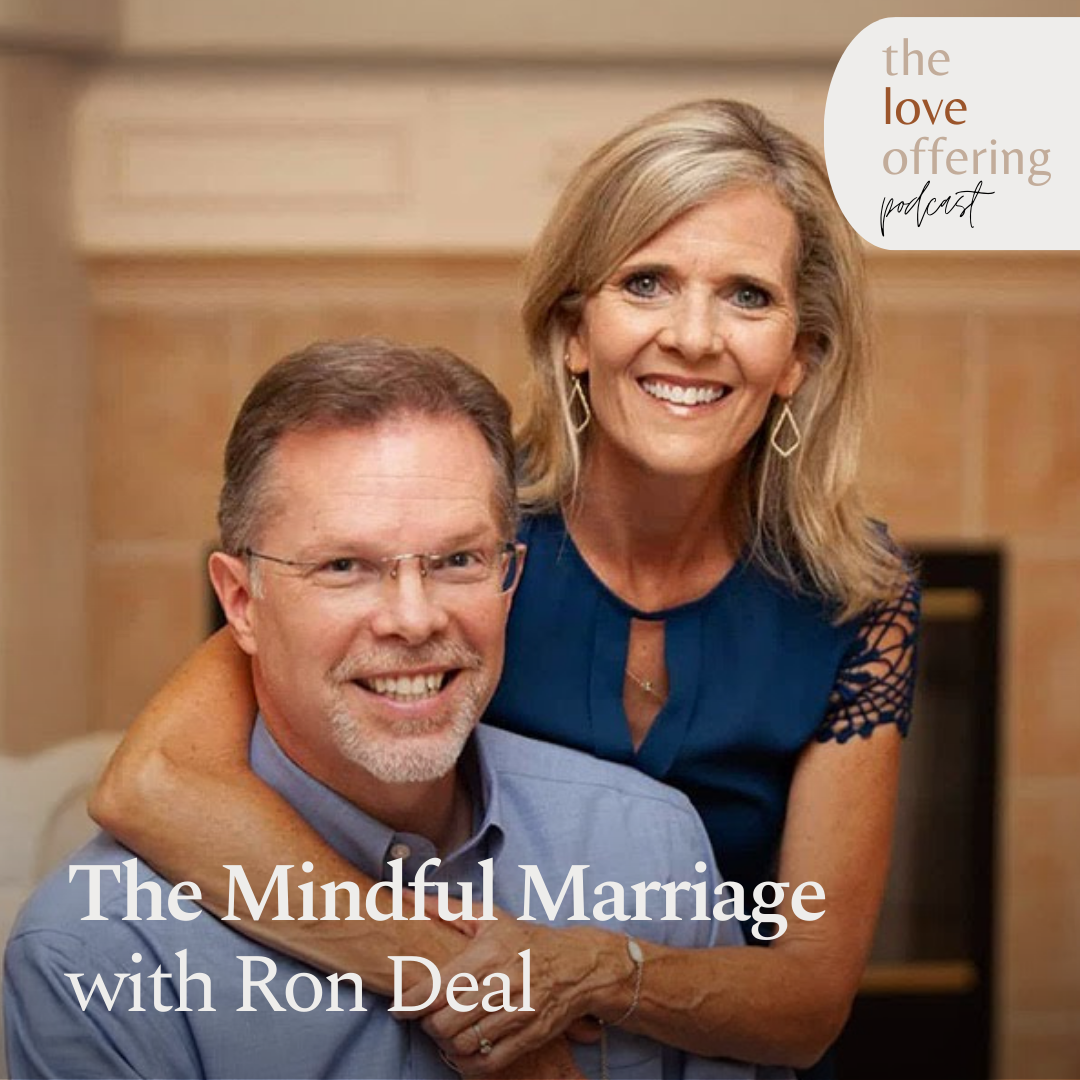
Marriage has a way of bringing both our deepest joy—and our deepest pain—to the surface. If you’ve ever found yourself stuck in the same frustrating patterns, wondering why you keep ending up here, you’re not alone. In honor of National Marriage Week, I want to share a meaningful conversation from The Love Offering Podcast with Ron Deal about his book, The Mindful Marriage: Create Your Best Relationship Through Understanding and Managing Yourself.
This book—and our conversation—is especially powerful because it’s rooted in both neuroscience and biblical truth. Ron openly shares how the devastating loss of their child nearly shattered his marriage, pushing him into painful and destructive cycles he and his wife Nan didn’t know how to stop. At their breaking point, they found help through Restoration Therapy, developed by pioneering therapists Dr. Terry Hargrave and Sharon Hargrave, LMFT—a model that has helped millions learn emotional mindfulness and self-regulation in relationships.
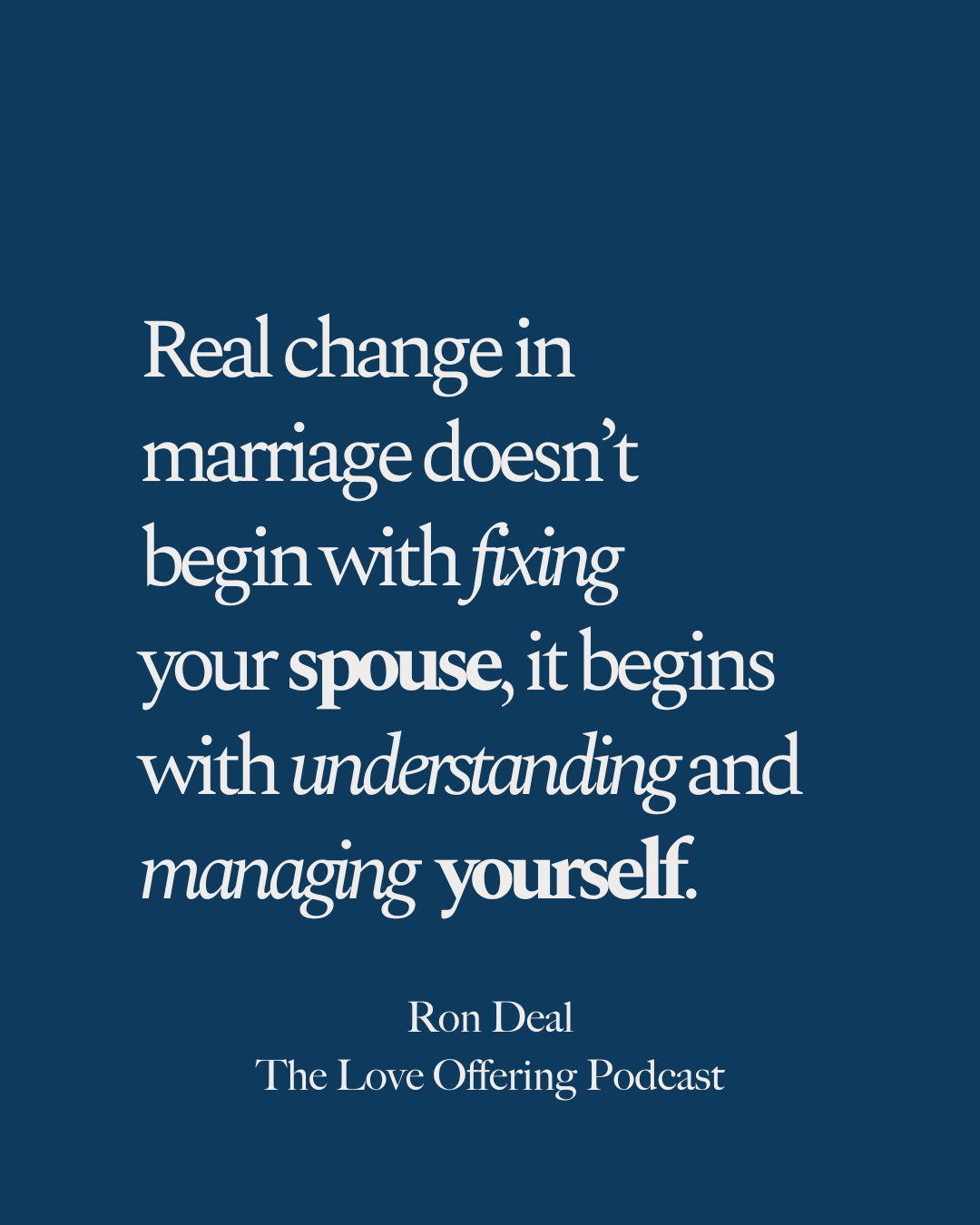
Real change in marriage begins not by fixing your spouse, but by understanding and managing yourself in moments of emotional distress. Ron and Nan, alongside the Hargraves, challenge many popular myths about how relationships work and offer a proven path to healing, connection, and lasting love. If you’re longing for a stronger, healthier marriage—or simply want to love your spouse more faithfully—this conversation is for you.
My prayer this National Marriage Week is that you would be encouraged to believe that healing is possible, patterns can be broken, and love can grow again—even in the places that feel tender or worn. You can listen to the episode wherever you tune in to podcasts. I’d love to hear what resonates with you. Listen HERE.
With hope for your heart and your home,
Rachael
Summary
In this episode of the Love Offering Podcast, host Rachael Adams welcomes Ron Deal, a licensed marriage and family therapist, to discuss the profound impact of grief on marriage and the importance of emotional mindfulness. Ron shares his personal journey of navigating the loss of his son and how it reshaped his marriage with his wife, Nan. They discovered restoration therapy, a model that emphasizes understanding emotional responses to break destructive cycles in relationships. Ron emphasizes that every couple faces challenges, and the key to overcoming them lies in doubling down on faith and learning to move towards one another during difficult times.
The conversation examines the neuroscience behind emotional patterns in relationships, highlighting how our brains respond to perceived threats and how these responses can lead to destructive cycles. Ron explains the importance of self-control and intentionality in marriage, urging couples to focus on their own growth rather than pointing fingers at each other. He encourages listeners to seek help when needed and emphasizes that true change comes from aligning one’s actions with God’s truth. The episode concludes with a call to action for couples to pursue love intentionally and to participate in National Marriage Week, which offers free resources to strengthen marriages.
Takeaways
“We all have hard stuff. I don’t care what it is, somewhere in your journey, you’re going to have hard things.”
“The challenge is, okay, what do I do? I double down on my faith in God in the midst of what really hurts.”
“When we’re bad, we’re really bad. This is the reason why couples get into those spots.”
“By renewing your mind, we tell our brain not to be its old self.”
“If you don’t deal with logs, you’ll end up just leaving this relationship and moving into another relationship and taking all the logs with you.”
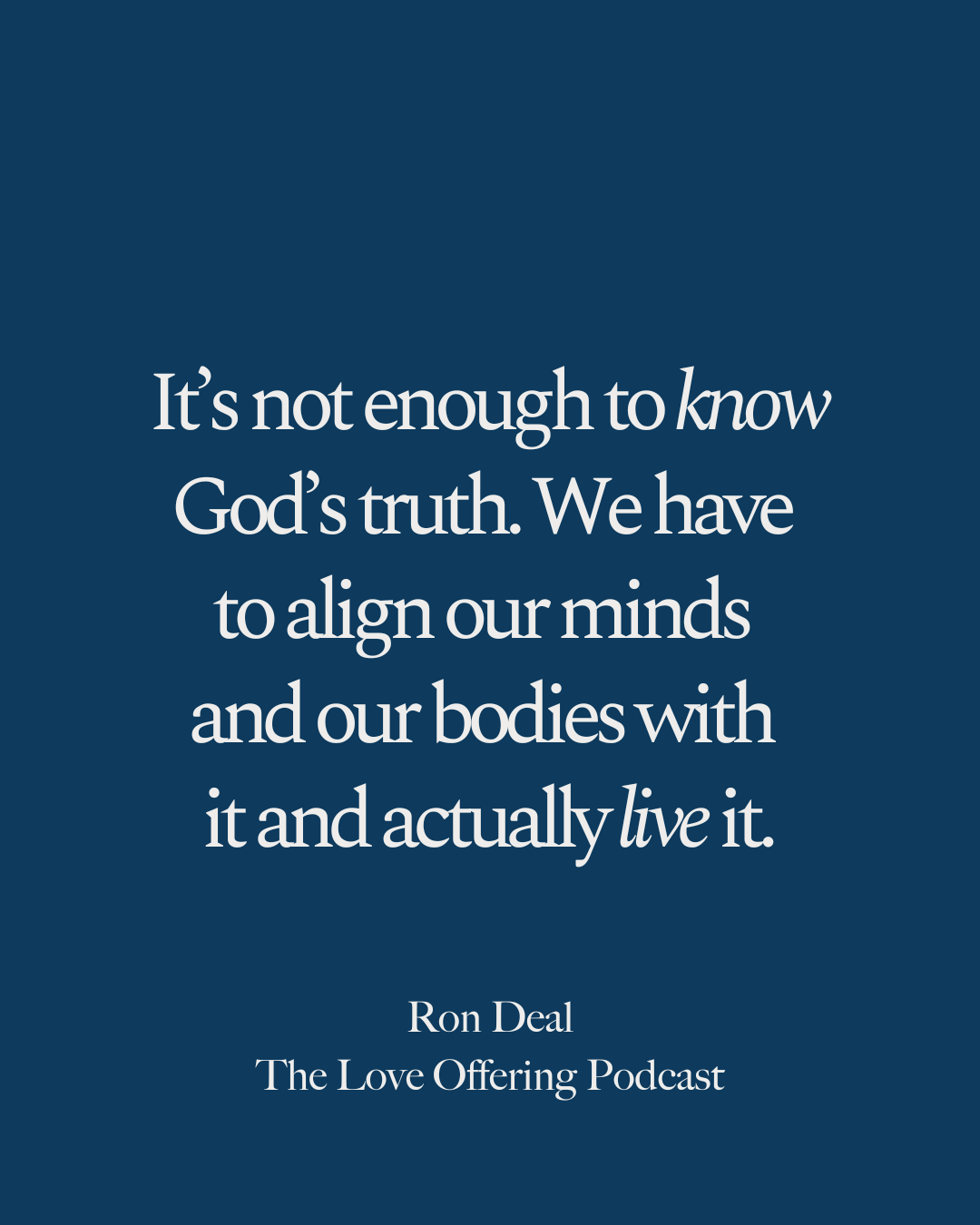
“It’s not enough to know it. The gap between knowing and doing is huge.”
“We want to teach you how to focus on logs, how to create that change for yourself.”
“Pursue the things and become the person that you want to be.”
“You need something outside yourself because when you’re really, really stuck, it’s so hard to get outside help.”
“Love is patient, love is kind. Go get it. Start chasing this thing down.”
Chapters
00:00 Introduction to the Love Offering Podcast
01:23 Ron Deal’s Journey Through Grief
05:51 Understanding Destructive Patterns in Marriage
13:05 The Neuroscience of Emotional Responses
18:46 Focusing on Self-Control and Personal Growth
22:40 Encouragement for Couples in Tough Times
24:27 Biblical Concepts of Love in Marriage
26:18 National Marriage Week and Available Resources
28:46 Closing Thoughts and Prayer
Transcript (AI Generated)
Rachael Adams (00:01.836)
Welcome to the Love Offering Podcast. I’m your host, Rachel Adams, author of Everyday Prayers for Love: Learning to Love God, Others, and Even Yourself. Each week, we dive into meaningful conversations about how to live out the greatest commandment, loving God with all of our heart, soul, mind, and strength, and loving our neighbors as ourselves. Through inspiring stories, practical wisdom, and biblical truth, my hope is to encourage you to love boldly, live faithfully, and reflect God’s love in your everyday life.
Today, I’m honored to welcome Ron Diehl to the show. Ron is a licensed marriage and family therapist, bestselling author of more than a dozen books, podcast host, and senior director of family life. Along with his wife, Nan, Ron co-authored the Mindful Marriage, a powerful trauma-informed resource grounded in both neuroscience and scripture. After walking through the devastating loss of a child, a grief that nearly shattered their marriage, Ron and Nan found hope and healing through restoration therapy, a model that helps couples understand and manage their emotional responses rather than repeat painful cycles. Well, hello Ron, and welcome to the Love Offering Podcast. I’m so happy to have you. Well, I feel a little bad about this, but your story is, is a tough story. I’d like to begin, if it’s okay.
Ron Deal, FamilyLife (01:12.518)
Thank you, Rachel. It’s an honor to be here. Mm-hmm. Yeah.
Rachael Adams (01:24.286)
Would you share about the loss you and Nan experienced and how it has shaped your ministry and, now, your message?
Ron Deal, FamilyLife (01:33.39)
Let me put this into context. We’ve been married for 40 years now. We just crossed 40 years, which is really unbelievable for me to say. We were 21 years into our marriage in 2007 when we hit a wall in our relationship. The patterns and things we’ve been doing have reached a point. We loved each other; we were never bad people; nobody betrayed anyone; we were always faithful to our vows; we were like many couples. We had a lot of good things going for us, but we had low-level issues within ourselves and between us that just hadn’t progressed. And one day Nan said, you know, I’m really fed up with this. That turned out to be a monumental moment of change for us. We found ourselves in the office of Dr. Terry Hargrave, who has now co-authored this book with us based on this incredible model that he’s created that therapists are using around the world called restoration therapy. And two years later, our son died. We often say it was God’s provision for us that we hit the wall two years before his death because we didn’t have enough in the tank to go the distance after his death, had we not found some growth, some change, had we not found real support for who we were. I would say that the death of Connor threw a huge wrinkle in that journey, our marital journey, because all of a sudden, everything stopped. Everything was focused on grief, dealing with our sadness. We have two other boys. How do we help them? It was like a massive earthquake that changed everything for us. And really, that set us on a trajectory of together and apart, together and apart in a new way, in a grieving way. And that, too, has its own story. All of which culminates in this book, The Mindful Marriage, not just about the death of a child, but really about the journey of understanding ourselves and putting on self-control in the midst of marriage and life.
Ron Deal, FamilyLife (03:38.752)
and whatever life throws at you. That said, Connor was 12 years old. We have three boys, and they were 14. Connor was 12. Our youngest was 10 at the time. And he had a headache one day. Little did we know he had an MRSA staph infection. They wouldn’t catch it for three or four more days. He was in the hospital for a total of seven. So 10 days after the first symptom, he was gone. He was taken. And here we are now, almost 17 years past that moment. And every day has a filter on it. And it’s a filter of sadness and sorrow. And what do we do now? And how do we move forward? And I would say God has been with us. If you really want the full story, we could spend all day discussing this. And I now have the opportunity, the blessing, to give back to other parents who have lost a child through the ministry called While We’re Waiting. We just volunteer with that ministry. And it’s doing amazing things for people because it’s focused on how we grieve, walk with God, and carry our children with us all at the same time. I think for your listeners or viewers, what I would say is everybody has hard stuff. We all do. I don’t care what it is; somewhere in your journey, you’re going to have hard things. It’s kind of a promise from the Lord, actually. He told us in this world, you’re going to have trouble. And whatever those things are, the challenge is, okay, this wasn’t what I wanted. How now do I double down on my faith in God in the midst of what really hurts, what really stinks, what really seems unfair and unjust, whatever that story is, and how do you and I, as husband and wife, double down on usness, finding each other? When grief wants to take us in separate ways, how do we learn how to move toward one another as best we can? When I don’t understand you in your pain or why you’re doing what you’re doing or why you react that way, that’s not what I need to do in my pain. How do we create bridges to one another? And everybody faces that in marriage.
Rachael Adams (05:53.836)
Yes, we do. I have been married for 20 years as of April, and I am in full agreement with that. I look forward to continuing today’s conversation, but we’ll take a brief break to hear from today’s sponsor. When we return, Ron will help us understand why so many couples feel stuck in painful patterns and how emotional mindfulness relates to lasting change.
Rachael Adams (06:20.234)
Welcome back to the Love Offering podcast. I’m talking with Ron Deal about building stronger, healthier Christ-centered marriages. And you know, in your book, you talk about destructive cycles that couples can fall into, especially during seasons of grief, like you just talked about, or stress. What are some of the most common patterns you see? And why are they so hard to break?
Ron Deal, FamilyLife (06:41.657)
Well, you know, the interesting thing about patterns is that they always have some sort of pain underneath them. So the pattern on the outside might look like. I’m not sure how to move towards you right now, so I’m just going to move away from you. The pattern on the outside might look like somebody gets frustrated and gripes or criticizes, and the other person comes back with more gripes, more criticism, kind of a counterblame approach. Or maybe there’s a distancing at that point. Or we escalate our argument, and then we don’t know what to do with it. And so we go our separate ways until it dies down a bit, get back into life and routine, and wait until it pops up again. There are various small patterns. Sometimes, one person, we call it the pursuit distance. One person is pursuing closeness and togetherness with the other person. The other person’s feeling a little awkward and uncomfortable about it for whatever reason, and they’re distancing themselves from the other person. Whatever the external patterns are, it’s the underlying pain point that most people lack awareness of. And I know that’s absolutely the case in my marriage. And I’ve been a family therapist for 32 years.
I’ve seen this over and over. And sometimes, honestly, marriage education and marital therapy have focused on outward patterns, and we haven’t gotten underneath them. And that’s sort of what happened with Dan and me. We were aware of many issues in our relationship. We were very intentional about developing ourselves. And yet we didn’t know what those pain points were. We didn’t know our reactivity or where it came from. So let me just give you 30 years of neuroscience in one minute or less. How about that? From the moment we’re born, our brain is trying to make sense of the world and make sense of relationships and interactions with the people, especially the people we know and love and care for the most, our parents. And every time you feel some sense of, I’m not sure I’m loved in this moment, or I’m not sure I’m emotionally safe in this moment, your brain kind of takes note of that. And it wants to preserve itself. It wants to preserve your integrity.
Rachael Adams (08:24.03)
Sounds great.
Ron Deal, FamilyLife (08:51.51)
And so your brain is designed by God to sort of react in a way that’s self-preserving. We call that coping. We do something to try to get the love back. Ooh, Mom doesn’t seem to be interested in me right now. I mean, I’m going to cry, see if that pulls her in. And it works. And lo and behold, crying is a good strategy. So all these little things begin to happen at a very innocent level, but they begin to take root in your brain, and your pain and your coping get connected neurologically, and it makes a let’s call it a neurological rut in your brain. And guess what? Here we are, I’m 59 years old, and all of that stuff still applies. That if I don’t tell my brain what to do, it will just automatically do the same thing it’s been doing for a very, very long time. So if I walk into a canyon, which we did one time with our kids when they were young, and we hear a rattlesnake, we don’t know where it is.
I didn’t have to form a committee to decide what to do about this. It’s an amazing thing, Rachel. Your brain goes, “Whoa, fight or flight; do one of those two things to preserve yourself.” I immediately took action and stopped my child from running out in front. We’ve all pulled back, and we did a flight. Okay. Now that seems reasonable, but here’s the catch. My brain and your brain do not know the difference between a rattlesnake and your spouse’s criticism.
Rachael Adams (09:50.116)
You’re right.
Ron Deal, FamilyLife (10:16.203)
My brain does not know the difference between somebody with a big knife in a dark alley approaching me and threatening me, and the threat is the keyword, and my brain doesn’t know the difference between that or your spouse going, no, I don’t ever want to be close to you. You just don’t know what to do. All of a sudden, fight or flight is about all you can do. Now there’s a bunch of neurological reasoning for this.
But part of your old self, what Paul calls our old self, that Roman seven thing, where like, all of a sudden I start acting in ways that I really don’t want to act. I start treating you in ways I don’t want to, ways I know I shouldn’t. But all of a sudden, why am I doing this? It’s often rooted in this neurological process. And you’re not thinking it; it’s just reacting. It’s a reflex. And what happens on the outside is predictable. It’s one of four things. We either blame the other person.
We get shaming of ourselves. We get control of the circumstances and maybe ourselves, or we escape them. Because that’s the way you fight or flight. Blame, shame, control, or escape. So guess what? Not only do I have a pattern, we call that a pain cycle, but now you and I, as husband and wife, have developed a little dynamic between us. And we have a couple of pain cycles. And in our worst moments, this is who we are. In our best moments, we’re nothing like that.
That was Nan and me for 21 years. We were nothing like that most of the time, but when bad things happened, it was ugly. This is every person on the planet. This is every couple on the planet. We all have this. That’s why you have those moments. You look back and ask, “Why did I do that?” Why do we get in those spots? We love each other. We’re great most of the time. But when we’re bad, we’re really bad. This is the reason why. Now, Paul invites us to put away our old selves, put on a new self in Christ, and start doing something different. And the way we do that is to be transformed, Romans 12, by the renewing of our minds, which, by the way, is how you tell your brain not to be its old self. Let me say that again. By renewing your mind, we tell our brain not to be the old self, but to be the new self. As he says in Colossians 3, Ephesians 4, and Philippians 4, on and on it goes.
Ron Deal, FamilyLife (12:34.622)
We put on the new self, but we have to take great intentional care to put away that old pattern, that old rut, if you will, and begin to live and act in a new way that develops new ruts. The brain science on here is really fascinating. Everybody’s heard of neuroplasticity. It’s the idea that your brain can change over time. Well, guess what? The more you put into the new, the more, the less your brain goes to the old, and the more it begins to develop patterns that are godly in their scope. And that godliness from one person makes it easier for godliness to grow between you, and you develop a new, peaceful way of interacting with one another. And that whole process from old to new, how do you do that for me? How does she do that for her? And how do we do that for us? Is the heart of the book, The Mindful Marriage.
Rachael Adams (13:26.018)
I can’t wait to continue this conversation, but we’ll take a brief break to hear from today’s sponsor. When we return, we’ll discuss how faith and neuroscience work together and what hope looks like for couples who feel worn down, disconnected, and discouraged.
Welcome back to the Love Offering podcast. I’m continuing my conversation with Ron Deal about cultivating healthier, more loving marriages. And you know, I think as you were talking about right before the break, this, this neuroplasticity and these unhealthy cycles versus the healthy ones. Often, when we talk about love, we mean a feeling.
Ron Deal, FamilyLife (14:00.334)
Yes. Yes, self-giving love originates in the mind, telling the body how to behave and act. Because left to its own devices, we’re going to react more out of pain than we are out of trust.
Rachael Adams (14:06.2)
But your whole book is it’s it’s so much of your mind that we need to change. So talk to us about that difference.
Ron Deal, FamilyLife (14:29.132)
And really, that’s one of the kickers or out of truth. Everybody goes to church; we all hear a good message; we all go home and think, “Yeah, I need to be more gentle when I’m frustrated with my wife.” Yeah, that’s what I’m gonna work on. But unless you actually develop a mechanism to help you put on gentleness in the midst of your frustration, you will default to your old self. That’s the way we work. We need great intentionality to embody that gentleness and identify the pathway into that space, so we can rehearse and practice it and eventually take it on more and more. It’s interesting to me that you discussed the intersection of faith and marriage. How many times in the New Testament does it say things like “train yourself to be godly”? 1 Timothy 4. First, let me pull this up: 1 Peter 1:13 says, “Prepare your minds for action and exercise self-control.”
It turns out self-control is at the heart of this process, and we have never taught people how to develop it. We don’t do it at church; we don’t do it in marriage ministry; we’ve never really taught people how to exercise self-control in our worst moments. Well, that’s what Dr. Hargrave has figured out how to do, that’s what we’re teaching in this book, The Mindful Marriage, because it is so foundational to being able to become the new thing that Jesus is inviting us to be more like him, self-giving love. So it takes work, it takes effort, it takes a trust in God, it takes a focus on the truth that he tells me about me, the truth he tells me about us, about how to be and how to respond in marriage, but then I have to practice that in order to begin to embody it.
Rachael Adams (16:17.9)
As you were speaking, I was thinking about the verse: God did not give us a spirit of fear, but of power and of love and of a sound mind. That is something given by the Holy Spirit. Do you think? Yes, we need to practice it, but there’s an element of needing the Lord to do this. Think, trying to think, and it’s not coming to me quickly enough, but in Revelation, it’s like, “Blessed are those who hear and obey.” It is real. This is like how do we put our faith into action, and we don’t wantto just be hearers of God’s word, but we want to be doers of God’s Word
Ron Deal, FamilyLife (16:24.08)
Yes. Yes. Absolutely. The Spirit empowers us in this developmental process, but there are imperatives throughout the New Testament about what we’re supposed to choose to do, right? I’m asking the Spirit to guide and lead, offer wisdom, and empower this process, and I’ve got to align my mind with God’s truth. Now, let me just preach for a second, if I could, because what I’m about to say sounds sort of like what everybody’s ever heard at church, but it’s a little different. We often say all you need is God’s truth. Yeah, and actually, you need a little more. You need to align your mind with God’s truth. It’s not enough to know it. The gap between knowing and doing is huge. Dallas Willard said this 50 years ago in one of his books on the spiritual disciplines: “Have not taught people how to actually do life as Christ did.” We teach them about it. They have the head knowledge. We walk around with an understanding of truth, but we don’t align our body and our mind with that truth and then live it. This is why the disciples followed Jesus for three years and still didn’t get it.
They knew the truth; they saw the truth; they saw it in action; they saw Him as truth. They knew the right answers. You’re the Christ, Son of the living God, Peter says. And in the next chapter, Jesus is saying, get behind me, Satan, because you don’t have in mind the things of God. They knew it, but they didn’t align themselves with it. This is what’s challenging about spiritual growth. And by the way, this is how we grow in marriage, and as parents, as friends, and as people in society. It’s when I get my body moving toward God’s truth. That is a discipline that grows me up. That’s the language Paul uses: “grow up into him.” That grows me up, and it matures my ability to love my wife. Obey.
Ron Deal, FamilyLife (18:43.095)
The parable of the foolish man and the wise man build his house upon the rock is not a man who knows God’s truth. Read the parable. He who does, who knows my word and obeys it is like a man who built his house upon the rock. The one who knows the truth but doesn’t obey it is the foolish man who built his house on the sand. They go to the same church, the wise man and the foolish man. They both know the truth. Only one of them does it. Obedience is everything when it comes to growing up. Otherwise, we just sort of sit in our old selves, going to church every Sunday, but never really growing up into Christ. There is a dual process: we invite the Spirit to teach, show, reveal, convict, and empower, and I choose to align my mind, heart, and actions with God’s truth.
Rachael Adams (19:39.449)
Okay, you mentioned the word “us” several times in our conversation. We are missing Nan today. Please tell her that we are. We’re so thankful to have you. But in marriage, it does take two. So talk to us about our role in renewing our own minds. But then, our spouse needs to do the same. What does it look like if we’re only responsible for ourselves, right?
Ron Deal, FamilyLife (20:04.472)
That’s right, that’s right. In fact, that’s the subtitle of our book, Growing Your Best Marriage by Understanding and Managing Yourself. You know, here’s the truth, excuse me, Matthew 7 comes to mind here when you think about this. I’m really good at seeing the specs in Nan’s eyes. man, I got a PhD in her specs, all right? Human nature is that we tend to see what’s wrong with others. Part of it is this part of our brain that is looking for a threat. If I see something wrong in you, it may mean you don’t love me the way I want you to. Perhaps I’m not as safe in this relationship as I would like to be. And so I’m constantly on the lookout for things in you that tell me you’re not loved, you’re not safe. Unfortunately, that makes me an expert on your specifications. And if I’m focusing on her specs all the time, I am not.
Jesus said, focusing on my log, you fool. He says, Ron, you fool. First, take the log out of your own eye. Then you will clearly see this and help the other person with the spec in their eye. Before I could be an asset to her on specs, I had to get my own act together. This is the way of humility. Pride says, I’m fine. It’s you, babe, that you need to get some change going on in your life. That’s what pride leads us to do. But humility says, look in the mirror first, Ron. Deal with yourself. So the first thing I’ve got to do is see how I’m reacting, how I’m responding, what’s going on with me. I’ve got to put on humility about that, and I’ve got to take charge of myself. That’s self-control. I need to take self-control. When I am in a better place and start acting better, I can love and support you, be compassionate, be curious, and be attuned to you. I can bring my best to you and our work. Now all of a sudden I’m bringing a better me, not a reactive, painful me, but a loving self-giving me. That’s bound to make a difference for us, even if the other person, in my case, even if Nan isn’t responding back. We had a series of our Over the last 40 years, I would say there were many, many times where she was loving me and I wasn’t giving much of anything. The opposite was also true across different seasons of our lives. The point is, I’m called to be the better me, not to fix her specs. This is gonna help. When both partners are dealing with the logs in their own eyes, my goodness. Meaning, Nan would tell you if she were sitting right here: you know what? 20 years ago, we’d have a fight. would last two or three days; it would then escalate, decline, go back up again, and we would drop it. Two weeks later, we would go back to life and never really resolve it. We didn’t make much progress on that issue. But today, she would tell you, we still have triggers; we still have moments when one of us goes off, and the other goes off, and we catch it in about 30 seconds. It doesn’t matter who started it, and we both do our log work. And then we go, okay, now I’m in a better place. Let me take another run at this. And in two minutes, we get through it. We resolve it. We move past. It’s so different because we stopped majoring in specs and started majoring in logs. This is monumental for couples who feel stuck. Anyone listening right now, he just says, “I just don’t know if it’s even worth it anymore.” Yeah, I know. Give up the spec stuff. It’s not going to help. We want to teach you, in the mindful marriage, how to focus on logs, how to create that change for yourself, and how it ripples into your usness. Yeah.
Rachael Adams (23:47.236)
So talk to the woman listening right now who is in a really tough marriage and says, “I just don’t see any hope for this.” I’m so discouraged. We feel so disconnected. One of us is fighting, one of us is fighting. We’re in a terrible place. What’s something other than maybe you just mentioned, focusing on your own log? Is there anything else you would encourage her to do today?
Ron Deal, FamilyLife (24:09.791)
Yeah, well, first of all, I would say been there, done that. I really know that feeling. I know the desperation of that. In my own life, we’ve experienced that in different ways. As a therapist, I’ve experienced this with others. It’s a difficult position to be in. And there are no quick answers. There’s no easy fix. There’s a long-term journey here. But my goodness, it is a good one to go on. Because here’s the truth. If you don’t handle logs, you’ll end up leaving this relationship, moving to another, and taking all the logs with you. I work extensively with blended families. In fact, most of my professional time of the last 20 years has been specifically working with blended families. And I can tell you, couple after couple after couple, walk into a new marriage, and here we go again, because they never really did the work. Okay, so let’s do the work. Don’t be afraid of that.
It’s a season when God wants to help you and your usness grow. And so sometimes it means you’ve got to get help outside help. We did that. We had to do that more than once in our relationship. Get that outside perspective, someone who can sit with you, even a book, even something that sort of takes you on a journey in a specific direction that can challenge what is and help you begin to think about what could be. But you need something outside yourself because when you’re really, really stuck, it’s difficult to break out of that cycle. Find some help. And that means you’ve got to set aside your pride a little bit. And you’ve got to ask somebody. You need to sit down with someone or start a process. And just don’t hesitate to do that. Yeah.
Rachael Adams (25:50.808)
Yeah, sometimes it starts with awareness and then prioritizing your marriage. We’re not going to give up on this. We’re committed. How do we make this work? This season, I’ve been asking all my guests: Is there a biblical concept of love that you think applies to this topic today?
Ron Deal, FamilyLife (26:06.757)
Absolutely. Most people listening right now, if I said 1 Corinthians 13, could say, “Oh, yeah, that’s the love chapter.” We got all this. We know what this is about. It was at our wedding. And you can just start rolling off the tongue a lot of stuff out of 1 Corinthians 13. So here’s my question. What are the first two words of 1 Corinthians 14? Of 14.
Rachael Adams (26:27.364)
Love is patient, love is kind. Oh, 14. Oh, I don’t know. Tell me. I was quoting the other one.
Ron Deal, FamilyLife (26:31.776)
See? Yeah, and we all know 13. What’s 14? The first two words in Greek in verse 14:1 are “pursue love.” He basically has just said, here’s this thing, here’s what it is, here’s what it’s all about. Then he says, “Go get it.” There’s an intensity and emphasis in how that Greek word conveys the idea of pursuit. Don’t just sort of meander after that. Get running. Start chasing this thing down. Go after it with much intentionality. Pursue the things and become the person that you, that we just talked about in 13. It’s not enough to know it. You have to start doing it. And that’s where the rub is. That’s where the challenge lies: learning to put it into action and follow through. I think that’s the invitation for all of us. Every day of my life, I ask myself: how do I put on gentleness? How do I put on quietness? How do I listen? How do I tone down my defensiveness and start tuning in to what Nan’s trying to say to me? Those are all self-disciplines I have to practice every day. Go after it. Yes.
Rachael Adams (27:45.791)
I love that; it makes me want to read 1 Corinthians 14. Thank you for the encouragement. So, something that we’re going to be releasing during National Marriage Week. I know you’re part of family life. Please talk to us about this week’s emphasis on marriage.
Ron Deal, FamilyLife (28:04.588)
Yes, I work for Family Life, a large marriage and family ministry nationwide. We do events, live events. There are curriculum resources online at familylife.com that are very easy to access. But National Marriage Week brings together leaders from diverse organizations and churches and features a series of live streams. Now, get this: a week leading up to Valentine’s, you can join each evening and hear from experts on a variety of topics. The theme this year for National Marriage Week is Together with purpose. It’s all free. It’s very easy to do. It is a fabulous opportunity for people. Just sit at home. Hear a good word, a word of encouragement. Ignite a conversation in your relationship. Help figure out what North looks like for your marriage. Your compass is all over the place. Yeah, all right. What’s true North? This series will help with that. Jump in on the weeks you can. marriageweek.org is where people can get in touch and learn more about it. You mentioned Gary Chapman on your program, and he will be one of the speakers. Greg and Julie Gorman, Les and Leslie Parrott, Deborah Felitta, Shanti and Jeff Feldhahn, and I will be on one night: Greg and Aaron Smalley, Jim Burns. I mean, on and on it goes. It’s quite a lineup. They do a fabulous job. Free help. Emphasis on the word free. It’s good stuff. You know, just the other day, literally our 40th anniversary was this month, and we are still so thankful to God. It was not long ago that we could remember life was so miserable for us. Both the death of our son, just not being able to be in tune with one another, and being at odds with one another around different things at different seasons. And yet we are living the very things we teach in the mindful marriage. By the way, we didn’t really come up with that book. That’s our mentor, our counselor’s principles, and we’re just the living example of that. We promote it all the time because we really didn’t write it. It’s simply us saying this is what works. Come join us. It’s so sweet. We feel God’s mercy every single day. And we’re just loving each other and loving being together. And there was a time when I could not say that, but we can now.
Rachael Adams (30:44.973)
What I love so much about that is that there’s hope, and that sticking to and being committed and staying in marriage, it’s worth it. And there and there’s and and not just for us, but for generations that follow after us. Yeah. I want to stay connected with you. I’m sure listeners will want to. So tell us how we can best do that.
Ron Deal, FamilyLife (30:56.628)
It is. Amen. Familylife.com is where you’ll find our ministry, and I lead the Blended Family Division. That’s familylife.com slash Blended. You can always find where Nana and I were doing mindful marriage conferences around the country at rondeel.org. Yeah. God, one of the things I’ve learned is just how incredibly patient you are with your children. We’re a mess. Lord, we endeavor to be like your son Jesus. We want to love the way he has loved us.
Rachael Adams (31:28.493)
Wonderful. Would you pray for us as we close today?
Ron Deal, FamilyLife (31:49.902)
We want to represent your kingdom well and in our best moments, we do and we do that For your glory and in our worst moments boy, we just look like everybody else and Yet you are kind and patient and you just keep inviting us through your spirit us to move towards you and move towards your ways, and you help us and we are grateful. We are grateful for the hope we have because of that and the peace that comes to our hearts, our spirits, and our relationships when we follow your ways. So we’re grateful for that. And we ask that you would continue to move, to motivate, to convict, to inspire us to love the way Jesus loves. In Jesus name we pray. Amen. Thanks, Rachel.
Rachael Adams (32:42.793)
Amen. Ron, thank you for helping us to be more mindful in our marriages. I appreciate you.
Thank you so much for listening to the Love Offering Podcast. I hope today’s conversation encouraged you to love God, love others, and even love yourself a little more. If this episode was meaningful to you, please share it with a friend and leave a review. helps others find the show and spreads the message of love even further. To connect with me, visit my website at rachellekadams.com, where you can download the Love Offering Calendar, a free resource with simple daily ways to love those around you. Be sure to pick up a copy of Ron and Nan Deal’s book, The Mindful Marriage, and explore the free expert-led resources available during National Marriage Week at marriageweek.org, happening February 7th through the 14th. A special thank you to Life Audio for supporting this podcast and enabling us to fund more great podcasts. Visit lifeaudio.com. Until next time, let’s make our lives an offering of love.
Every year, I like to change the Bible I read to keep my quiet time with the Lord fresh. Over the next two months we are featuring one of my favorites called Every Woman’s Bible. This Bible has contributions from more than 100 women around the world and explores the heartfelt needs, gritty challenges, and uncommon faithfulness of women of the Bible, throughout history, and today. Through deep study and reflection, you’ll discover God’s heart for you and clarify your calling through personal stories, insights, inspiration, and study notes—all created by women, for women. Check it out. I think you’ll love it!
Connect with Ron:
Download your Free Love Always Devotional:
https://www.rachaelkadams.com/free