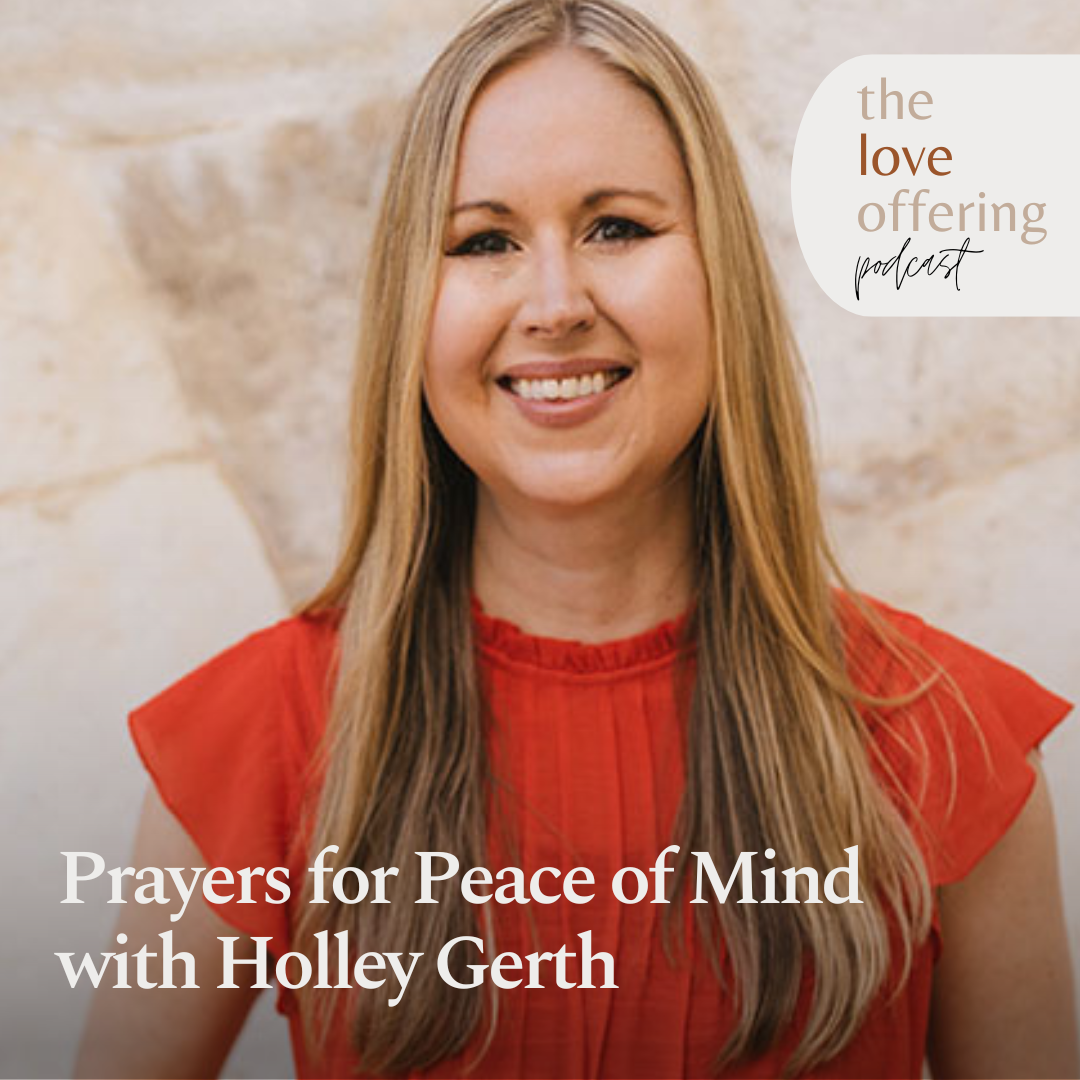
If you’ve ever lain awake at night with your thoughts racing, or felt your heart pound with worry over what’s next, you’re not alone. We all face anxious moments — but we don’t have to face them without peace. This week on The Love Offering Podcast, I’m talking with bestselling author Holley Gerth about her new book, Prayers for Peace of Mind: Scripture and Encouragement for Days of Anxiety, Worry, and Stress.
In this beautiful collection, Holley shares 100 inspired prayers and powerful truths to help us experience more contentment, more peace, and more joy — even in the middle of life’s uncertainty. Whether you’re worried about a loved one, overwhelmed by your to-do list, or feeling the weight of the world, this conversation is an invitation to breathe deeply and remember that your faith isn’t failing — it’s growing stronger as you bring your fears to God.
Listen in to be reminded:
- Anxiety and stress don’t disqualify you from peace.
- God is near to your anxious heart.
- Prayer can turn panic into peace.
🎧 Tune in to this calming and hope-filled episode wherever you listen to podcasts or at rachaelkadams.com/podcast.
May this conversation help you release your worries and rest in the One who holds it all together.
With love and peace,
Rachael
Summary
In this episode of the Love Offering Podcast, host Rachael Adams welcomes back bestselling author and counselor Holley Girth to discuss her new book, ‘Prayers for Peace of Mind.’ They explore the universal struggles of anxiety, stress, and worry, emphasizing the importance of prayer and community support in navigating these challenges. Holley shares her personal journey with anxiety and offers practical tips for managing it, including the significance of understanding our identity as beloved and the power of relationships in fostering peace. The conversation highlights the need for compassion towards ourselves and others in times of distress, ultimately guiding listeners towards a deeper sense of peace and well-being.
Takeaways
Anxiety is a common struggle that many face.
Understanding the difference between biblical and biological anxiety is crucial.
Prayer is a relational act that helps us feel less alone in our anxiety.
We can greet our anxiety with curiosity rather than condemnation.
It’s important to take small steps to manage anxiety rather than trying to eliminate it completely.
Our identity as beloved is foundational to overcoming anxiety and worry.
Relationships play a key role in healing and managing stress.
Asking how we can love others well is vital in supporting those who are anxious.
We can manage our thoughts and redirect them to positive pathways.
Stress management involves auditing our commitments and seeking support.
Chapters
00:00 Introduction to Love Offering Podcast
01:09 Holly Girth’s Journey and Background
02:01 Understanding Anxiety and Its Impact
05:05 The Role of Prayer in Finding Peace
10:10 Overcoming Shame and Guilt Around Anxiety
11:59 Finding Contentment and Joy in Everyday Life
16:03 Managing Stress and Life’s Demands
19:24 Transforming Our Thought Lives
22:06 The Importance of Relationships in Healing
27:58 The Biblical Concept of Love
31:12 Closing Prayer and Reflections

Transcript (AI Generated)
Rachael Adams (00:02.066)
Welcome to the Love Offering Podcast. I’m your host, Rachel Adams, author of Everyday Prayers for Love, learning to love God, others, and even yourself. Each week, we dive into meaningful conversations about how to live out the greatest commandment, loving God with all of our heart, soul, mind, and strength, and loving our neighbors as ourselves. Whether through inspiring stories, practical tips, or biblical truths, I hope to encourage you to love boldly, live faithfully, and reflect God’s love in your everyday life. Today, I’m excited to welcome Holley Girth back to the show. Holley is a Wall Street Journal bestselling author, licensed counselor, and life coach who imagines a world where we all become who we were created to be, use our strengths to serve, and grow for a lifetime. She’s the co-founder of the groundbreaking blogging community, Encourage, and co-host of the popular podcast, More Than Small Talk. In her new book, Prayers for Peace of Mind, scripture and encouragement for days of anxiety, worry, and stress. Holley offers a beautiful collection of more than a hundred prayers to help us find calm and anxious moments, peace in uncertainty, and hope in hard times. Well, hello Holly, and welcome back to the podcast. I’m happy to have you again.
Holley (01:12.898)
Thank you for the invitation. I’m glad to be here.
Rachael Adams (01:16.188)
Well, for those that aren’t familiar with you, would you just give us a little bit of your backstory? Who, who is Holly and, and, and what are you, what are, what are your typical days where you live?
Holley (01:22.094)
Yes, yes. So I’m an expert at naps and excellent at snacking. So those are my special life skills. I’m also a writer, and I had grandparents who owned a Christian bookstore. So ever since I was a little girl, I had a big dream of growing up to write books, and God graciously has let me do that. So I’ve been married to my husband Mark for 25 years. We have a kind of crazy family story. We adopted our daughter, Lavelle, when she was 20 years old. She aged out of the foster system. She’s married and 33 now, so we get to be Nana and Poppy to Eula and Clement as well. That is a little bit of my story.
Rachael Adams (02:05.928)
I love that. And I love naps and snacking too. And so I know that you’ve spent years encouraging women through your writing, counseling, and coaching. So tell us about maybe your journey, even with anxiety and stress, like worry, what really led you to want to write a book on this topic?
Holley (02:25.303)
Yeah, I think we write what we need to read and reread. And I always feel like I’m a listener first and then pass that on to others. So anxiety has been a lifelong struggle for me. I was the little kid in third grade who had to go to the nurse’s office and lie down all the time because she had a tummy ache. And it was just that my little nervous system was overwhelmed. And I carried a lot of shame around that. But God showed me that the nervous system that sometimes led me toward anxiety is the same nervous system that leads me toward my gifts of empathy, creativity, and observation. And so he really freed me to see anxiety in a different way, that it wasn’t about eliminating it completely, it was just about noticing when it came and placing it in his hands, along with getting the practical help we needed. Like, I go to counseling, move my body, and try to get sleep because I think it’s a holistic thing. But this book, Prayers for Peace of Mind, is especially about having just short little reminders of truths and simple prayers that we can say in the moments when life just gets overwhelming, which I think it is probably for all of us right now.
Rachael Adams (03:40.488)
Absolutely. And that’s why I told you before we hit record. I’m really looking forward to today’s conversation because we’re not the only ones dealing with these issues. It’s a universal feeling. Do you think, and maybe now more than ever? I don’t know. What’s your opinion on that?
Holley (03:51.522)
Yeah, I do. The research supports that anxiety levels have significantly increased since 2020. And what happened is that for the first time in human history, we globally went into fight or flight. I don’t know that that has ever happened. Even with world wars, not every country was involved. And it wasn’t that going to the grocery store became dangerous; hugging a relative became dangerous. So suddenly our threat levels got raised, and then we’ve lived in a world where I think that’s continued to increase. So we didn’t get the chance to heal fully; we just went back to life. And so there is just this higher threat level. It’s kind of like at the beach, where they have the different color flags. We’re just globally under a higher sense of danger than we have been. And so if anyone is listening and saying, yeah, maybe I’ve never even dealt with anxiety before, but I am now, that’s actually really common and normal. And it doesn’t mean anything is wrong with you. It just means that as humanity, we’ve been through a lot, especially the last few years.
Rachael Adams (05:05.224)
Gosh, I can’t wait to continue today’s conversation. We’re going to take a brief break, and when we come back, we’ll talk about how prayer can become a powerful pathway to peace.
Rachael Adams (05:19.356)
Welcome back. I’m talking with Holly Girth about her new book, Prayers for Peace of Mind. And you know, you just talked about how anxiety and stress are probably at an all-time high. And it really is just an inevitable part of being a human being. And sometimes we feel shame or guilt for that. And you mentioned that even in your own story. So talk to us about why we shouldn’t feel shame for feeling the way that we do.
Holley (05:43.732)
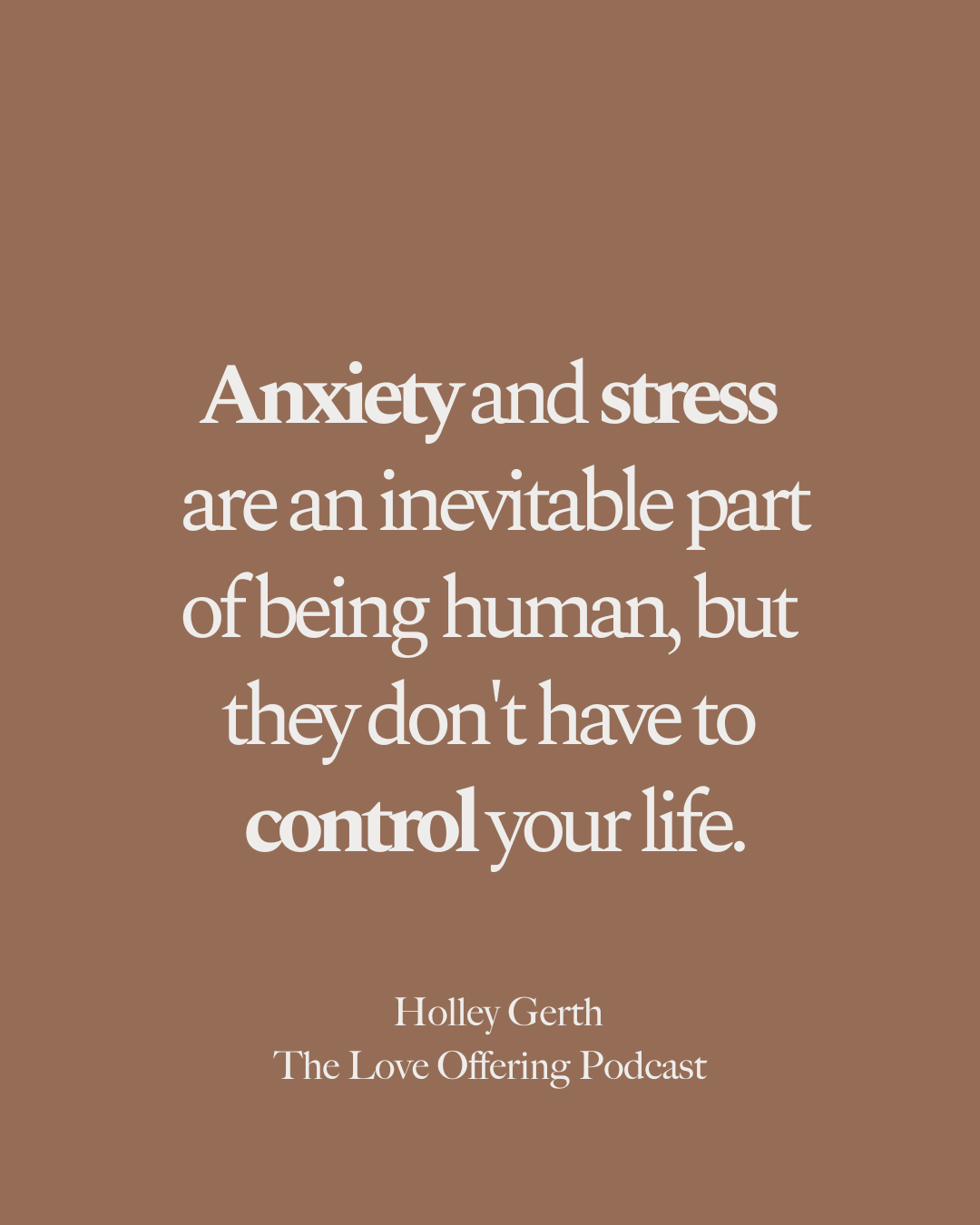
Yeah, it was really helpful for me to understand the difference between what I call biblical anxiety and biological anxiety. So God gave all of us a fight or flight response that is naturally triggered when we experience a threat. You know, in the past that threat might have been a tiger, but today it might be someone at a business or a party giving you a look that you think, uh-oh, you know, did I say something wrong? Did I do something wrong? We experience social threats and even self-criticism in the same way that we do physical threats. And so it’s inevitable that our fight or flight system is going to get set off, and we’re going to experience anxiety. And God understands that. He’s not upset with us for it. He’s not saying, “Does it matter to you?” Why is this still happening when you know you love me and trust me? You’ve seen me treat you well. Instead, he’s saying, you’re human, and I wired you with an alarm system to keep you alive. So when the Bible says, don’t be anxious or don’t be afraid, when I looked, it’s almost always spoken to someone who is already afraid. So we hear it as a rebuke, but when you look at it in context, it’s actually a reassurance. So when God is inviting us to not be anxious, that word actually means living in a state of anxiety, and none of us wants that. So he’s not saying don’t ever feel anxious, he’s saying when you do, don’t stay there, come with me out of that. I will lead you out of that with compassion, grace, and gentleness. And please feel free to get whatever help and support you need in practical ways, too. But I think that’s really helpful for us to understand that anxiety is inevitable and God has deep compassion for it. But we get to choose what we do with it, whether we control it or it controls us.
Rachael Adams (07:40.648)
Well, so on that topic that segues really well to my next question for you. How do we not allow it to control us? What are some practices that, if somebody is feeling anxious even in this very moment, what’s something that he or she could do?
Holley (07:53.708)
Yeah, I think the first step is what we just talked about because when we go into shame or guilt, that actually heightens our anxiety. We experience that as an additional threat. So pausing just to say. I’m anxious, greeting it with curiosity rather than condemnation and saying, Okay, nervous system, you’re trying to keep me safe. What might be going on here? Just pause, greet it with curiosity, and then say, “Okay, I’m nervous because I have a big presentation coming up.” I don’t know how it’s going, gonna go, or my kiddo is about to head off to the first day of school, or I just saw a news headline that is really scaring me. And then pausing to say, What am I hearing inside? Am I hearing you’re gonna fail? Your kid’s not gonna be okay? The world is doomed? And if so, what is the truth that actually is in that moment? You know what, my worth isn’t in my work. Or my kid’s gonna make mistakes and have hard times, but I’m going to help them get through it, and so is God. Or yes, there have always been hard headlines, there always will be, but I’m going to trust that God, who loves me, is still in control. So, replacing truth and then being kind to our bodies. Often, we do need a nap or a snack. We need to go outside for a minute. We need to text a trusted friend and say, I’m really struggling right now. Can you pray for me, or can we meet for coffee? So I think it’s about taking the next small step that I can do in this moment that will not eliminate my anxiety, but if it’s at an eight, how can I get to a 7.5? And then once I’m there, how can I get to a seven? And if that feels impossible where you’re completely stuck, it’s okay to reach out to a counselor, to a doctor, to say what else might be going on here that’s keeping me stuck in this place. So I think it’s really about saying, instead of I have to eliminate my anxiety all at once right now completely, or I don’t have faith and I’m not a good person, to I’m human, this happens, what’s one small thing I need right now to help me just not get stuck here.
Rachael Adams (10:02.982)
Yeah. Well, I love how you’re simplifying that because even if you are in an anxious place and then you think about all the things you need to do to get out of it, it just makes you even more anxious, right? Well, so talk to us about the power of prayer because they’re, they’re even, you know, I love how science backs up the Bible because prayer actually, you’re having this communion with God, which helps because you know, he is with us, but the action of
Rachael Adams (10:30.696)
Praying actually calms your nervous system down, too. Yeah, talk to us about the value of prayer for dealing with our anxiety.
Holley (10:33.422)
Mm-hmm, yes, it does. Yeah. And we want to avoid ever saying, Just pray about it. Like, as an anxious person, I’ve had people tell me that, just pray about it. And I’m like, that is not that simple. That’s not how being human works. So I think first changing our perspective from I’m praying so that I can get rid of my anxiety to I’m praying so that I’m not alone in it, a shift from I need to fix myself, which is anxiety-provoking, to this is relational. This is so God can be in it with me. And maybe I’ll start feeling anxious soon, or I may be in this place for a little bit, but I don’t have to be here alone. And so I think that is the beauty of prayer, bringing us back into the presence of a God who loves us, even in our most anxious moments. And then I think relieving the pressure to have big, long prayers. This book is full of little tiny short ones because when we’re anxious, sometimes we can only manage a few sentences. One of my favorite prayers to say is, Give me the wisdom to know the work that is mine to do today. I release everything and everyone else to you. And there are days I have to pray that 50 times because we’re so good at taking back everything and everyone. And so I love that prayer doesn’t have to be complicated. It’s not about fixing ourselves. It’s just about pausing, taking a deep breath like you said, which is so good for our bodies, and just knowing that we’re going to be anxious, but we don’t have to be alone in it.
Rachael Adams (12:10.376)
I’m so thankful for that truth and that promise. We’re going to take another brief break to hear a word from our sponsor. When we come back, we’ll talk about how to experience more contentment, more joy, and more peace in our everyday lives.
Rachael Adams (12:26.096)
Welcome back. I’m talking with Holly Girth about her new book, Prayers for Peace of Mind, Scripture and Encouragement for Days of Anxiety, Worry and Stress. So, for the woman who is feeling really anxious right now, what might be a simple prayer? You gave us one that you pray, but is there another prayer or truth in her book that you would want her to hold onto today?
Holley (13:04.684)
Yeah, it’s actually a statement that I have found really decreases my anxiety. The truest thing about me is that I am beloved. Because whenever we’re anxious, we become somehow centered in something external. It could be an event. It could also be the fear of criticism or not having approval. And so I find coming back to my God given identity is deeply calming to me just to say the truest thing about me, no matter what, is that I am beloved. And that has been a really powerful place for me to start. And so turning that into a prayer might be saying, Jesus, help me. I’m trusting that the truest thing about me right now is that I am beloved, that you are with me and for me, and together we’re going to get through this.
Rachael Adams (14:03.0)
Yeah, when we know we are beloved, understand our identity in Christ, and recognize who is for us and who is with us. We know that on some level, but we still worry and feel stressed. Like you said, like in this world, we are going to have trouble like God knew, but yet how do we learn to just trust him no matter what we’re going through? Like, what’s your journey with worry? We’ve talked so much about anxiety. Let’s focus more on worry. There are a lot of things to worry about. What’s the actual root of that in us? Is it mistrust?
Holley (14:42.23)
It’s the desire to have control, which can be really healthy. But when things feel beyond our control, we worry about them. So we worry about the people we love because we can’t control them. We worry about news headlines because there’s so much we just can’t do anything about. You know, we can do some things, but not everything. No, we worry when there’s a tornado coming our way. Like all of that is helpful, and it’s the difference between worry that we can do something about and, in that case, the next step is to actually take action. If you’re worried about not doing well on a project that needs to be completed, the best next step is to work on it for five minutes. But it’s when that worry is about something that we truly cannot control that we need release instead of continuing to try to have control. And that’s the tricky part for us as humans. And so that line in that prayer, Jesus, I release everything and everyone to you. John Eldredge has a similar prayer, and he calls it benevolent detachment. So that for me is over and over and over again releasing. And that is not an easy process. It’s not meant to be simple. Jesus in the Garden of Gethsemane is a picture of this: he knows he’s loved, he knows he’s going to be okay, and he knows what he’s about to do is worth it. But at the same time, he’s deeply distressed. And so he takes that to God, and ultimately it’s surrender, it’s saying, this may not be what I want, but I’m giving all of who I am, all I have, everything in my life to you. And I’m gonna trust you to get me through it. And if that comes with anger, sadness, disappointment, fear, sweating drops of blood, then that is okay. That’s sometimes part of the process.
Rachael Adams (16:47.314)
Talk to us about stress. Sometimes we can be stressed out about things that we have put on our plates ourselves. And then there are other things that we really, going back to what you just said, that we can’t control. Maybe we’re stressed out because we have a loved one who has made choices for us that we wouldn’t have chosen, or maybe they’re in the hospital or whatever it may be. Like, there are life circumstances in different seasons that may be more stressful than others, but talk to us about the stress we can handle, control things that we’ve added on too much to our plate, like what your decision-making process looks like to kind of de-stress your life a little bit.
Holley (17:26.868)
Yeah, an exercise I love is a stress audit. And so you write down what you do in a given amount of time, like a day. You could do it for a week, but that’d be a lot. Even a few hours or just one thing is fine. And you put a plus by what energizes you and a minus by what stresses you out or drains you. And then you look at the minuses, and we’re all gonna have minuses, some of them unavoidable, the laundry must be done. But you can ask three questions. Can I eliminate this? Is this something that has to be on my plate in this season? And sometimes the answer is yes, I do need to keep feeding my children. But sometimes the answer is no. I said yes to something out of fear and the desire for approval, realizing it’s okay for me to release. And then the second question is, if I can’t eliminate it, can I delegate it? Is this truly mine to do? Can I get some help or support with this? And if you can delegate it, that’s another option. There may be someone with different gifts from you who actually would love to have it on their plate. If you can’t eliminate or delegate it, how can you get the support needed to make it sustainable? Often, we start with things that seem doable, and almost anything is achievable in the short term. It’s like a sprint. But at some point, you realize you cannot keep up this pace, and it’s okay to ask if you need to continue doing this and what will make it sustainable. So, for example, speaking takes a lot out of me. I rarely do it, but when I do, I know to keep the day before I leave and the day after I come home empty because I’m gonna need time to fill up on both ends of that. And I know that’s not always possible, but strategies like that, or Joanna Gaines saying she sits in her car for five minutes before going into an event, are her little ways of self-support or letting someone else know what she needs in this season. So that was eliminated, or delegated if you can. If you can’t, then ask yourself what support do I need to make this sustainable? So stress is inevitable. It’s just about keeping it at a level that is manageable and where it doesn’t take over our lives.
Rachael Adams (19:47.017)
Yeah. Well, the title of your book, Peace of Mind, makes me think a lot about our thought lives and how, for me, one thing can happen in my life. And then I go on this negative thought cycle and this pattern, and like my mind can just go somewhere that I’m like, how in the world did I get here from, you know, from A to Z so quickly? And so I’m just reminded of how important it is to be transformed by the renewing of our mind and to create those positive pathways. So talk to us just about our thought lives and what we’re putting into our lives. And then that is going to result in what comes out and overflows.
Holley (20:26.35)
Yeah, and that is connected to your gift as a visionary and a dreamer. Part of what you do is the ability to spiral in positive ways, and that has led to your buh. Yeah.
Rachael Adams (20:39.72)
I love the positive spin you’re putting on this. Thank you.
Holley (20:44.462)
It is; it’s led to your book and this podcast. Every dream that you’ve pursued with Jesus has come from that same gift. It’s just sometimes our gifts turn against us, and we all know what that’s like. But for everyone listening who’s a dreamer, you’re more likely to worry. It’s an unfortunate side effect. So it’s about turning that active imagination into a more helpful direction. And so first in pausing, even in just laughing about it and saying, I’m using my superpower in a way I might not want to right now. How about I refocus this in a different direction? And then sometimes, it is helpful to consider the actual worst-case scenario. Like when I published my first book, my friend was like, Okay, Holly, really? Like, what is going to happen? And she’d be like, and then what, and then what? And I ended up homeless, friendless, you know? And she was like, really, really? That’s gonna help if someone gives you a one-star review on Amazon. And so if you can’t get your brain to switch tracks, sometimes it helps to let it go all the way to the end because it can defuse that in a way. Or, you know, distract yourself. I’ve been mentally, you know, those road closed signs that they put in front when there’s construction. I’ll literally picture that in my mind and think Road closed, let’s go a different way. And then just intentionally try to think about something else. And I realize that doesn’t always work. As someone who has anxiety, sometimes our brains just get stuck. And that’s when we pull in someone else, like my counselor. I saw her weekly for a long time. Now I call her when I get stuck in that place where I can’t do it on my own and say, Hey, I’m stuck. I need to come in. So sometimes we need support or conversation with our friend to help us get ourselves out of our heads, too. Worry, worry like all these things we keep saying, is part of being human.
Rachael Adams (22:45.488)
Well, I’m hearing you say to be patient with ourselves because this isn’t like, okay, we’re going to read Holly’s book, and it’s going to help us. I’ve already learned so much. You’ve given us lots of great tips, but it’s an ongoing process. Can we get better at managing it? It’s just because, you know, we need to learn all the tips and practices. You’re not just going to experience worry and stress and anxiety ever again. Right.
Holley (23:12.596)
Yes, right. I say it’s like a wild horse. If you do not tame the horse, it’s probably going to kick down your mailbox and eat your tulips. But if you can tame it and learn to manage it, as we discussed, those same parts of your brain can contribute to your giftings. They can be energy you can harness. It’s about you being in charge of it, and ultimately, that means God being in charge of it. But yes, as long as we are humans on this earth, we are going to experience anxiety, worries, and stress sometimes. I think it’s about knowing what we need to not get stuck there. Because all of those events can push us a little in certain directions, they can help us pay attention. They can help us be careful with other people’s feelings, as there are consequences that can arise from it. It’s when we get stuck in them, where we’re dominated by anxiety, we’re dominated by fear, we’re dominated by worry, that is when they become harmful. And I think that’s what God invites us out of. So yes, I cannot tell anyone you will read my book and never have anxiety, worry, or stress. I believe what’s in there will help you take one small step forward, moment to moment. Over time, as someone who’s lived it, those small steps make a huge difference. I’m in such a different place with anxiety, worry, and stress than I was even a few years ago.
Rachael Adams (24:44.604)
Yeah. Well, I love that you test and can testify to this. Like I’ve struggled with it. I’ve done these practices, and this is what’s helped me. And so, I love that you’re giving us tools we can use, which are little steps that don’t seem too overwhelming. I am mindful of the spiritual side of it as well. You know, Jesus is the Prince of peace, and even peace is a fruit of the Spirit. And so, how much of a solution is it? That may not be the right word, but it’s just leaning on the Holy Spirit working inside of you, doing what you can’t do in your own strength.
Holley (25:25.6)
Yeah, everything I’ve said you do in partnership with the Spirit. So, yeah, nothing I’ve said is meant to be done on our own. It’s a partnership with the Spirit. And Jesus is the Prince of Peace, and the word for that is actually shalom, which means complete well-being in every part of who we are, physical, emotional, spiritual, relational. It is what Adam and Eve experienced in Eden and is what we will experience forever in heaven and on the new earth. And so God’s heart is always to lead us deeper into shalom. And so when he is bringing us into peace, that’s the kind of peace he is bringing us into. And that kind of peace is rooted in a relationship. It comes from our relationships with God, each other, and our own self-righteousness. So I love that it’s a relational piece too. And I think it’s the same for anxiety, worry, and stress, that we experience calm in relationship with God, with others who are safe, even with ourselves. And so that helps to remember, like, what do I need relationally right now? Because God is a relational God, and I think we heal in relationships.
Rachael Adams (26:42.844)
Yeah. Well, you’re like teaming up perfectly because I was thinking about relationships with people. So we’re in a season where we feel like everything is at peace, and we’re feeling really good about our lives. Praise the Lord for that. But what if somebody in our lives is feeling really anxious, worried, or stressed out? What is something we can do to come alongside them in relationship and community to support them?
Holley (27:08.32)
Yeah, one of the most important things is to realize that if the person you love is anxious, worried, or stressed, they feel unsafe in some way. And so you can ask yourself, how can I help them feel safer right now? And some of the things we do in those situations, like advice, often make people feel more unsafe. So even simple statements like, I am in this with you, I care about you, I’m willing to listen, I will support you in whatever help you need those reassurances can help bring more calm than saying, you know, if you do these, you know, 10 steps right now, then I’m sure you won’t be anxious anymore. And a question that I love is simply asking, How can I love you well right now? Because we love the way we think that, you know, others need the same thing as we do. So often when I ask my people that question, I’m surprised by the answer, you know? For example, I’m an introvert, and usually when I’m overwhelmed, I need a little bit of peace and solitude, some quiet to sort myself out, and I assumed my extrovert daughter needed the same thing. She was like, “No, mom, if I’m stressed, I want you to show up on my front porch uninvited with coffee in your hand,” and I was like, “Okay, that is very different from what I would want.” So, that’s a really helpful question to ask. How can I love you? Well, right now? And then listen for any shame or guilt narratives that may be kicking in and saying, “It’s okay that you feel this way.” It’s understandable. You don’t have to stay here. I will be with you as you figure out how to move forward. You are human, what you’re going through is human, and you’re not alone in it. God is with you, and I’m with you too.
Rachael Adams (29:03.547)
I’m already feeling less anxious, worried, and stressed. I have so much more peace of mind talking to you, Holly. So thank you. And you’ve mentioned love so many times. And so I’m anxious to see if you have anything else to say on this topic because each week I ask my guests, Is there a biblical concept of love that you think applies to this topic? So you’ve already done a really great job. Is there anything else that you would add?
Holley (29:23.566)
Yes. Yeah, that word beloved, I keep coming back to. It’s like using Colossians 3:12, where Paul calls believers holy and beloved. A lot of translations change it to something like dearly loved, but that word beloved is beautiful because it’s an identity word. Because God is love, we are beloved, which to me is deeper than even someone saying, Love you. Like that’s something you experience and receive. It’s a beautiful thing. It’s absolutely part of our relationship with God. But there’s something about him saying, No, I don’t just love you, you are beloved, and that is unchangeable. Like nothing can touch that because it is rooted in the character of God and imparted to us. And then we experience it in a relationship. And so, to me, that has just been an anchor that I keep going back to because I even think sometimes we can feel like we need to earn God’s love, and that makes us anxious. That makes me anxious for sure. So pausing and saying, like, no, I have an eternal, unchangeable identity, and the truest thing about me is that I am beloved. When I’m in that place, I can look at other people in my life, even challenging people, and say the truest thing about you is that you are beloved. And that’s how we live out the love of Jesus: by realizing that every person who has breath in their lungs is, at the most authentic essence, beloved. Even if they’re different from us, even if they’re a challenge to us at times, that doesn’t mean we don’t address things in relationships. Instead, we start from the place of saying belovedness is our identity and our destiny. It’s what God speaks over us, and he’s the only one who can. And so that’s something that helps me rest on the inside these days.
Rachael Adams (31:22.792)
So beautiful and so well said. So, Holly, tell us something you are loving right now.
Holley (31:29.496)
Let’s see, what am I loving? I’m loving being outside because it is patio weather right now. One of my favorite things is to find a patio, my own or at a restaurant, coffee shop, wherever I can find one, and just be outside. So that is one of my favorite things, trying to get all that in before it gets colder and darker.
Rachael Adams (31:48.361)
Yes, me too. We have our sunsets on our back porch, and so we’ve been eating out there almost every single night, and it’s been lovely. So, Holly, I know I want to stay connected with you, and listeners will want to too, so tell us how we can best do that and grab a copy of your new book.
Holley (32:07.35)
Yeah, you can go to holleygerth.com/peace and get a free download of the first five days of the book—so holleygerth.com/peace.
Rachael Adams (32:17.288)
I’m going to have to do that as well and include it in the show notes. But speaking of prayers and how valuable that is, would you pray for us as we close?
Holley (32:26.712)
Jesus, thank you that you are here with us, even across miles and airwaves and in all the places where we are as we’re listening today. God, I thank you that you are peace, that you are the source of all true well-being, of all shalom, of all belovedness, of all the calm that we need in a world that is often a little crazy, which you understand because you lived here. So I just pray for each person who is listening today that you would bring your divine peace into every area of their lives in whatever way they need most right now, God. Where there is anxiety, bring assurance and calm. Where there is fear, bring courage and belovedness. Where there is worry, I pray that you would bring the assurance that you will get them through whatever they are facing today, tomorrow, and for the rest of their lives. So God, ultimately, we entrust ourselves to you. We entrust our hearts, our minds, our cares. We entrust our people, our problems, and our projects. We entrust our moments today and our cares about tomorrow. We give all of who you are, all of us to who you are, because we know that you deeply love us. In Jesus’ name, I pray. Amen.
Rachael Adams (33:52.416)
Amen. Well, Holly, I find it really interesting that you struggle with these things because when I’m talking to you, it’s like you embody peace. I mean, that’s what you have, such a beautiful disposition and demeanor about you. And when you speak, that’s what I feel from you. So what a gift from God and what a gift you are. Thanks for joining us today.
Holley (34:13.24)
Thank you. Thanks again for having me.
Rachael Adams (34:16.626)
Thank you so much for listening to the Love Offering Podcast. I hope today’s conversation encouraged and inspired you to love God, love others, and even love yourself a little more. If you enjoyed this episode, please share it with a friend and leave a review. It helps others find the show and spreads the message of love even further. To connect with me, visit me on my website at rachelkadams.com. While you’re there, be sure to download the Love Offering Calendar, a free resource filled with simple daily ways to love those around you. Don’t forget to pick up a copy of my book, Everyday Prayers for Love, and Holly’s book, Prayers for Peace of Mind. A special thank you to Life Audio for supporting this podcast and making it possible. To find more great podcasts, visit lifeaudio.com. Thanks again for joining us today. Until next time, let’s make our lives an offering of love.
Connect with Holley: