Have you ever woken up already feeling behind… already carrying the weight of the day before your feet even hit the floor? Maybe your mornings feel rushed, chaotic, or even a little heavy. Or maybe you’ve wondered if you’re “doing it wrong” because your mornings don’t look like the picture-perfect routines we often see online. If that’s you, I think this week’s episode of The Love Offering Podcast will feel like a breath of fresh air.
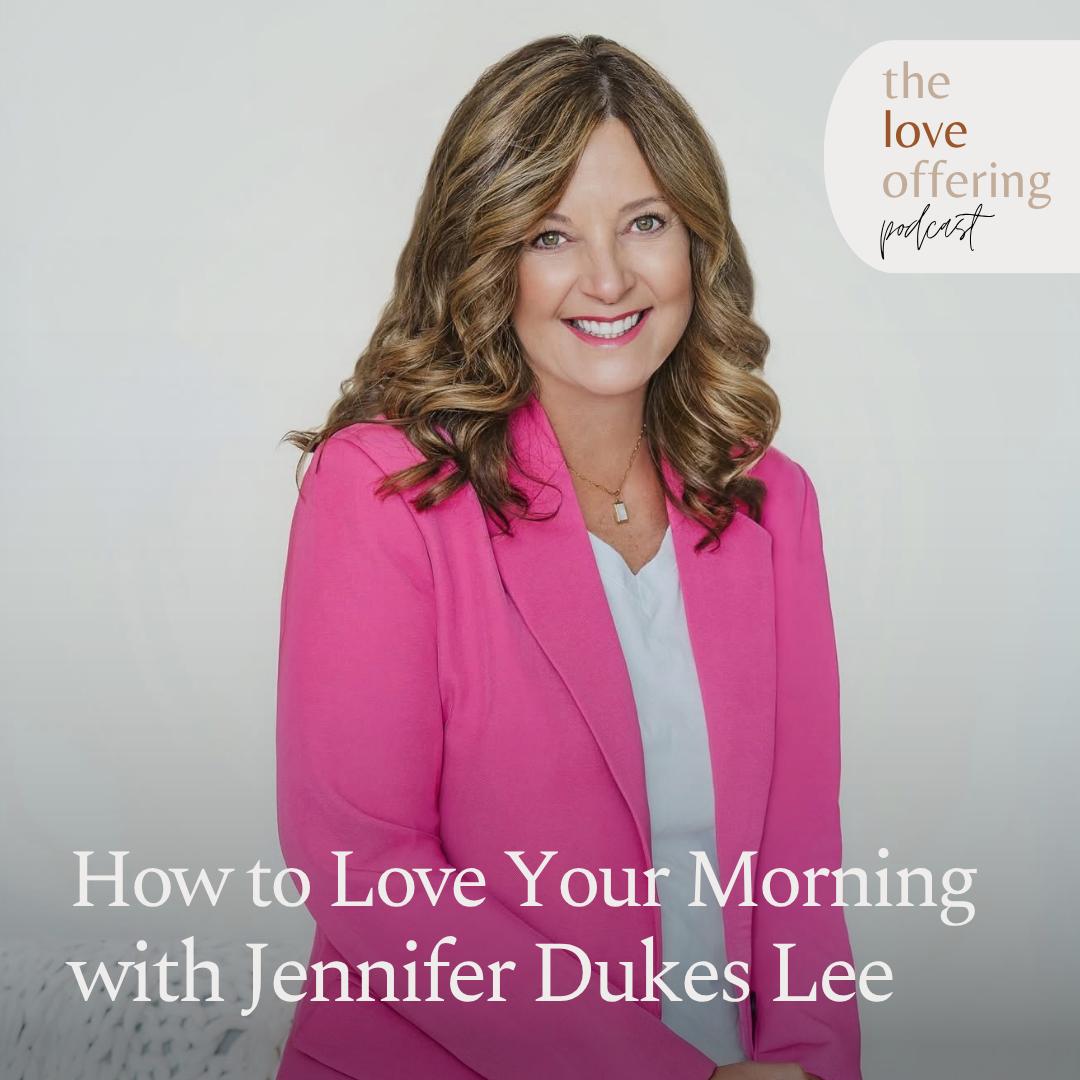
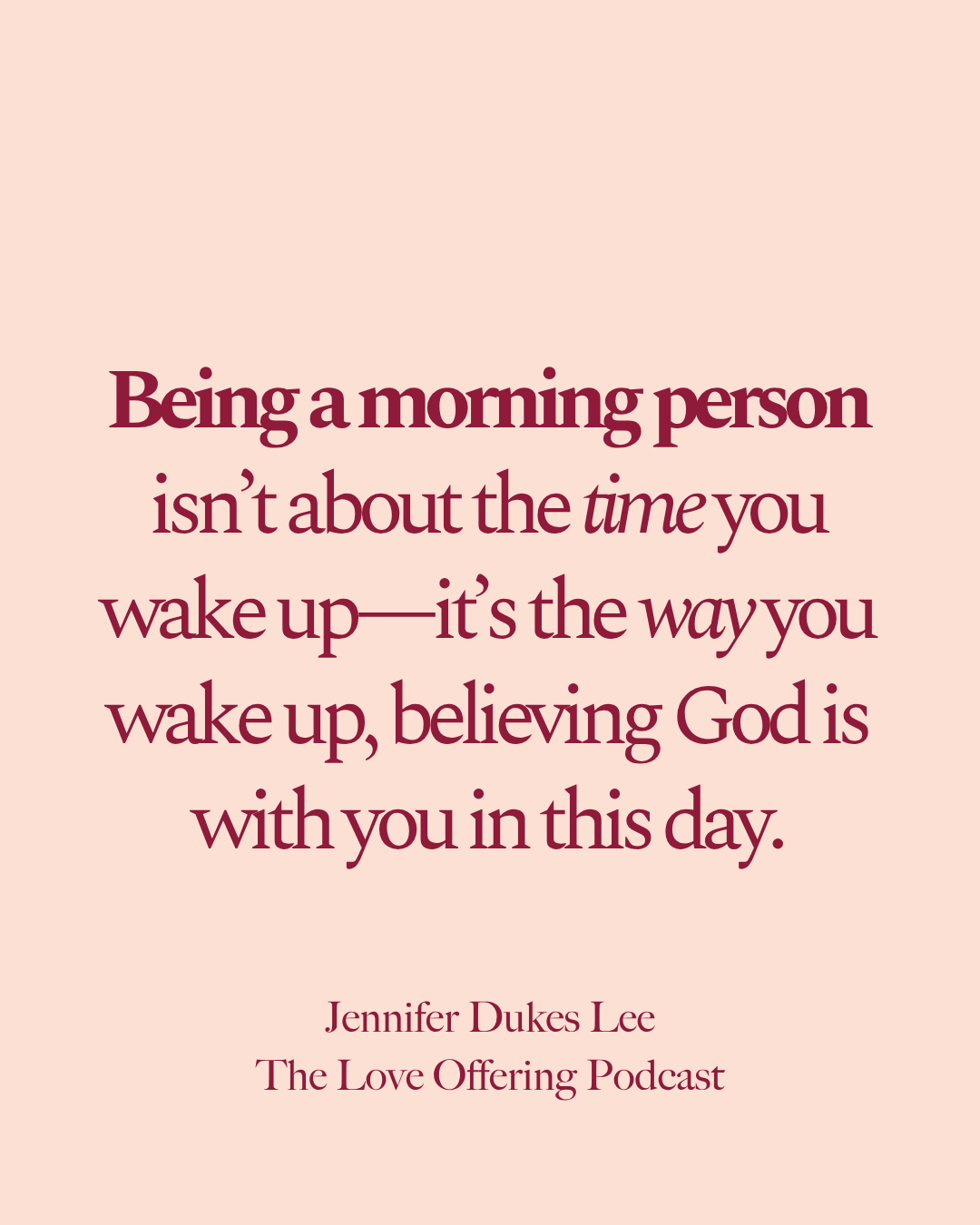
I had the joy of talking with Jennifer Dukes Lee about her new book, How to Love Your Morning, and our conversation was both practical and deeply encouraging. Jennifer reminded us that being a “morning person” isn’t about waking up at a certain time or having a perfect routine—it’s about how we begin and who we begin with. We talked about:
- Why mornings matter so much in Scripture (and how they’re woven throughout God’s story)
- Letting go of pressure, comparison, and unrealistic expectations
- How your personality and season of life shape your morning rhythm
- Simple, grace-filled ways to meet with God—even on the busiest days
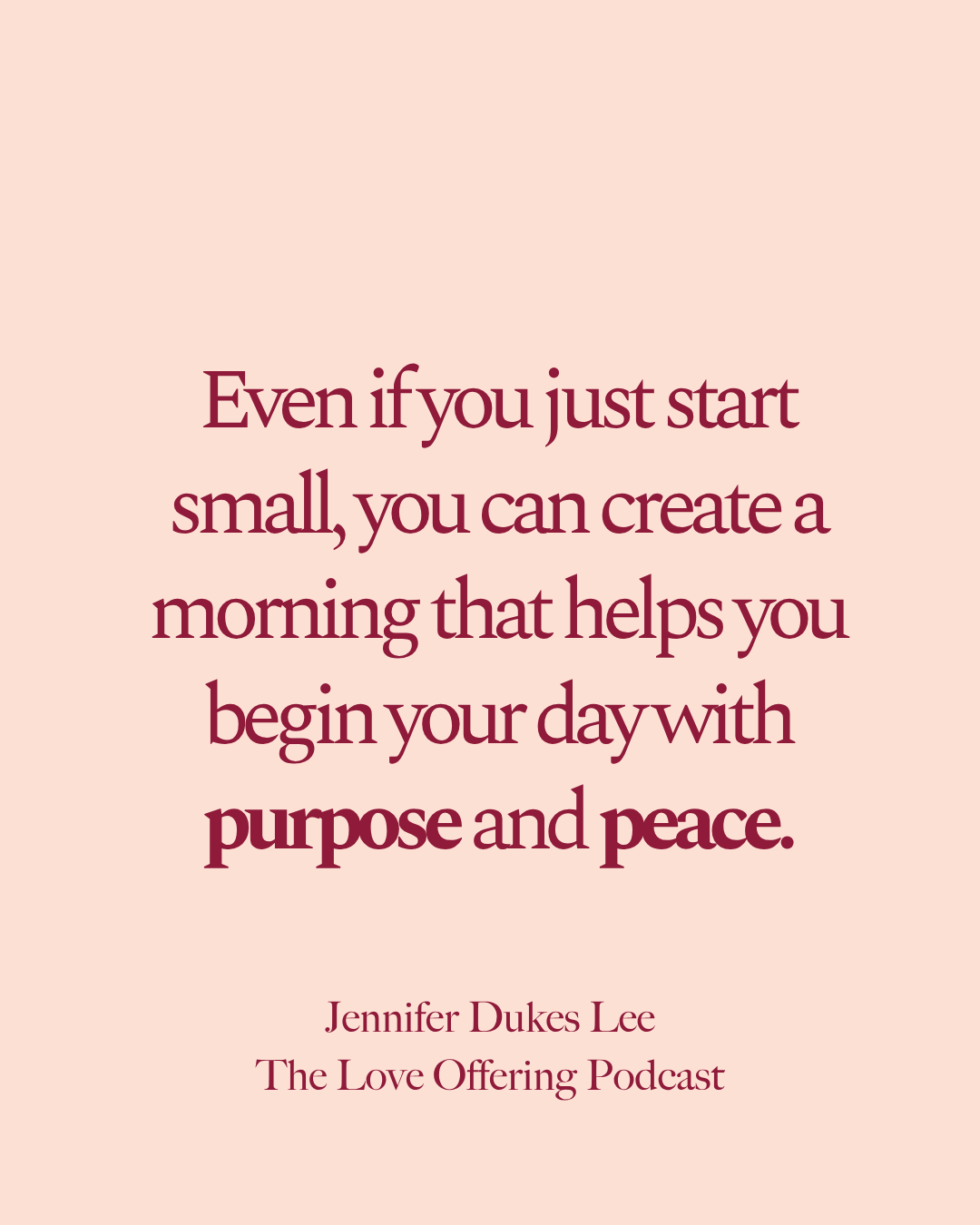
One of my favorite reminders from our conversation was this: you don’t need a perfect morning to meet with God. Even a whispered, “Lord, help me,” is enough. Because the truth is—every morning is an invitation. An invitation to receive God’s mercy again. An invitation to begin again. An invitation to trust that He is already with you in whatever the day holds.
Scripture tells us: “His mercies are new every morning.” So today or tomorrow, before you reach for your phone or rush into your to-do list, what if you simply pause and met Him there? I’m praying this conversation encourages you to start your day with a little more grace, a little more peace, and a whole lot more awareness of God’s presence.
Summary
In this encouraging conversation, Rachael Adams sits down with Jennifer Dukes Lee to reframe what it truly means to “love your morning.” Together, they explore how mornings aren’t about perfection or performance, but about presence—meeting God in whatever the day begins with, whether peaceful or messy. Drawing from Scripture and real-life rhythms, Jennifer shares how God uses mornings as a daily invitation to renewal, hope, and connection, offering practical and grace-filled ways to create life-giving routines that fit your personality and season. Ultimately, this episode reminds us that every morning holds the opportunity to begin again, anchored in the truth that God is already with us and His mercies are new each day.
Transcript (AI Generated)
Rachael Adams (00:01.724)
Welcome to the Love Offering Podcast. I’m your host, Rachel Adams, author of Everyday Prayers for Love, learning to love God, others, and even yourself. Each week we dive into meaningful conversations about how to live out the greatest commandment, loving God with all of our heart, soul, mind, and strength, and loving our neighbors as ourselves. Whether through inspiring stories, practical wisdom, or biblical truth, my hope is to encourage you to love boldly, live faithfully, and reflect God’s love in your everyday life.
Today, I’m excited to welcome Jennifer Dukes-Lee to the show. Jennifer is an author, speaker, Bible teacher, and storyteller known for her warmth, wisdom, and deeply biblical approach to everyday life. Through her writing, she helps women step out of striving and into a more grace-filled way of living, one rooted in scripture, hope, and God’s abiding presence.
In her newest book, How to Love Your Morning, Jennifer invites us to rethink how we begin our day, drawing on every morning mentioned in the Bible. She shows us how mornings were designed by God for renewal, revelation, and connection, and how even the most ordinary or chaotic mornings can become holy ground. Well, good morning, Jennifer, and welcome to…
Jennifer (01:10.574)
You’re doing this in the morning. I’m only slightly obsessed with mornings right now. And so at some point, I have got to hear about your morning routine too. I learned so much. I can’t wait to hear about how your mornings go. What’s a good morning for you? I promise I won’t try to over-interview you, but I’m just super stoked about this conversation.
Rachael Adams (01:29.032)
Well, me too. So I actually had a little bit of a behind-the-scenes look at this whole process and this concept. And I remember you bringing this idea to a group of ladies, and we all liked this. We’ve never seen anything like this. We love mornings. Look at all these mornings that are found in scripture. And so as we begin, I want to hear the backstory. And I think because I know a little bit more, and I think that listeners are going to want to know too.
Jennifer (01:37.271)
You did.
Rachael Adams (01:57.136)
When you’ve been a lover of mornings for a long time, but you actually had a conversation with your daughters, I want to know that backstory.
Jennifer (02:01.358)
I’m going to give you that back story, and then we have to talk about, from my perspective, what it was like to speak with that group of ladies who are a mastermind group, because I think that is so cool. OK, so we’ll go back to the beginning. We were on vacation. My husband and our daughters were college-aged at the time, and we got up right with the sun, with so many things we wanted to do on vacation. We wanted to watch the sun climb up the sky, take a walk on the beach, get some espresso, and read our Bibles together. We had so many things, doing a workout, you know, just all these kinds of things. And I said to the girls, mornings are never long enough. I wish we could just stretch the mornings out. And in that moment, Lydia, our older daughter, put her hands flat down on the table, and she said to me, ” Mom, you need to write a book about mornings. And I didn’t even know what that meant or what that would look like. But that very morning, we started talking about how mornings were this starting point, literally, but also in our hearts every morning as a mom. You know, the girls faced hard things in school when they were younger. It was, you know, who was gonna sit with me at lunch? And when they were older, it was online bullying or losing grandparents. And at night, things always looked kind of dark and dreary and sorrowful and sad on those kinds of days. But we had this attitude that everything would be better in the morning. And not just to slap a cliche on it, but we really, truly believed it based on what we understood God saying about his mercies being new every morning. And that was something that we carried then into our day as soon as the day began, we prayed together, we ate a nutritious breakfast, we moved our bodies, we did all the things to set ourselves up for success. We reminded ourselves of God’s truth. It wasn’t pretty, it wasn’t Instagrammable. It happened in the context of a very busy life as a mom, dad, and daughters. So when Lydia said that while we were on vacation, we began to recall what mornings meant to us and how they got us through as a family.
And then I began that very morning to study, the mornings mentioned in scripture during our morning Bible time there on the beach. And what I discovered really blew me away. And I began to see this book take shape, based fundamentally on what God has to say about mornings. Not about what I have to say about mornings, or what my morning looked like, necessarily, but I wanted to start with God and his word to understand how critical mornings are to the whole biblical narrative. Then, you know, months later, I began to write that book. I began to, you know, do all the things that authors do, tell their own stories, unpack the scriptures, so forth. But I really hadn’t talked about that book to anybody else except my husband, my literary agent, and my daughters.
And then came the mastermind that you, Rachel, are a part of. It’s a wonderful group of women who really love the Lord, support each other, and challenge each other to excellence as we do ministry. And it was my turn to share a project that I was working on, and I shared about this book. And to receive the kind of eyes-wide-open excitement as I began to unpack the scriptures and talk about those mornings of scripture was so important to me, Rachel. It was so affirming to know this book was going to matter. And then you all helped me shape it and ask good questions, like, “What about the woman who dreads mornings?” What about the woman who is worrying and anxious before her feet even hit the floor? What about the woman whose life has been completely turned upside down? What about the woman who doesn’t have time for reading the Bible or in-depth study, and all those kinds of things? And that really began to solidify and move this book toward what I think the reader ultimately needs.
Rachael Adams (06:20.616)
Well, I can’t wait to dive into all those different women and circumstances you just alluded to, but we’re going to take a brief break to hear a word from today’s sponsor. And when we come back, we’re going to talk more about some of the warnings that Jennifer found in scripture.
Rachael Adams (06:39.042)
Welcome back. I’m talking with Jennifer Dukes Lee about her book, How to Love Your Morning. So, okay, I want to know, have you always been a morning person? You’re like, I can’t wait to get up every single day and just hit the ground running. Is that you?
Jennifer (06:55.788)
didn’t think that I was, but it turns out that I am. And I know that sounds odd, like how could I know if I was a morning person? But what I learned is that being a morning person isn’t about the time you wake up. It’s the way you wake up. It’s what you hope that a day can be, regardless of what’s on the schedule, regardless of what you carry into the world. is saying, I am a morning person is saying, I believe that God is in this with me today, regardless of the chaos. But I do look back on my life, and I think about how my mornings shaped me and what that means to me now. Like when I was a little girl, I wouldn’t say that I was excited to get up early in the morning, except for Saturday mornings, because I loved cartoons, and it was the only time you could actually watch them. I know I’m dating myself like a dinosaur here. And then, when I was a teenager and college age, I wasn’t maybe what looked like a morning person because I was up late working on school projects in high school, and then probably up too late as a college kid, visiting establishments with neon lights and drink specials. Having to get up the next morning for class means just confessions here. But when I became an adult woman who needed to get in for work, I realized how critical it was to have an evening ritual and a morning ritual to prepare me for a day when other people really depended on me. So I think into adulthood, I really began to live like a morning person, although I wouldn’t have called myself that, as I mentioned. Part of the reason I think that we don’t call ourselves morning people is that there’s a certain Instagram aesthetic that tells you what a morning person is. You know it?
Rachael Adams (08:46.972)
Yes. And that was one of the things I wanted to talk about because I think that there’s so much pressure. Like, I need to wake up at 4 30 a.m. and go get my workout in. I need to have, like, those little eye patches under my skin. You know, I need to have my matcha tea. Like it’s almost become so much pressure. That’s like, I can never live up to that expectation and go run like a half marathon before I even get my kids up and make their bed and get them to school and get to work on time and look gorgeous doing it all, you know?
Jennifer (09:17.886)
Absolutely, and we see women online, and I don’t want to throw any shade on people who actually look like a Disney princess when they wake up. I love watching their reels. I’m obsessed, but I got to tell you, I mean, as this person who’s launching this book out into the world, I’ve had to like be real and show my mornings, and I’ve gotten so tickled at times, like laughing as Scott is like taking videos of me waking up in bed when it’s like 8.30 at night. You know, like if I have the eye patches on and if you want to see my hair sticking out in 15 different directions, well then you’re really going to love my reels. But I’m telling you, like it’s hard, it’s hard to do it for, you know, just like marketing or whatever. I mean, it feels impossible just as a regular person. You hold yourself up to all those things, and you’re like, man, I’d be, I’d be tired by 8 a.m. if I was like doing all that plus ironing my bedsheets all before eight, so yeah, it’s hard, it’s like well then no I’m not a morning person, my mornings don’t look like that
Rachael Adams (10:22.743)
Well, I think so. I do have friends who wake up at five 30, go to the gym, and do all those things. Like, there are people who do that. That doesn’t work for me. I feel like I need more rest, but I probably stay up a little later than they do to get up at five 30. They’re asleep, fast asleep by eight 30 or nine. And so that brings me to you. You said something about this. You’ve got to start almost your morning the previous night, right? Yeah.
Jennifer (10:44.738)
Mm-hmm. The night before. Yeah, absolutely. And that’s so hard. One of the reasons it’s hard is that at night we feel like we deserve a little bit of me-time, but as women, we’re needed all day long. Kids, maybe if you’re a mom, people at the workplace, a spouse, if you’re married, just I mean, aging parents. And so at night you plop down on the couch, scroll on Instagram, and watch just one more Netflix show. And there’s actually a name for this. It’s called Revenge Bedtime Procrastination. And yeah, so it happens when people put off sleep and scroll or binge, and it’s just a way to decompress at the end of a long day. But what happens is that you have then, you know, stalled your own sleep schedule, and you’re already behind before the next day begins, because suddenly you’re now at six and a half hours of sleep or whatever it is. You still have to get up and be present the next day. So, I think, one of the hardest things for people who want to have healthy mornings is acknowledging and understanding what’s happening the night before. Am I looking at my screen for two minutes before I close my eyes? This is not good for us. You know, how we fuel our bodies at night, what kind of rituals are we doing that kind of, you know, sort of bring the whole energy level down? Like what is it, you know, like washing your face, taking a bath, having a hot cup of tea, reading a devotional, deciding I’m not going look at my phone for the last hour of the night, whatever it is, like figuring out these ritualistic things that feel sacred, that feel like you’re doing your future self, your tomorrow self, a favor is so important to having a helpful, hopeful, healthy kind of morning.
Rachael Adams (12:44.912)
Okay, so I want to hear what your typical evening routine is, and then what your typical morning routine is. So let’s start there.
Jennifer (12:52.052)
Okay. Yeah. So my evening routine is to spend time with my husband after supper. We do watch, we watched Netflix, whatever show we happen to be watching, or maybe we’ve gone out for dinner or something like that. And then, when it’s time to go to bed, I set my phone aside, wash my face, and take, like, some night supplements. I often take a bath, but not always. I have had hot tea for about an hour. I don’t want to have too much liquid before I go to, yeah, it’s an issue, right? I mean, it’s something to pay attention to. I make the room and the house cooler about half an hour before I go to bed. I turn the temperature down. We know scientifically that a cooler environment is better for sleep.
Rachael Adams (13:30.478)
Yes, that’s an issue.
Jennifer (13:47.788)
I turn, I’m one of those fan babies. I turn on a fan, and I don’t tend to journal or read devotional material at night. That’s more a part of my morning routine. But I am generally, as I put my head on the bed, sometimes praying prayers that are kind of prayers I’ve had from memory since I was a child. For instance, the Lord’s Prayer. Very commonly, this is what I will pray at night. And I am quite certain that before I get to the end of the prayer, I’m actually asleep, but I’m pretty sure God does not mind. But it’s a way of placing my cares and worries, and the next day, even in front of the Lord, and just giving it to him. Another thing I do is I often remind myself, especially on a difficult night, that even as I sleep, God does not. Like he’s working still, and he will be there with his new mercies come morning. That’s exactly right. And then for the morning routine, it varies day by day because I live in a small town. I have one workout opportunity. It’s not even in a real fitness center. It’s in a community room. And that happens at 530 in the morning, which means that is not the time that I naturally want to wake up, but I don’t really have a choice. So I get up at 5:07 getting like literally every second of sleep I can and on those mornings I am out the door before I do anything else including Bible reading and I think that could be freeing for some people to hear because it’s like well I’m supposed to I’m supposed to do these certain quiet time things before I need anything else but for me moving is a great way to start my day on those particular mornings and I meet with women who I love and trust and that I can be in community with. Then I come home, and I’ve been waiting for that cup of coffee since the night before, and I have it in my very favorite cup, and then I sit down for devotional time. I read some commentary or a book to help me understand the scriptures better, read my readings, and fill out my prayer journal. And then I am eating a nutritious breakfast every day. I rarely skip breakfast, and that’s typically two eggs sunny-side up. And then it’s off to work right here where I am. I get movement every morning, even on non-workout days, because I have a walking desk and I work while writing morning devotionals for people on Instagram and Facebook. And it’s also where I write books, give talks, and do all the other things we do as writers and authors. So that’s my routine.
Rachael Adams (16:50.066)
So one aspect of your book is discovering your morning archetype. Could you explain what that is and why understanding how we’re wired helps us avoid guilt and comparison based on our spiritual habits?
Jennifer (17:08.11)
Okay.
Jennifer (17:16.094)
Mm-hmm. Yes, absolutely. So when I wrote this book, one of the first thoughts I had was to come up with a one-size-fits-all morning ritual, because I’d seen books in the secular marketplace like that. Like everybody needs to get up at 5 a.m. Like there are books exactly like that that say these are the things that you need to do and that would, you know, kind of reinvent everybody’s mornings. But it became really evident to me that that would be an impossible task because each of us is in a different life stage. Morning is going to ask something very different from a young woman than it will from an empty nester. And we also have different reasons for wanting to get up or not in the morning. And so that’s where these morning archetypes come in. So archetypes are basically like personality categories, and they’re based on what you are interested in. And you can take a test on my website, How to Love Your Morning, to understand what your archetype is, but I’ll briefly tell you what they are. I think you’ll know right away what yours is. So there’s the daybreak doer, a kind of person who’s ready to hit the ground running. They really feel most relaxed when they have a pretty clear idea of what’s ahead for the day. So that might just look like, you know, making the to-do list, tidying the kitchen, just mentally preparing for a work assignment. It doesn’t mean just jumping headlong into work and forgetting everything else. It just means, as a daybreak doer, you need to know what the day is going to hold. Then comes the morning mover, who functions best if she can get moving as soon as possible in the day. Whether that’s a walk around the block, a stretch routine, or a high cardio workout at a fitness center, or what have you. It really gets the metabolism and mood going.
And then there’s the meditative mind. And I think a lot of people are like, well then that’s the one that’s really good. That’s the one that God loves the most. Because the meditative mind is immediately drawn to prayer, Bible study, journaling, and all those kinds of quiet time activities with God. And those are great. And I hope and pray that everybody makes a little bit of time in their morning ritual for some of those kinds of practices. And then finally, there is the social seeker. So this is a type that wants social interaction right away. That’s what I also get when I go to the gym those three days a week. I am a social seeker in part, and I love to connect with people right away. I think many children are social seekers. Think about how you got a child who comes out of their bedroom and maybe wants to be hugged, held, or talked to. They have a story they want to share. And they really need to start their day with a real, meaningful connection. My mom lives in an assisted living center, and she needs that because she’s all alone, she’s a widow, and she likes to pick up her phone and see what us kids have been up to and if we have texted her since she went to bed. So those are the four types. And what’s important here is it’s so helpful as you begin to customize your own morning ritual, because if you incorporate activities right away that are common to your type, it will motivate you to wake up. So you can build your morning ritual from there. If you are a social seeker, go ahead and seek social interaction. You can add in other elements later, but what is the thing that gives you life? What is the thing that says, I wanna wake up for that? Start there and build your morning routine.
Rachael Adams (20:53.896)
So I think I’m the daybreak doer, I’m thinking, well, I want to know, what are you?
Jennifer (20:59.724)
You know, I think I’ve been so immersed in it. I can see parts of all four in my life. I think that at heart I am a meditative mind, but when I didn’t have, when I had kids at home, it was really hard to nurture that first thing. So now, in the space that I’m in now, I’m an empty nester, and I’m able to do that. But you know, being a morning mover, that invigorates me and gets me excited, too. So I don’t know, I feel like I’m all of them.
Rachael Adams (21:35.449)
It makes me almost think about Dr. Gary Chapman’s five love languages. And I think it’s really important for us to know other people’s love language. Well, in relation to our conversation, I think it’s really important if you’re living with a group of people to know what their type is. Because the last thing if one of my husbands wants to go and get in the sauna first thing in the morning and have quiet, and that kind of meditation. My daughter wants quiet and no socialization. My son goes immediately to football workouts. First thing in the morning at 6:30 AM. And so each of us is different. And then I’m even thinking about myself during the work week, I’m different than I am on Saturday. First thing on Saturday, I just want to get my cup of coffee and spend time with the Lord. But on a typical day, busy making lunches and doing all the other things for everybody else. And then I can focus on what I need to do. So do you find that even different seasons, different people, different days of the week?
Jennifer (22:37.166)
I think so, I think so. I mean, as I have worked through these, I see the benefits of having them all play a part in our lives, in some way. But the most important thing is, if possible, to lead with your dominant type. So I can get up and be motivated in the morning to go to a workout. There’s not, I mean, I might not get up at 5.07 to read my Bible. I know that sounds terrible, but I will get up to do that workout. But on the other mornings when I don’t go to the workout, the first thing I do is meditate. And I think that’s exactly what you’re saying. Depending on the kind of day or the season you’re in, that’s going to fluctuate quite a bit.
Rachael Adams (23:22.63)
Yeah, there’s grace in this whole process, which I love and I’m so thankful for. Well, so, okay, we’re going to take another brief break to hear a word from today’s sponsor. And when we come back, we’re going to continue talking about some of the more biblical examples of mornings.
Rachael Adams (23:38.572)
Welcome back. I’m talking with Jennifer Dixley about how to love your morning. I’ve been wanting to ask this question. I’ve gotten like way off track. So give us some biblical examples of mornings, because there are so many in the Old and New Testaments. I love that.
Jennifer (23:50.562)
Yeah. I’m so glad you came back to this question because this is my favorite part of the book. I’m a Bible nerd, and sometimes I think, you know, I’ve read this verse before. What else is there for me to glean from it? And God always proves me wrong and teaches me something new. So I studied all 200-plus warnings in scripture, and they became the basis and foundation of the book. I impacted many of them through How to Love Your Mourning, and then more of them through the How to Love Your Mourning Bible study. The morning is such a prominent theme throughout the biblical narrative. And one of the things that surprised me the most was how early on it was the prominent theme.
In Genesis, the very first thing that God created on this earth was a warning when he said, ” Let there be light. He gave us light by which to see his goodness in this beautiful world that he was creating, and that he has created, and he keeps bringing that light every single day. As we move through the Old Testament, we see so often how people are given instructions and commanded by God to get after them. As soon as their morning begins, they’ll say things like, in the morning, Abraham explains what he did. In the morning, Moses. In the morning, Joshua. In the morning, Jacob. Over and over and over again, people are commanded to get moving in the morning and not to make haste, not to put it off, or hit the snooze button. They’ve got to get things done, which I find really remarkable about how important warnings are to carrying out our purpose in this world. Then we move on to, you know, metaphorical warnings, ones that we probably know by heart, like Lamentations 3:22-23, which says that mercies never fail, they are new every morning. I think so many of us think of those verses when we see a sunrise or imagine that God is with us in whatever hard thing we face. I think about Psalm 30, where it says that weeping may last through the night, but joy comes in the morning. Like, over and over and over again, we get to the New Testament and see Jesus getting up very early in the morning to consult with God so he knows what he’s supposed to do. And then comes the saddest morning in history, in the history of ever and ever and ever that was crucifixion morning. Jesus was crucified at 9 am on a morning on a Friday morning. That reminds me that no matter how bad my morning is, Jesus gets it. He knows what it is to face incredible suffering and hardship on his mornings as well. And when all hope was lost, then came Easter morning, resurrection morning in the garden when Jesus rolled back the stone and walked out of his tomb. I mean, the morning that really changes everything, and that is the one that all the biblical narrative hinges on. And then I, this one is one of my favorites. Jesus is the risen Christ, and he’s praying a lot of things he could do at this time, right? I mean, he’s done, he just rose from, he’s erected his own funeral, right? So he’s got some things he probably wants to do. But he woke up one morning, and he’s like, huh, pretty sure my friends are fishing right now, so I think I’m going to go to the beach this morning and make them breakfast. And during that morning, breakfast time was an opportunity for restoration and renewal, especially for Peter around that charcoal fire. And then there’s a whole bunch more, but the very last one that I want to point out is that Jesus is the bright morning star. We understand that very well in the book of Revelation. We will have no more night in that our world will be lit up by Jesus himself, the bright morning star. So many, I’m so excited, can you tell?
Rachael Adams (28:07.56)
I’m so excited about it. And so what is your hope? I know your hope is not just like want everybody to look forward to mornings, and I want them to have a smooth morning. I know you want that, but what do you think the difference can be in their life? Why do you think God even cares about mornings? What can change in a woman’s life after doing this study and reading this book?
Jennifer (28:28.726)
Yeah, there are some practical considerations that you mentioned. I would love for women to wake up and get into God’s word. And I help them in this book find ways to do that that work in their lives and in the seasons that they’re in. I would love for women to take better care of their bodies. We have an embodied faith. Jesus came to earth as a human, and he went to heaven in bodily form, and he sits at the right hand of God, the Father Almighty, as a body.
And we need to take care of our bodies too. And that can kind of be an afterthought, but I really, I devoted a whole chapter to that in How to Love Your Mourning. And I want people to, you know, to move their bodies and to do the things they can in the morning to just get the blood pumping through their bodies. And I want women to just engage with people, their loved ones, and all those kinds of things. Most of all, I want women to wake up knowing that they are in this with God and, more importantly, that God is in this with them, that there is hope for a new day, that a morning isn’t just a time stamp on some calendar. It is an opportunity to love God, to love people, to live, to seek his grace and his goodness, and to reflect that morningness to others, because ultimately being a morning person isn’t about us. It is an opportunity to share that hope and love with others. This is the idea that we’ve heard since we were kids: everything will be better in the morning. That is God’s way. Like that’s his idea. He shows it again and again on the pages of scripture. I mean, I can’t even imagine how he’s trying to whisper that into the ears of Jesus friends on that Saturday night when they’re just feeling such despair and sorrow in the darkness of night. can imagine him almost whispering in the ear, everything will be better in the morning. And sure enough, the women arrive at the tomb, find the stone rolled away, and discover Jesus alive in bodily form. So, that is my hope is that they would be able to express and feel the goodness of God and carry it out into the world.
Rachael Adams (30:46.246)
Yeah. Well, and how we start our day really does carry into how the rest of the day goes. It really does. It compounds on itself. Don’t you think?
Jennifer (30:55.816)
Absolutely. When we start our day with God and say, ” You know, no matter what, I know that you are in this with me. Like you are here in these first moments of the day. think that we can believe as if we dread mornings or if mornings are hard, that somehow we are failing, but we’re not failing. We’re human. You know, not every morning are we going to be thinking about sunrise walks or like, you know, eating our eggs.
A lot of times, we’re thinking about bad medical news or the grief that meets you as soon as your eyes pop open. So, for everybody, morning isn’t always a fresh start. It’s sometimes the moment when the weight just returns. And so my whole message is not to work hard to have a perfect, performative morning. The message is to meet God in the first moments, even if they’re messy, because it will make a difference in your entire day. And if all that you can do is whisper, God help me. mean that counts, that counts.
Rachael Adams (31:59.581)
Yeah. Well, I’m just thinking, and I don’t know if this is bad or not, and I probably shouldn’t admit it. Sometimes my husband are like, we cannot wait to get to bed, you know, because it’s like, it feels like that almost feels easier because it’s a safe place. You’re finally comfortable. It’s like, I’m just ready to rest from this day. I’m exhausted. And so I just imagine in our culture today, many people are probably feeling that way. Does that evoke any thought in you?
Jennifer (32:30.154)
Yeah, you know, Rachel, I think that’s absolutely true. And I think that’s actually really helpful to say, I’m just ready to get to bed because you know, that on the other side of that is this God is this sentiment that everything will be better in the morning. I mean, it is a timeless truth that has, like, thrilled the human soul across cultures, across literature, across oral traditions for centuries. There’s just something about a morning, and how it insists on rising over this beautiful and baffling world we live in every single day. So when you’re going to bed and just like, I’ve had enough of this day, in a way, you’re saying everything’s going to be better in the morning because that is the hope that ties the whole biblical narrative together that God promises to us. Cause mornings, I mean, they are just not a shift in time from night to day. They are an invitation to trust that he is working.
Rachael Adams (33:27.878)
Yeah, this did you when I’m trying to think, I guess maybe my mom sang it to me and now then I sang it to my children, but I won’t sing for everybody right now, but it’s like rise and shine and give God the glory. Glory. Do you know that song?
Jennifer (33:42.117)
I do, absolutely. You know, some of these things, when they roll off our tongues, they sound like, my, us roll our eyes, or they sound cheesy or whatever, but there’s so much truth embedded in these things in ways that we could understand as children that we can understand in more complex ways as we grow up into adulthood.
Rachael Adams (34:04.872)
Yeah, today is the day that the Lord has made. Let us rejoice and be glad in it, right? Yes. Yes. Well, okay. So this season, I’ve been asking all of my guests, Is there a biblical concept of love that you think applies to this topic? You gave us a lot of great biblical examples of mourning that talk to us about the love relationship.
Jennifer (34:08.238)
So good! Yes, Rachel, yes!
Jennifer (34:22.882)
Yeah, I was really intrigued when you were doing the intro for your podcast here. And I believe you were speaking of the Shema and of Mark 12, 30, where it says to love the Lord your God with all of your heart and all of your soul and all of your mind and all of your strength. I love, mean, this is gonna be more perfect. That’s the verse. That’s the verse. That’s the verse for everybody’s morning. It was the verse for Jesus’ morning. He would have prayed those very words as a part of his morning ritual. And here’s how I can be so sure. Because Jesus’ words, to love the Lord your God with your heart, soul, mind, and strength, are taken from that ancient Old Testament prayer called the Shema. They prayed every morning and at night too. But as a devout Jew, Jesus would have heard the Shema every morning since he was a baby and likely recited it as he got older as a part of his faith tradition. And so I’m like, if Jesus morning ritual is a way of daily expressing his intention to love God with his whole being, that can be ours too. I find that so beautiful that Jesus’ morning intention to love God in that way can be ours as well. I actually built the whole book around the concept of loving the Lord your God with all of your heart, soul, mind, and strength.
Rachael Adams (35:48.392)
That makes me all teary, and what a beautiful way to start your day. I’m gonna start doing that. I mean, why haven’t I already? I’m not sure, but tomorrow’s the new day to start, right? Jennifer, tell us: other than loving your mornings, what else are you loving right now?
Jennifer (37:20.014)
Well, you know, I did allude to this before, but part of my morning movement to love God with all of my strength is I have a desk treadmill, and it’s a walking pad, and then there’s a desk over it. So all the time that I am writing and working, I am moving my body, and I love it. I’m easily getting 15,000 to 20,000 steps a day on this thing.
I actually wrote the whole book while walking. I wrote, I did the calculation. It would be the equivalent of going from the Hamptons on Long Island to the U.S. Capitol in Washington, D.C., or, another way of thinking about it, from San Diego to Las Vegas. So I covered a lot of ground right in this book.
Rachael Adams (38:07.076)
Wow, wow. Okay, so when you’re walking and working, what speed do you set it up?
Jennifer (38:15.83)
Okay, so I started at 0.5 because I was really scared of falling off the back. But now I’m up to three, and I think that’s my max, three miles an hour.
Rachael Adams (38:23.89)
Wow, yeah, that’s fast. Well, good for you.
Jennifer (38:27.05)
If Scott comes in through that door over there, I have to like totally stop it because if I turn, you know, I’m gonna fall off, I’m sure. I don’t ever check my phone when I’m on here. It’s just a safety hazard for me to be looking around.
Rachael Adams (38:41.352)
I was gonna say, you’re okay. You can, you can walk and write, but can you like walk and podcast? Like you’re not walking right now. The ba- the yeah, maybe that’s true. The sound quality. Well, okay. We talked about this right before we hit record, but the new thing that my husband and I have purchased is a sauna, and it’s a red light sauna. And it was, I mean, it was pricey, but by the time we priced it, we actually were going to pay for a membership at a place to get a sauna for a family of four, versus us just having one.
Jennifer (38:46.862)
I think it might be annoying.
Rachael Adams (39:11.306)
And that has been super transformative for us as well. And that is something new, just as of Christmas, that we are really loving, and we can all tell the health benefits. I’m sweating without moving. Does that count?
Jennifer (39:25.006)
I love this. I want one so bad. I’m like, immediately let’s wrap up this podcast because I’m headed over to Amazon right now. I’m serious. I am so excited about this.
Rachael Adams (39:34.492)
Yeah. Yes. Okay. Well, we’re going to have you send me your walking pad link, and then I’ll put it in the show notes, and we’ll put them both in the show notes. We’re going to be, yes. Okay. Well, I know, I know, prayer and the spiritual side of this is so important, and we always close our episodes with prayer. So would you just do us the honor of praying for us as we close today?
Jennifer (39:40.654)
That’s sweet. Awesome.
Jennifer (39:53.634)
Lord, thank you so much for another morning, another day, another chance to live, to enjoy you, to share your love with others, to be a reflection of the bright morning star in our lives. Lord, I pray for the woman right now who dreads waking up every morning and faces hard things. Just remind her that you faced hard things too. That morning, resurrection morning was as true for the women who observed what had happened as it is for the woman listening to this podcast right now. Thank you, Lord, for transforming the whole world on that morning and for continuing to do so for us every single day. Your mercies are new every morning, and weeping may last for the night, but joy comes with the morning. We’re grateful for that, Lord. Help us now to love the Lord our God with all of our hearts.
all of our soul, all of our mind, all of our strength, and in this way that we might love you, Lord God, with all of our mourning. Amen.
Rachael Adams (41:01.632)
Amen. Well, Jennifer, thank you for helping us to love our mornings. Appreciate your time today. Thank you so much for listening to the Love Offering podcast. I hope today’s conversation encouraged you to love God, love others, and even love yourself even more. One morning at a time. If you enjoyed this episode, please share it with a friend and leave a review. It helps others find the show and spreads the message of love even further. To connect with me, visit me on my website at RachelKAdams.com. While you’re there, be sure to download the Love Offering calendar, a free resource filled with simple daily ways to love those around you. Be sure to pick up a copy of Jennifer Dukes Lee’s book and Bible study, How to Love Your Morning. A special thank you to Life Audio for supporting this podcast and making it possible. To find more great podcasts, visit lifeaudio.com. Thanks again for joining us today. Until next time, let’s make our lives an offering of love.