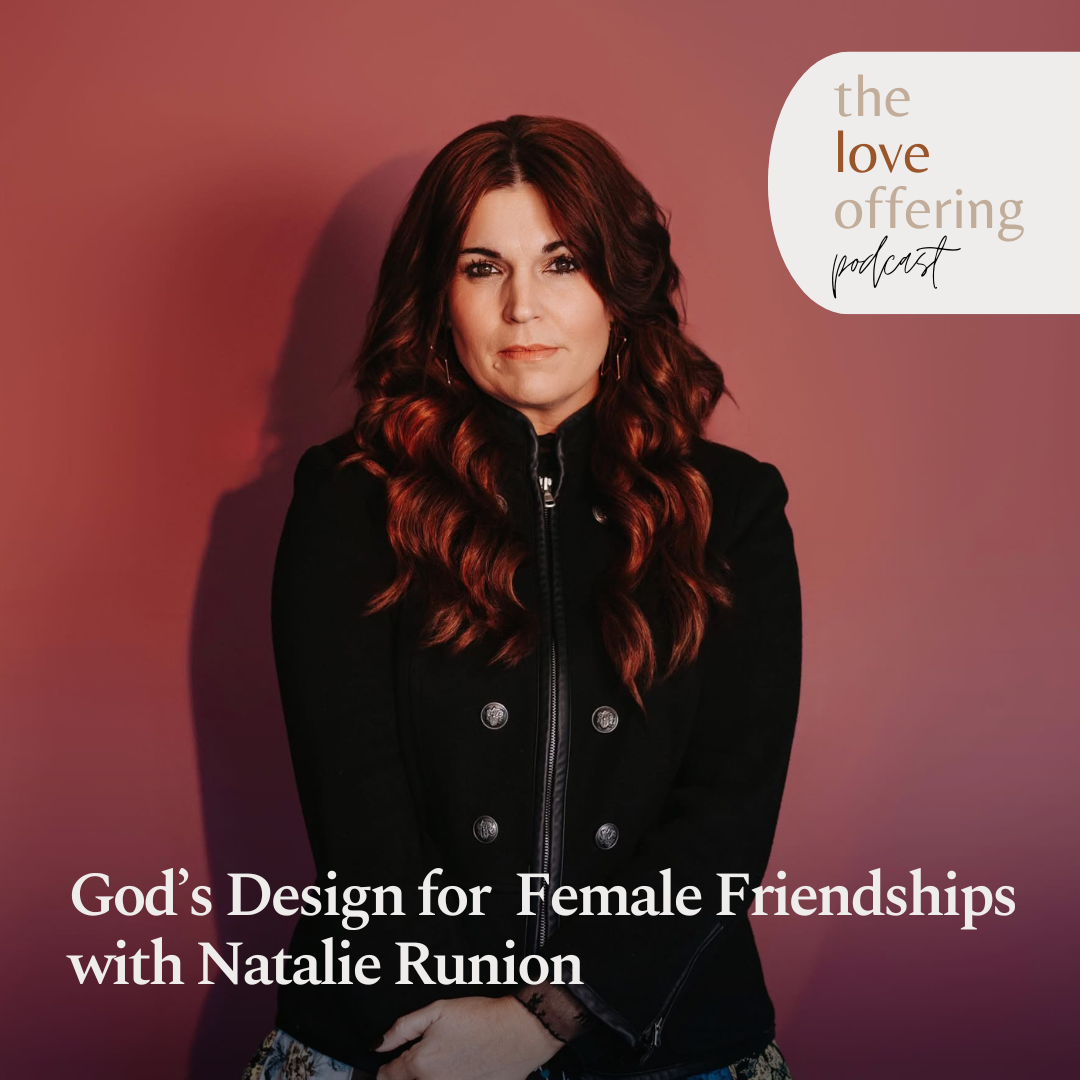
Have you ever wrestled with the tension of female friendships? One day it feels like a refuge, the next like a rivalry. Too often, even in the Church, women can struggle to truly trust—or even like—other women.
That’s why I was so excited to sit down with bestselling author Natalie Runion to talk about her new book, I Don’t Even Like Women. In it, Natalie flips the script on the narratives that keep us divided and reminds us that God designed friendships with other women to be life-giving, healing, and deeply purposeful.
In our conversation, Natalie shares how:
- We can dismantle the lies that distance us from one another.
- Past trauma doesn’t disqualify us from finding safe, meaningful friendships.
- Humor and honesty can free us from comparison, fear, and insecurity.
- Healthy female friendships equip us to live boldly into our God-given callings.
This episode is for anyone who’s ever wondered: Are women my competition or my collaborators? My rivals or my refuge?
I promise you’ll walk away with hope, encouragement, and practical tools for building friendships that last.
Listen to the episode HERE.
Grateful to be on this journey of love and friendship with you,
Rachael
Summary
In this episode of the Love Offering Podcast, host Rachael Adams welcomes Natalie Runion, author of ‘I Don’t Even Like Women.’ They discuss the complexities of female friendships, the false narratives that often isolate women from one another, and the importance of building authentic connections. Natalie shares her journey from disliking women to embracing the beauty of sisterhood, emphasizing the need for vulnerability and intentionality in friendships. The conversation also touches on overcoming competition among women, the significance of community, and the biblical principles of love that guide these relationships.
Takeaways
Natalie’s book title reflects a common struggle among women.
Many women feel isolated due to past negative experiences.
Authentic friendships require vulnerability and honesty.
Friendship dynamics change across different life stages.
Celebrating other women’s successes can reduce competition.
Community comes to those who are committed to it.
Social media can create false perceptions of friendship.
Women need to support each other in their unique callings.
Building connections can start with simple gestures.
Loneliness is a common feeling, especially post-COVID.
Chapters
00:00 Introduction to the Love Offering Podcast
00:55 Exploring Female Friendship Dynamics
03:24 Dismantling False Narratives
05:36 Friendship in Different Life Seasons
09:30 Building Authentic Connections
13:39 Overcoming Competition Among Women
17:31 The Importance of Sacred Sisterhood
21:20 Navigating Loneliness and Community
25:15 The Biblical Concept of Love
28:13 Closing Thoughts and Prayer
Rachael Adams (00:02.946)
Welcome to the Love Offering Podcast. I’m your host, Rachel Adams, author of Everyday Prayers for Love, learning to love God, others, and even yourself. Each week we dive into meaningful conversations about how to live out the greatest commandment, loving God with all of our heart, soul, mind, and strength, and loving our neighbors as ourselves. Whether through inspiring stories, practical tips, or biblical truths, I hope to encourage you to love boldly, live faithfully, and reflect God’s love in your everyday life.
Today I’m so excited to welcome my new friend Natalie Runion to the show. Natalie is the author of I Don’t Even Like Women, a book that flips the script on female friendship and helps us break down the barriers that keep us from the sacred sisterhood God designed. If you’ve ever felt burnt by friendships, struggled to trust other women, or wondered if meaningful friendship connection is even possible, this episode is for you. Well, hello Natalie and welcome to the Love Offering Podcast. I’m so happy to have you.
Transcript (AI Generated):
Natalie (00:58.945)
Hey there, Rachel, thanks for having me.
Rachael Adams (01:01.326)
So you and I, we have already found lots of common ground. And so it’s funny because you’re saying like, I don’t even like women, but if I’m being honest, I already really like you.
Natalie (01:09.719)
I really like you, which is like a good sign. You know, we meet in the first five minutes.
Rachael Adams (01:15.79)
It’s true. So let’s start with the title. mean, immediately, as soon as I saw it, I’m like, have to have her on the show. So I don’t even like women. I think it’s just so bold. It’s very honest. And honestly, it resonates with many of us if we’re being really true to how we actually feel and we don’t want to admit it because it’s like, gosh, I’m a Christian woman. I shouldn’t have these feelings, but yet we do. So as we begin, how have your own experiences shaped your passion for redeeming female friendship?
Natalie (01:45.653)
Well, I was a worship leader for years and very suddenly had my title changed to women’s pastor at a very high level, large mega church. And I didn’t want it. It wasn’t really an option. They were like, we think you have a teaching gift. We’re moving you. And I remember looking at my boss and being like, I don’t know why you’re putting this on me. I don’t even like women. Like I don’t even like nothing about me is girly. Nothing about me says that I like women. And it was that five years of serving as their women’s pastor that I really had my heart broken for God’s women. And that came through surrendering my best for God’s even better and really spending time with women in different seasons of life, different generations. And over the last, especially, think seven years of mothering teenage daughters, spending time traveling and meeting women from all over the world who are in the church and out of the church. I have found that a lot of times we say this, I don’t even like women out of just simply not truly being in relationship with women or from the past where we’ve had experiences that haven’t been really pleasant and we’ve isolated ourselves away from friendship. And so this whole title, this whole book came from my heart’s cry to say, like I say, I don’t like women, but actually I’m really desperate for female friendships that make me feel wanted, valued, seen. And I think it’s Satan’s attempt to keep us all separated because he knows that women, when we’re unified, we’re a force to be reckoned with.
Rachael Adams (03:19.982)
I can’t wait to continue today’s conversation, but we’re going to take a brief break to hear a word from today’s sponsor and when we return, we’ll explore the narratives that isolate us from one another and how God invites us into deeper connection.
Welcome back. are chatting with Natalie Runion about female friendship. So Natalie in your book, I don’t even like women you talk about the lies that distance us from other women. What are some of the most damaging false narratives that women believe about female friendship and how do we begin to dismantle them?
Natalie (03:54.305)
I think so many of these have been spoken over us since we were little girls, which is why it’s really easy to believe them as adult women. I think some of the worst ones that I hear are women are so emotional. Women are so competitive. Women are so jealous. I mean, if you think about the movies that talk about women, it’s a mean girls and gossip girl. And there’s actual shows that are telling us who we are supposed to be as teenagers, as adolescents, and then into adulthood. And so some of these scripts that have been written over us become super dangerous because then we feel validated in being gossips and being emotional. And then it also discredits us when we step into the workforce or into church ministry where we’re told we aren’t allowed to have emotions, we’re not allowed to react, we’re not allowed to basically be who God created us to be because it discredit us from having opportunities for leadership or for different types of relationships. And I have been in the workforce in like corporate America and I’ve seen what happens when women assert dominance and I’ve seen what happens when men do it. And when men do it, it’s seen as strong leadership, as passionate, but when women exert this emotion, we’re seen as too emotional or dramatic. And so I do believe that some of these lies that have gotten placed on us are what we’ve used to distance ourselves from other women out of our own self-preservation and also out of a need to kind of distance ourselves from that script.
Rachael Adams (05:32.846)
You know, you and I, before we hit record, we were talking about, we both have teenage children. And in this season of life, it feels difficult to have friendships of our own because we are maybe so focused in this season on work and on our family. So talk to us a little bit about the struggle of friendships in different seasons.
Natalie (05:53.355)
When we’re kids, feels natural. Like I can remember standing in line for VBS and my mom would be like, go talk to that little girl. She looks about your age, right? Like we associate like if we’re in the same season of life or the same age as someone who would be a good friend. And really as we’re getting older, we’re learning that it’s not about necessarily sharing friendship with those in the same season of life, but looking for women who have already survived and thrived in this season of life. And so I find myself at four Yes, still wanting women who are raising teenagers, we can encourage, we can sit together in sporting events and go out to get coffee. But I’m also looking for women who have already been where I am, have raised their kids and have some wisdom to impart in me and with as little time as we have, because right now time is precious between work and raising our children. It takes a lot of strategy to know who am I going to spend time with, who’s going to invest in me. Who I can also encourage, but also not waste time. And, know, when we’re kids, you can go play in the pool for five hours. We don’t have five hours to lay out at pools anymore. So what does that look like for us as 45, 50 year old women to find friendship that is rich, that is authentic, and that isn’t just beating around the bush and wasting time. And I know that sounds harsh, but we really are looking for that authenticity and transparency that a lot of women are scared to give because they’ve been hurt by it.
Rachael Adams (07:23.788)
Yeah. In fact, this past weekend, we’ve been doing a lot of travel ball and there was one new mom that I literally just met this past weekend and immediately we connected over like perimenopause symptoms, and so then she’s like, can we continue this conversation? Like let’s meet for coffee the next morning, before the ball games, we had so much time to spend and to waste, so to speak. And so she started to just share her story and honestly went so deep so fast and she said, have I just overwhelmed you? She asked me that afterwards. And I said, you know, no, it was actually really refreshing. And she, said, I don’t know if that’s the correct word, but to just say, look, here I am, or this is who I am. And whether you like me or not, it was just so vulnerable. And it took so much courage for her just to be like, this is me. And so let’s get to really know each other because I think so often we want to put up this pretense and put up these walls in this facade, especially as Christian women I’ve got it all together. I don’t struggle with any of these things because I have the Lord. So I don’t know does that resonate? that evoke any thought in you as we talk about this?
Natalie (08:34.943)
my goodness. Yes. I mean, I feel like a dry sponge sometimes when I sit down with a woman like that, like I’m like, no, please dump on me all that you have because I’m, I’m desperate for authenticity. I’m desperate to know that I’m not the only one struggling with health anxiety or fear that my children are going to go off the deep end or that my hormones are all over the place. Like somebody please validate to me that I’m not crazy. And I think that in this season of life, like friendship is that in a lot of ways is it may not be girls weekends with wine and a trip to the mountains, it’s sitting at ball games and being like, am I crazy? Like, are we okay? Like, are we going to make it? And like, it could be a complete stranger, but we have this one hour to just be like little sponges and just soak up this sisterhood that doesn’t necessarily have to be a lifetime of braiding each other’s hair and having sleepovers. But we have this moment where we’re like, man, like I’m not alone. We’re in this together. And this is, this gives me hope that I’ll find somebody else down the road that’s also looking for the same thing.
Rachael Adams (09:35.982)
Yeah. Yeah. One of the best tips I got this weekend is we were all, it was 95 degrees in Georgia. And this woman’s like, you need to try this Lume, um, no, no sweat lotion. And she actually gave me some, I’m like, man, this is a friend I need. You do know.
Natalie (09:51.991)
This girlhood. This is girlhood. You know, and we did that kind of stuff when we were kids, you know, you would bring over like, I watched my youngest, she’s so generous with her friends. Like if she knows somebody likes a certain chapstick or a body spray, she’ll find a sample of it somewhere and take it to them. Like there’s so much intentionality when we’re younger because we have more time. Like there’s not as many burdens on us when we’re nine and 10 than when we’re in our forties and fifties. And I just I look at that and think, you’re right, like somebody just sharing their favorite deodorant or sharing their favorite book or whatever it is. Like those are little moments that we shouldn’t miss out on because that’s still invitation to community that may not be in our hometown, but that reminds us that we’re still worth spending time with.
Rachael Adams (10:39.328)
Yeah, absolutely. We’re going to take another brief break and when we return we’ll focus on building the kinds of friendships that help us thrive.
Welcome back Natalie, you know, many listeners, including myself, we long for these deeper friendships, but we’re really not sure where to start. And maybe it does just start with like, Hey, here’s a book. Here’s some deodorant here’s favorite drink, whatever it may be. But let’s talk about some other simple practical steps that we can take today to strengthen existing relationships or begin new ones.
Natalie (11:10.229)
You know, it’s hard because I think we are either invitation or either invitational people or we’re initiators or we’re not. And that can be personalities. Like if you’re more quiet and shy, you may not be one to like go after someone for friendship. But I’ve learned to look for it in like those kind of shallow pools of, of not too much effort. And really that can start in your neighborhood. Is there a woman that’s in the same season of life or maybe raising kids and you’ve already done that who you could just take, you know, bread to or invite to come over for a cup of coffee. And that’s really where I’ve had to start since we’ve moved back to Kentucky. It’s kind of just befriending the people that I’m in everyday life with and saying like, I’m here for you if you need me and the conversations that have come from that standing on front, like front doorsteps and in our yards while our kids are playing was unexpected. And it was super low hanging fruit. Like it wasn’t like I had to go search it out. They’re right next door. But then we have to start thinking about, who’s in my workplace? Who’s in my kids’ schools? Who’s in my church? Where I don’t necessarily need to pursue these women to be my new BFFs, but how can I just be a familiar, friendly face for another woman so that when we see each other, we’re honestly happy to see each other. We give each other a hug. And I may not see her till the next Sunday, but there are still people that are looking for me and I’m looking for them. And I think it’s just kind of stepping out and slowly making ourselves available to friendship that could find us if we were in the same spot all the time, kind of being consistent and just being a kind woman. And I think that’s what a lot of women are looking for. They’re not looking for their new BFF. They’re just looking for like a familiar face.
Rachael Adams (12:51.95)
Yeah, I saw on Instagram and so I don’t know who to credit it to but they were talking about like becoming somebody’s favorite new person and she said she was basically watching a friend of hers and how she interacted and she said everybody loved this friend of mine and I couldn’t quite figure it out. She said it so as I continue to just watch her it was like she would take initiative to always greet the person and call them by name and she would be the one that’s like, Natalie, it’s so good to see you every time. So then she said, eventually Natalie would be like, it’s so good to see you too, Rachel. You know, and she’s like, there was an immediate connection because it was like the passing of energy. If that makes sense, like that level of excitement, that friendliness, it’s contagious. And so I know I’m actually an introvert. And so that doesn’t come naturally for me, but my husband even said he came up to the ball games a little bit later than me. he’s like, Rachel, are you the mayor of like this ballpark? How do you know everybody’s names already? Like, well, because I didn’t just sit in my chair and just sit on my phone. I try, I actually, I had to, you know, get out of my comfort zone and get out of my shell and go and introduce myself and try to find that common ground. So it’s not easy. mean, is it, is it, does it come naturally or easy for you?
Natalie (14:06.835)
It was probably easier when I was younger. I’m tired now. I travel so much and I talk to so many people that I really have to make it a point to be intentional to seek people out and to not just leave church and go get in my car. I think social media and our phones have actually created this barrier because now we can stand in lines and look on our phone. We’re not forced to talk to each other in grocery store lines or, you know, when we’re waiting in the foyer at church, we can pretend to be scrolling. I was actually watching on old videos of 1990s high school. And I was blown away by a few things. Number one, how affectionate everyone was. They were all hugging each other and they were home videos of like a high school day in the life. And I was watching how there were no phones, there was no technology and these kids were dancing and there were girls who were braiding each other’s hair and like putting on makeup. And I just thought, you know, we’ve lost so much of that one-on-one connection because our heads are just down these phones and we can busy ourselves, make it look like I’m answering an important text message or important email when really I’m just avoiding having to talk to anybody. And I think for me, I’ve had to really just get out of work mode, get out of looking busy mode and put my eyes up and say, okay, God, who are you putting in my, in my way today that might just need a word of encouragement and how selfish of it is me, you know, is it of me to just try to put these barriers up so that I don’t have to be inconvenienced by a conversation. And so that’s just honesty for me. Like I want these friendships, but it does take intentionality and almost like a vulnerability for me not to be afraid that I’m going to get hurt by a woman or that I’m going to be used by a woman. So there’s a lot of layers in this, especially for those of us who have been hurt by women in the
Rachael Adams (15:59.372)
Yeah, let’s talk a little bit more about that. I think we have had bad interactions with friendships. We have been hurt, we have been rejected, we have been betrayed, we have been gossiped about. Women have been competitive with us, women have been catty with us. so talk to us about what has helped you shift from seeing other women as rivals and now seeing them more as allies.
Natalie (16:25.687)
I’ve been learning that the antidote to competition is generosity and that the more I celebrate and am truly generous with my sisters who are having success, who are in a season of life to celebrate them actually takes away any feelings of jealousy or competition or drama that I might be feeling. I know social media makes it hard because now we can see into like everybody’s lives, like not just people we know, but perfect strangers. And so for me, I’ve had to just be really intentional about preferring other women. You’ll see on my social media account that every now and then I’ll share three women who are doing incredible work, preaching and teaching because my schedule is full and I just want people to know about them and I want them to know their voices. And even though I’m not in competition with them, there’s something so freeing about preferring other women and referring other women that kind of takes that edge away of me trying to hoard opportunity because I don’t think there’s enough seats at the table. And so, you know, we’ve been taught since we were little girls to compete and compare. That’s just something that we’ve had since school when we were competing about what kind of outfits we were wearing and, you know, who had the best friend that was the most popular and who had the best grades. And we’re just kind of wired for that. And I think the church makes it hard because they don’t really offer a lot of opportunities for leadership to more than one or two women. And so we need to start flipping that script as well and reminding women that we’re not to be isolated just to kids ministry and women’s ministry and admin, but that we too have the ability to preach, teach, carry the gospel of Jesus Christ in all avenues of ministry from the church to our jobs.
Rachael Adams (18:08.396)
I’d love to piggyback on that and talk about this idea that friendship, female friendship is essential to the body of Christ. So what do you think? How does sacred sisterhood impact our ability to live at our calling?
Natalie (18:22.763)
Well, we look at the relationship between several women, but you know, Deborah and JL are a perfect example of this because they were basically in Israel at a time where there had been constant warfare. And Deborah is found under her palm tree every day, rightly ruling the people of Israel. She was there. She heard from the Lord. She was obedient to speak it. And then Barak sees her. She’s faithful. She’s always there. He’s like, Hey, come into battle with me. I know you hear from God let me know what the strategy is. And she’s like, all right, I’m going to come with you, but this battle is going to fall to a woman. And a lot of people think she’s talking about herself, but it actually didn’t fall to Deborah. It fell to JL who was a tent making woman. She was a tent city dwelling woman who moved her tent time after time. And you know, the enemy shows up at her tent thinking that they’re on friendly terms and she ends up putting a peg through his temple and brings 40 years of peace to Israel because she was obedient to use what was in her hand and when I see that relationship These two women who probably weren’t friends. I mean, we don’t even know if they knew each other She just prophesied Deborah prophesied. Hey, it’s gonna fall to a woman It actually does fall to a woman but not to her and what is Deborah’s response not JL storm stole my thunder No, she begins to sing a song over her and judges chapter 5 where she says blessed is JL, the woman in the tent dwelling city. And she begins to give her praise and say, well done. And that relationship, though completely not maybe like a playdate, it wasn’t like something that they were friends over because they went to the same church or they were in the same community, but they were operating in their unique gifts and callings brought that peace to Israel. And I believe that for us as women, when we show up and we are obedient to sit where we say we’re going to be and use what’s in our hand that we can bring peace to the church. And I do believe that that’s what the enemy hates about women is that we have that biblical and spiritual legacy of uniting the people of God. And we see it in Ruth and Naomi. We see it in Elizabeth and Mary. We see it throughout all of scripture. What happens when women stop competing and start collaborating?
Rachael Adams (20:30.55)
In your life right now, who are some, you don’t have to name them specifically, but like what kind of women are your favorite women to be friends with? Like what is it that you look for in a friendship now?
Natalie (20:41.577)
I need like the lowest maintenance friends ever. And by that, I mean that we are a phone call away from each other, but there is no condemnation if we don’t talk to each other for a few weeks, even months. And I know people would say, well, that’s not friendship, but in a lot of ways, that’s exactly what true friendship is, is that we’re generous with our time, but we’re also protective of one another. And I’m looking for women who can be with me and sit with me through hard seasons, celebrate with me, but that we know that if we need something, we’re right there, but that if we don’t hear from each other, nothing’s wrong. I’m looking for like good listeners and people who will pray and, and fast alongside of me who will speak into what I’m carrying and allow me to speak into what they’re carrying. Accountability. I want it to be told, Hey, you’re wrong in this. I really need people to help me. I’m looking for women a little bit older than me. I love having women in their fifties and sixties who can speak into the season that I’m in. And some of the girls that I’m friends with now are in their twenties and they just remind me not to take myself so seriously and to be grateful that I’m not 20 anymore. But yeah, some of my best friends right now are people that don’t even live in the city and don’t even live in the state, but we talk and we send funny memes and TikToks and you know, that’s who my friends are right now and I’m grateful for them. And I know we’ll be together in 10 years.
Rachael Adams (22:02.594)
I think that that speaks to another maybe false narrative that I have seen. Cause there are those people that we see on Instagram or maybe we even know that are together all the time and they sell, mean, you just see pictures over and over of them of just them out to eat and out on vacations. And so that is a thing for some people, but that just because that works for some people doesn’t mean that we should feel bad about the friendships that we have. Does that make sense? Do you think?
Natalie (22:31.729)
sure. I mean, we have to understand too, social media is such a facade. mean, those people could have been together just for a weekend and took a hundred pictures and they’re posting them like they’re together every weekend. You know, we don’t really know people’s reality, but I do know that there are some people that have that ride or die best friend that lives next door to them. They live in a commune, but I don’t actually think that’s the norm. I think that it’s aesthetic. looks good on social media, but I do think most of us are flying by the seat of our pants when it comes to finding this, these friendships and sometimes we’re finding it as we’re in different seasons and those people are really super close to us while we’re on a ball season or we’re in a, a church building season or whatever it might be. But those people will eventually also continue on with their lives and God will keep bringing us. New friends and new faces. And so I think for me, it’s just having a heart that’s available to whoever he has in front of me in that moment. and if it’s somebody that’s going to be my ride or die and want to go get dinner every weekend, I probably can’t commit to that. I can’t commit to being on, you know, going to a Friday night dinner every night right now, but maybe one day can. So my heart is always open to whoever God has for me in the season that I’m in.
Rachael Adams (23:40.942)
Yeah. Talk to us about loneliness. I’m just thinking of the woman just mindful of her. That’s like, okay, I hear what you all are saying, but I am just, um, I’m feel alone. I feel like there isn’t anybody that I really connect with and I don’t even know how to connect. How would you encourage her today?
Natalie (23:57.355)
Well, you’re not alone. think a lot of people feel lonely and isolated, especially following COVID, where a lot of us use that as an excuse to finally rest and like take a minute away from the chaos of everyday life. And I think it did feed over into a lot of our personal lives where we became comfortable being alone. And now we’re five years post that and we’re like, wait a minute, but now I’m lonely. Like at first it was kind of nice, but now I don’t have anybody in my life. And to that, I would say, don’t let the enemy lie to you that you’re the only one feeling that way. And the only way to fix that is to find community. And, you know, I would love to just believe that the first place that you can find that would be a church. But I also think it’s something as simple as joining your YMCA and taking some aerobics classes or joining a dance class or finding something that brings you into community with other women in unconventional ways, you know, joining a book club or even doing something virtually if you’re not quite ready to get out there and be personal. But, you know, my pastor that I love, you know, a few years back used to say that community comes to the committed and it takes a lot of commitment to be part of community. And that means showing up when you don’t want to. And also being what you needed. And for me, I’ve had to do that. I’ve been not, I’m not really like a gift giver, but what I’ve started doing is when I’m with the younger generation, like leading worship with a team, I’ll take little Christmas gifts if we’re doing a Christmas service. Or for my neighbors, I dropped off little Easter baskets for their kids because I want to be what I needed when I was 20, when I was a new mom, like to have a neighbor that saw my children. So I’ve really had to step outside of my comfort zone and be what I needed when I’m desperate for it to be given to me now. And I’ve seen the Lord give back to me as I’ve been generous in that.
Rachael Adams (25:48.962)
So one of the questions I’ve been asking all of my guests this season, is there a biblical concept of love that you think applies to this topic? I think, you know, loving others the way we want to be loved is what we’re doing as the greatest commandment and not to put words in your mouth, but what would your answer be to that question?
Natalie (26:03.637)
That’s it. It’s loving God, loving people. And that is the great command. Like when we think about, okay, well, I don’t know what my purpose of life is. Well, Jesus makes it very clear that the great command is to love God and to love people, to love your, you know, love one another. And that, you know, when we’re friends, like there is no greater love than a man that would lay down his life for a friend. Jesus models sacrificial love as a friend. We are friends of God but I also see it in his relationship with Peter where he’s looking at Peter and he’s saying like, Hey, do you love me? And Peter is trying to like get out of this in a way that doesn’t make him have to commit to Jesus that yeah, I’d die for you, Jesus. And Jesus is like, cause this is how this is going to go down. You’re probably going to have to die for me. And you know, we kind of dance around commitment and that’s what Peter’s doing. Jesus is trying to have like this, define the relationship moment with Peter. And, and he is just kind of like, you know, I know you agape love me, but I think it’s Filet-O-Love you, which is a different type of love. And I think we tend to do that as well. Like there are people who want to agape love us, to love us and to be with us and that, we’ll take a bullet for us. And we have to decide what kind of friend are we going to be not only to the Lord, but to one another. And that, that could cost us something. And I think that’s what stops a lot of us is fear of that, but I’ve never invested in someone, even when I’ve been hurt and been, and have regretted it. I’ll just say that.
Rachael Adams (27:29.868)
Yeah, yeah, yeah, me either. Me either. Okay, so tell us something, Natalie, that you are loving right now.
Natalie (27:36.919)
Man, I am loving being home. And I know this sounds crazy, but I travel so much and I am on the road so much and I am just loving my house. I am loving my own bed. I am loving my own yard. I threw about 180,000 wildflower seeds out into my backyard in March and they’re starting to just be amazingly gorgeous. And so I go back with my cup of coffee and I stand and just look at them every morning like some crazy old woman, but that’s what I’ve been doing. And so I’m just loving this time with my family and watching my girls grow and because I know it’s going to go so fast.
Rachael Adams (28:16.3)
Yeah, yeah. it does go fast. You know, we’ve got some land and we don’t have crops or cattle or anything on it. I’m thinking I may have to throw that by my husband. Like, let me put some live flowers out there.
Natalie (28:27.293)
I ordered almost in the TikTok shop. can get like 180,000 for like 20 bucks. And I don’t know what I threw out there, but I was like, Donnie Appleseed. I was just like throwing them into the wind. Like, see what happens.
Rachael Adams (28:35.798)
Well, and now I’m thinking like you could cut some of those wildflowers and take them to your neighbors. Like what an easy, beautiful gift to give.
Natalie (28:43.283)
Yes! Yeah, there’ll probably be some weeds in there because I don’t know the difference, but hey, they’ll still be pretty.
Rachael Adams (28:48.462)
You know, I think about that sometimes. I’m like, who decided something was a weed versus a flower? Like dandy lions, they’re pretty, right?
Natalie (28:55.643)
Right? They’re gorgeous. There’s some pretty stuff back there that will cut you if you touch it, but the flowers are gorgeous.
Rachael Adams (29:02.472)
Yes. I love that. Well, I know that I want to stay connected with you. I’m sure listeners are going to want to use to tell us how we can best do that.
Natalie (29:11.873)
Well, you can follow along with us on Instagram under raised to stay. That’s where everybody hangs for the most part. And then Facebook under Natalie Runion, you can get all of my books at Amazon, Walmart, Christian book books, a million. And yeah, just follow along as I’m on these podcasts and people share because it really is a fun community to be part of.
Rachael Adams (29:30.21)
Yeah, absolutely. Well, would you do us the honor of praying for us as we close?
Natalie (29:34.335)
Absolutely. God, I thank you so much, Lord, for the bond that you have given your family, especially your daughters. And I just pray, Lord, that for those who are looking for friendship, God, that you would bring it in unexpected places. I pray, Lord, that we wouldn’t isolate and seclude ourselves, God, but that we would have our eyes open looking for other women in our lives, God, who are looking for the same things we are and that we would be what we needed. Father, I pray for radical generosity God for kindness of heart, Lord, and just for an open spirit, Father, to hear you when you say, go pursue that one, you know, and that we would be the safest place, God, as people are looking for friendship and sacred sisterhood. We thank you, God, for modeling love and for modeling what sacrificial love looks like in your life and our lives. And it’s in Jesus’ name we pray. Amen.
Rachael Adams (30:18.004)
Amen. Thanks so much for being my friend today. I just appreciate your time so much.
Thank you so much for listening to the love offering podcast. hope today’s conversation encouraged you and inspired you to love God, love others, and even love yourself a little more. If you enjoyed this episode, please share it with a friend and leave a review. helps others find the show and spreads the message of love even further. To connect with me, visit me on my website, rachelkadams.com. Don’t forget to pick up a copy of my book, Everyday Prayers for Love and Natalie’s book, I Don’t Even Like Women. They are available now wherever books are sold and we hope they will be meaningful
resources for your faith journey. special thank you to Life Audio for supporting this podcast and making it possible. To find more great podcasts, visit lifeaudio.com. Thanks again for joining us today. Until next time, let’s make our lives an offering of love.