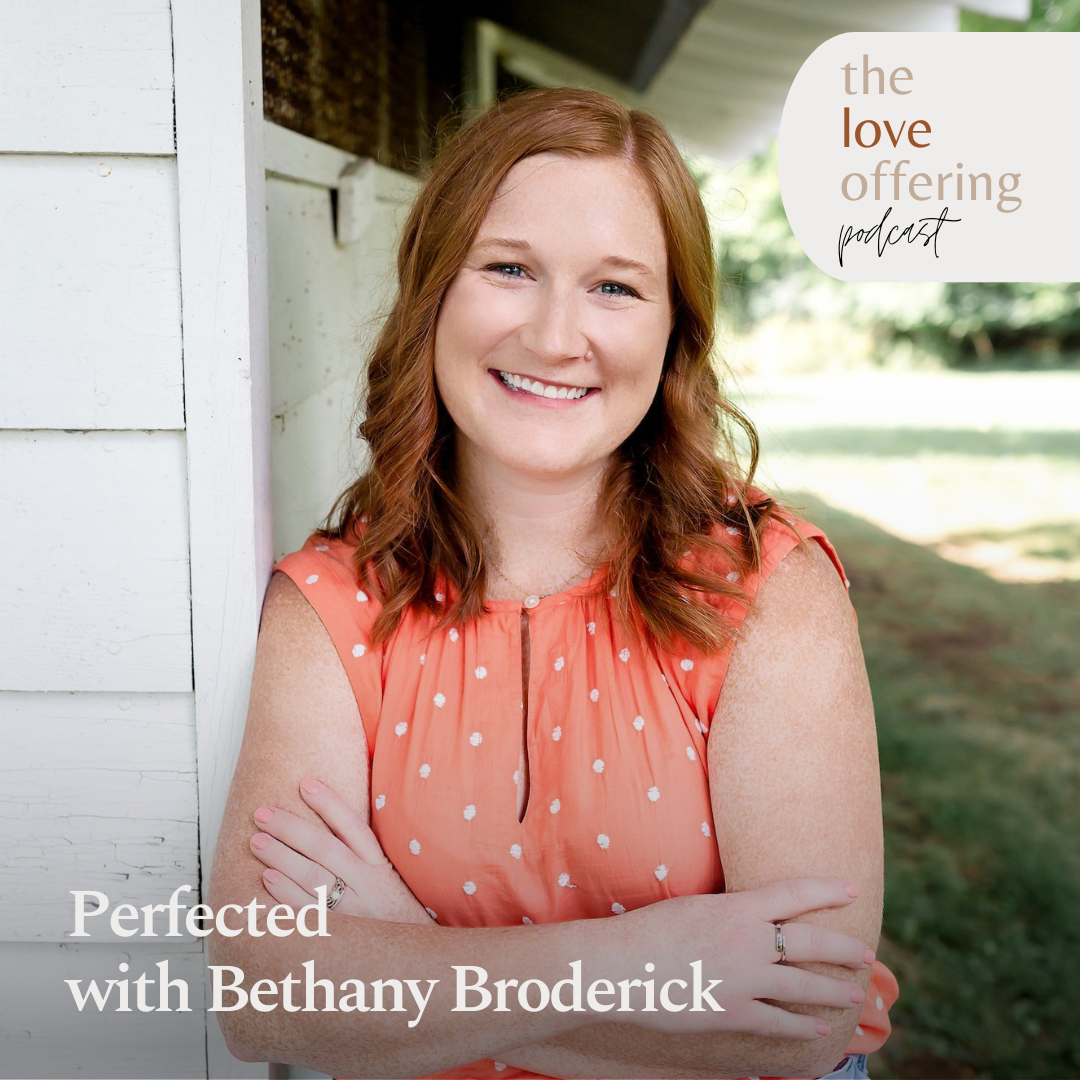
“Am I good enough?” It’s a question so many of us whisper in the quiet moments—when the lights go out, the to-do list is unfinished, and our hearts ache with the weight of not measuring up.
This week on The Love Offering podcast, I’m joined by Bethany Broderick, author of Perfected: Ditching Perfection & Receiving God’s Grace in the Midst of Our Mess. In this beautiful conversation, Bethany vulnerably shares her struggle with perfectionism, insecurity, and the desperate desire to feel “enough”—for others, for herself, and even for God.
We talk about:
- Why the affirmations of culture and even the church sometimes fall short
- The hidden ways perfectionism can shape our faith
- What it means to truly rest in the finished work of Christ
- How we can live in freedom, not fear
If you’ve been caught in the exhausting cycle of striving—this episode is an invitation to let go. You don’t have to be good enough. You don’t have to prove yourself. Christ is enough for you.
🎧 Listen now: The Love Offering – Rachael Adams – Christian Podcast
I pray this conversation gives you permission to stop striving and start resting—in the arms of the One who has already perfected you by His grace.
With you in love and freedom,
Rachael
P.S. Know a fellow perfectionist or weary soul who needs this message? Share the episode with her—you never know how God might use it.
Takeaways
We often struggle with the question, ‘Am I good enough?’.
Perfectionism can lead to feelings of inadequacy and isolation.
God’s grace allows us to let go of striving for approval.
Identifying lies we believe about ourselves is crucial for healing.
We can find our worth in Christ, not in our performance.
Community helps us combat the lies of the enemy.
Parenting with grace involves modeling imperfection to our children.
Our longing for perfection reflects our desire for wholeness in Christ.
God’s love is unconditional and steadfast, regardless of our actions.
We can grow in holiness through the grace of God.
Chapters
00:00 Introduction to Love and Perfection
01:06 Bethany’s Journey with Perfectionism
03:39 The Roots of Insecurity
05:36 Cultural Messages and Their Shortcomings
06:48 Breaking the Cycle of Striving
09:16 Identifying Lies and Finding Truth
11:46 The Role of Community in Healing
12:37 Balancing Grace and Growth
15:10 Social Media and the Pressure to Be Perfect
18:01 Extending Grace to Others
21:28 Parenting with Grace
23:43 Biblical Characters and Their Struggles
26:43 Hope and Longing for Perfection
29:07 God’s Steadfast Love
31:53 Closing Thoughts and Prayer
Transcript (AI Generated)
Rachael Adams (00:01.236)
Welcome to the Love Offering Podcast. I’m your host, Rachel Adams, author of Everyday Prayers for Love, learning to love God, others, and even yourself. Each week, we delve into meaningful conversations about how to live out the greatest commandment: loving God with all our heart, soul, mind, and strength, and loving our neighbors as ourselves. Whether through inspiring stories, practical tips, or biblical truths, I hope to encourage you to love boldly, live faithfully, and reflect God’s love in your everyday life.
Today, I’m thrilled to welcome Bethany Broderick to the show. Bethany is the author of Perfected, a powerful book for anyone who’s ever asked the question, Am I good enough? If you’ve wrestled with perfectionism, insecurity, or the pressure to measure up to others, to yourself, or even to God, this conversation is for you. Bethany gently reminds us that we don’t have to strive for approval because Christ has already made us perfect.
Well, hello, Bethany, and welcome to the Love Offering Podcast. So happy to have you today.
Bethany Broderick (01:04.088)
Hey Rachel, I’m so glad to be here.
Rachael Adams (01:06.604)
So I think you wrote this to me. I’m your avatar. I want you to know that it was specifically me that you were envisioning when you crafted these words, because these are questions that I ask, I think, daily, multiple times a day. So I imagine this is you, too. This is something you’ve always struggled with.
Bethany Broderick (01:26.2)
Yeah, absolutely. And it’s so funny that you mentioned that because like when I started working on the book, I like to put a sheet of paper in front of me, like, who is the woman I’m writing this to? And her name was actually Rachel. It’s so funny. Yes, because the, well, it’s so funny because in every single season of my life, there has been a significant Rachel in my life. And as I started,
Rachael Adams (01:36.407)
No. The Lord put you on, put me on your heart. No kidding.
Bethany Broderick (01:52.47)
What prompted me to write this book wasn’t just that I struggled with it, but the fact that as I started writing more publicly about my struggles with it, I realized I wasn’t alone. For so long, I had thought I was the only one who felt I couldn’t keep it together. I thought I was the only one who felt like I couldn’t live up to God’s standards. And as I started writing publicly about it, I was shocked by how many other women said, me too, I struggle with this. I don’t think God loves me because of all the things that I’ve done.
I think that it’s all up to me to prove myself to God. And from every single season of my life, all these women that I know in person, not just online friends, were saying, Yes, this is a struggle. And I’m like, how has Satan convinced us that we are all alone in this struggle, that we are the only ones who don’t feel like we are good enough? So I wrote this book for all these different women, all these different Rachels that I know who maybe grew up in the church, have a strong faith who want to love God, want to love others, but have fallen for this lie that that love is all up to their own ability, their own willpower, their own knowledge, and that they have to do it themselves. Ultimately, it is God’s love within them that is transforming and empowering them to live for Him.
Rachael Adams (03:08.807)
I can’t wait to continue today’s conversation, but we’re going to take a brief break to hear a word from today’s sponsor. And when we return, we’ll delve into God’s grace and how it reshapes our view of ourselves. Welcome back. I’m talking with Bethany Broderick about her book, Perfected. And in the book, you open with the question, Am I good enough? Something that so many of us, like we just talked about, we are silently asking. So, when did this question begin to shape your own story?
Bethany Broderick (03:41.646)
I mean, it was a question that I was asking even as a little girl. Like I always wanted to get those straight A’s. I always wanted all my friends to like me. I wanted my teachers and parents to approve of me and think I was the good girl who could do everything they asked and do it perfectly. And it was really easy to manage that perfectionism, as you know, as a young girl. But as I got older, it became more and more crippling in the sense of making a lot of decisions out of fear, failure, or pushing people away because I didn’t want them to know who I really was and what I really struggled with. But it really came to a head when I got married. You know, before marriage, there was a way for me to hide those insecurities that I was feeling. But in marriage, he saw them all. And I struggled so much, and there were so many sins I couldn’t seem to overcome, that I was like, how could my husband love me? How could God love me if I cannot overcome these sins, if I cannot be perfect for them? And so it was really in those early days of my marriage where I didn’t feel like I was doing a good enough job as a wife, as a believer, as an employee at my new job. And so, with all these different ways, I just felt like I was failing, and I really hit rock bottom, thinking that I must not be a believer. I’m never, no one’s ever gonna love me as I am, that God really just tenderly pursued me and started to show me who he was and how he loved me.
Rachael Adams (05:18.938)
So, you write about how even our well-meaning cultural and Christian messages failed to reach the root of your struggle, which I have also found. So why do you think these bandaged truths fall short?
Bethany Broderick (05:34.978)
Because the way the world wants to encourage us, and this is what their worldview is, the secular worldview is that to find approval, to find meaning, we have to look deeper into ourselves. So, if you look deeper, if you dig down, then you’ll find that inner goodness, that inner sufficiency, and the satisfaction you’re looking for. But we know from scripture that while God created us in His good image, sin has broken that image in us, that we are marred by our sin, by other sins against us, and that there’s no way that we could ever be good enough in and of ourselves. So, rather than these empty affirmations that point our eyes inward, scripture offers us truth that draws our eyes upward to Christ. So, rather than feeling that we are not good enough, rather than saying, ‘just look deeper and maybe you’ll find it,’ scripture tells us to lift our eyes to Christ, who is the perfector and founder of our faith. And that is where we can find our true satisfaction and sufficiency, when we look to Him and what He has done for us rather than what we can do, who we can be in and of ourselves.
Rachael Adams (06:46.902)
There’s such relief in that. I’m so thankful for that truth. And you talk about that freedom when you stop striving and trust in Christ’s finished work, which is entrusted to you. So what does that practically look like for the woman who is still caught in the cycle of striving?
Bethany Broderick (07:02.466)
Yeah, that’s still me, too. I’m still working on it, even though I’ve written this book; this is not something I’ve 100% mastered. Like every single day, I feel that temptation to strive and do things on my own. And usually, a sign that I am caught in that cycle is anxiety, fear, or shame. And so those emotions are beneficial indicators to me, suggesting that I might not be believing the truth, that I might be telling myself a false story.
Bethany Broderick (07:32.62)
So like I can think of even yesterday, I was running like for something and I was just feeling super anxious about it, like gripping my steering wheel, like running through all these scenarios in my head about where like, and I just kind of stopped myself and I’m like, okay, I’m feeling anxious, which means that something is off inside me. And I’m like, what story am I believing? What lie am I thinking about how my worth is found in being on time? My worth is found in not letting these people down and start identifying those lies that we are believing that we have to be sufficient in ourselves and instead replace those lies with the truth so that Christ is my righteousness and that God’s love is steadfast no matter what we do and that the Holy Spirit is faithful to work in me to make me more like Christ even as I am late again for something. And so it’s choosing to identify those lies and walk in and believe those truths, and then walk in that. Like I have to let go of these expectations, say like, I’m no longer going to define my worth by what I can do, what I can produce, but I’m going to rest in what Christ has done for me and trust that that is enough and that I can, even if people continue to put unrealistic expectations on me, God never does. He knows that everything has been fulfilled in his son.
Rachael Adams (08:55.61)
We’re going to take another brief break to hear a word from our sponsor, and when we return, we’ll talk about how to live free from condemnation. You know, when we started today’s conversation, you were talking about these lies that we’re believing, and I think so much of it is what the enemy wants us to believe. Like if he feels that he causes us to think that there’s no hope and that we don’t have what it takes, and really defeats us and discourages us. Like that’s his goal, right? And so, talk to us a little bit more about the enemy’s tactics and a way to achieve victory in that area.
Bethany Broderick (09:31.756)
Yes, and what’s interesting is that I grew up in a family, church, and community that loved me, loved the Lord, and loved the gospel. They poured a ton of knowledge and Bible information into my life during my early years. And I’m so grateful for that, and that really has shaped me. But unfortunately, Satan even used that Bible knowledge against me as I was growing up, and I knew so much about the law of God in his word and so much about these commands that God has given us, that I thought that was all there was to the Christian walk. So Satan even twists scripture. So he takes a good thing and twists it and says, like, did God really say that, you know, that he doesn’t expect you to do all these things? Like, why would God put these commands in there if he didn’t expect you to be perfect? And so we have to be in the world. But we also, I feel, need to be in community to help identify some of those lies. Because sometimes we are so blind to what Satan is telling us that we need others to help us say, that’s not true. That is not what scripture says. That is not why commands are there. And like really, it was mentors like that. It was dear sisters in Christ like that who helped me start identifying some of those lies. But the hard part is that to get to that point in the community, we have to be honest with one another about what’s going on in our hearts and our heads. And Satan also doesn’t want us to do that. He wants us to keep those lies in the dark. But the more we can bring them to the light, no matter how embarrassing they are, no matter how much we think we might be the only one who believes this, there are no new lies. Satan is using the same tactics today that he did with Eve in the garden. It’s the temptation to look to ourselves, to do things in our own effort and our own knowledge. And so the more that we can bring those lies to the light, through scripture, through prayer, through community, the more we can begin conquering them. Because if they say in the dark, there’s no way we can do anything with them because they’re just going to be festering there. But with this body of Christ around us and the spirit of Christ in us, we can walk in the truth.
Rachael Adams (11:52.532)
I hope I can articulate my next question sufficiently, so please let me know if I’m not. Yes, we need to trust in God’s perfect work on the cross, and there’s freedom in knowing that there’s grace in this whole process. But at the same time, we don’t need to be complacent. Like, where does that make sense? I want to be content with where I am and accept the grace, but I also don’t want to take that it’s okay to grow still and improve. I still want to be sanctified. want to become more like him. So does that make sense? Like, what does that process look like of accepting it’s okay where we are? We are never going to be perfect, but we also shouldn’t be content with just being stuck here and thinking it will never get any better. Does that make sense? What I’m trying to say?
Bethany Broderick (12:44.038)
Absolutely. And I have been in both places, the places of striving really hard and then, you know, well, if I can’t be perfect, I might as well give up and just, you know, wear leggings all the time and eat cookie two-step ice cream every night, which is my favorite ice cream. And no, I don’t know, it’s really good. And I think, again, going back, both of those strategies are self-focused. So, one says that I can be good at it myself, so I’m going to keep striving harder.
Rachael Adams (12:53.953)
Yes, that’s not okay. Okay. I’m just kidding. I’m kidding.
Bethany Broderick (13:12.236)
And the other says, I’m just focused. I’m not good enough, so I shouldn’t try it all. And so, just like I said earlier, the solution to both of those is to look to Christ. And the title for my book came from Hebrews 10:14, where it says, For by a single offering, he has perfected for all time those whom he is sanctifying. So, it’s both: not only did Christ save us by grace, but He’s also sanctifying us by grace. And so, it’s not just that I think for many of us, we believe that Christ’s work of salvation was like this one moment in the past. For me, it was as a little girl. That’s where Jesus’ work of salvation stopped. Like he gave us grace then, and now he handed me this salvation, and I’d better keep hold of it until I reach heaven. But the true gospel is that not only did Christ save us in the past, but He is also currently saving me right now. That every day he’s given me grace upon grace to walk in the righteousness that he has already given me, that I don’t have to earn my salvation, but neither do I have to prove my salvation by how much I work. So we do obey those commands. I said that Satan twisted it into making it all about what I could do for God. Those commands are still there. That is God’s inspired word. But rather than obeying those commands from a place of I’m trying to earn God’s approval, now I can abide by and I can grow in holiness because I know that I’m already his beloved. That there’s nothing I can do to make him love me more or less, because when he looks at me, all he sees is the righteousness of Jesus. And so every single day, I can grow in obedience through the power of the Spirit in me to become more like Christ because he is the one carrying me even in that. It’s not just at one moment. It’s for every single day until we reach eternity, and we will be perfect forever, that we will be completely whole in heaven. And even that will be a gracious gift of salvation when we get to see him.
Rachael Adams (15:16.097)
I’m just wondering, and I hate to use this as a cop-out example. Still, I feel that social media has exacerbated this problem, particularly with platforms like Pinterest, which often feature magazines, images, and editing tools. I think there’s just so much pressure to look a certain way or to have certain things, or then we also know what everybody else is doing. And so I think that, almost like this pressure to be perfect, is even stronger now than ever before. Do you think so?
Bethany Broderick (15:46.144)
Absolutely, I talk about a whole chapter in my book called ‘DIY Religion,’ where we’ve taken this cultural impulse to ‘do it ourselves,’ to do it perfectly, and to do everything. Just as we all have to dress perfectly, we also have to bake bread perfectly, decorate our homes perfectly, and raise our kids. There are all these different things because we see social media influencers doing it all. And so obviously we have to imitate them. We’ve even turned that into something that has impacted how we grow spiritually. We often see Christian women with wonderful ministries, and we assume that we have to be just like them. We have to use their highlighters. We have to buy the correct Bible verse prints. And again, all these things are good. I love a good highlighter. But what are we chasing afterwards? What perfection are we pursuing? Because Paul talks about how he lays aside everything. He is going to run with endurance, and he’s pursuing the prize. What is that final prize, exactly? Is the final prize to be like this social media influencer I see? Because if so, I’m gonna spend my life studying her, watching her wheels, doing everything that she does. But if my prize is Christ and Christlikeness, then I’m going to pursue him. And yes, maybe these Christian influencers, you know, they may help me, they may give me, and they may remind me of the truth.
They may give me another idea to help me grow in a certain specific discipline, but I’m not ultimately trying to be quote-unquote perfect like them. I’m trying to be like Christ. And it’s exciting; this word is perfected, as used in Hebrews 10. think we often think it means like without flaws or there’s no mistakes, but this verse here actually means a wholeness or a completion or a fulfillment. And I really love that idea that Jesus is not just trying to whitewash us all into making these little robots, that He’s trying to make us into the men and women, the whole men and women that He designed us to be. He’s slowly removing this curse of sin from our lives until we are in heaven, and we are going to be fully whole in Him forever. And so I think just like so much of this is about where we set our eyes. We’re not setting our eyes on ourselves. We’re not setting our eyes on the women on social media. We’re setting our eyes on Christ and seeing the satisfaction and sufficiency that only He can give us.
Rachael Adams (18:11.413)
You know, most of our conversation has been focused on viewing ourselves rightly and our perspective on ourselves. But I’m also thinking of this when we apply the same thought concept to our relationships and the other people in our lives, such as not expecting them to be perfect. And I’m thinking of my husband, I’m thinking of my children, like my parents, just even my friends, my pastor and my pastor’s wives. This gives them a little bit of freedom, too, allowing us to extend more grace, forgiveness, and acceptance of where they are, because they are growing as well. So, how has this concept, as you’ve been studying it and living it out in your own life, affected your relationships and the way you treat other people, too?
Bethany Broderick (18:55.84)
Yeah, I think that I really wasn’t able to enter true biblical community until I started living out these truths that God was teaching me, because it’s twofold. I have such high expectations for myself that I struggle to let my true self shine through. And then I have the same high expectations for others. So when they let me down, I am doubly hurt because they are not perfect. And I think that when we have this understanding that, yes, Christ perfected us, forever, for all time, at this one moment in the past, but he is still working in us, we can give each other grace as we both grow together. So, you know, my friend, my dear sister at church, when she, you know, lets me down or she fails, I can come alongside her and be like, I understand. I felt that way, too. And I can pray for her. I can share that burden for her. And I can be there for her in the same way, I can be honest with her about where I am struggling, where I have sins that I can’t seem to shake, when I have doubts that are lingering. And I can be honest with those with her, and she can share that burden. And I think that in our very Western individualistic culture, we believe that we have to do it all by ourselves. As if we’re in a little silo, and it’s all about me, but really, the Christian life is all about this community and togetherness. And Christ didn’t just call us to be only children in the family of God, but He has given us brothers and sisters to help us grow in this. However, we have to be honest with one another and show that grace to one another. You know, as I was also starting to grapple with God’s love for me and his grace, even when I messed up, I started to realize that I was projecting some of that onto my husband, too. And it was, it was a great picture for me that God does not love me. Like I even love my husband sometimes, like when my husband messes up, like I’m quick to anger, but the Lord is slow in his anger. When my husband struggles with something that I may not struggle with, I don’t always have compassion towards him. However, God is always compassionate towards us, even when we struggle. And so sometimes it’s even from my poor behavior that I can kind of see that stark difference of like, how much more does the Lord love us? And I love my husband so dearly, but like how much more steadfast love the Lord’s love is for us.
Rachael Adams (21:18.155)
I’m just thinking about even just raising my children and expecting them even just to be perfect, you know, get perfect grades and have perfect attendance and to, know, like even, don’t know, even with their sports and like all their chores and getting up on time and like not to, to, impress upon them, the struggles that I have in myself, like I want my kids to be really confident in who they are and what their worth is and what their value is. So for those of us who are mothers, how do we parent maybe differently so that we’re not giving them our same struggles that we’re dealing with that we’re talking about today?
Bethany Broderick (21:59.106)
It’s so funny; my oldest is seven, and I can already see some of my struggles in her. That’s so hard to watch. But I feel like I received this advice early in my motherhood, and I can’t remember who gave it to me, but I apologize frequently, confessing my imperfections and sins against my kids to them, even at a young age. I have a seven-year-old, a four-year-old, and a three-year-old. Even to my three-year-old, I will apologize to her when I lose my temper, or I forget something, or I wasn’t paying attention to what she wanted. And I am in a culture that tells us that we have to be perfect, that we can’t let others see our failures. When we are honest and vulnerable with our kids about our failures, we are showing them that it’s okay to make mistakes. But on the other side of that, I get to say, I am so sorry that I messed up.
I need Jesus to forgive me and to help me do it differently next time. And I get to model for them confession, repentance, and also grab their hand and pull them alongside me to Jesus. When you mess up, you can confess, you can admit your failures, and you can run to Jesus. Like mommy and you, we both need Jesus. Mommy’s imperfect, but I will do the best that I can. Ultimately, we both need Jesus. And so I think it takes away that you know, mommy and daddy have it all going together, and we have to be like them, and say, like, we are both like, you know, when my kids come to the Lord, like we are brothers and sisters in Christ. I’m much further along than you, and God has given me authority and responsibility over your life. But ultimately, we are both brothers and sisters in Christ running to Him for that rest and that freedom that He offers us.
Rachael Adams (23:50.838)
You know, we’ve talked a lot about Jesus, the only person who was ever perfect. Was there somebody in the Bible that you really connect with that has struggled with this insecurity and feelings of inadequacy, that they were enough? Is there anybody that you connect with a biblical character?
Bethany Broderick (24:09.782)
You know, I think a lot about Paul, and I actually include a lot of Paul in my book, and I really appreciate him because he seems to have both ways he swings. Like the one in Philippians three, who gives his religious pedigree, is what I call it. As if he had everything religious, he needed to rise to the top and achieve that perfect exterior. And I get it. Like I had a dad who was a minister. I went to a Christian school. Like I was in church nine months before I was born, never missed a VBS. I have a lot of religious pedigree. And I’m thankful for how much of that was invested in me. But like, ultimately, I can count those as a loss for the sake of knowing Christ. And my righteousness does not come from that, but it comes from Christ. But at the same time, Paul also tells Timothy that he was the worst of sinners. Like Paul was so aware of the sin that he struggled with before Christ, when he, you know, persecuted Christians, he killed Christians, but also the thorn in his flesh. We don’t know what that is, but it was potentially like a sin that he couldn’t just seem to shake, or I doubt that he kept having. And he had the humility to say that I am the worst of sinners. But then he also wrote that he said, we are not sufficient in ourselves, but our sufficiency comes from Christ, who has made us sufficient to be a better minister. And I love that, like the Paul who said, I had it all together. And the Paul who says that I am the worst has, ultimately, the foundation of my sufficiency in Christ. When I feel like I’m the best, no, it’s Christ. When I feel like I’m the worst, it’s Christ. And I love that Paul helped me see that both of those pendulum swings are ultimately rooted in pride, but the true humility that comes from resting in Christ and what He has done is where we can walk in that freedom.
Rachael Adams (26:02.175)
I really connect with Paul, too. And then also with Moses, you know, when he’s questioning like, Who am I, and Do I have what it takes? And I can’t go to the Pharaoh and all the things. And honestly, God doesn’t say, Yes, you do, Moses. You can do it. He says, I am, I am, and I’m going to be with you, and I’m going to take care of you. And that’s not exactly, that was the Rachel version, but I hope everybody gets the gist. And so honestly, that’s been lately, my kind of theme verse is like, I am. It doesn’t matter what God is or anything that Rachel can do. It doesn’t matter what I can do. It’s what God can do through us. And thank goodness that he does want to partner with us and utilize us, and that we matter to him and he loves us. But I think just to keep our eyes on him and who he is, rather than like you’ve said that several times, that instead of focusing so much on ourselves, to keep focused on the Lord. Like, where are our eyes, and where is our focus? I think that is so, so helpful. And so I’m thinking, I’m just mindful of the woman right now that is just really battling insecurity and her value and her worth and her significance. And so, what would you hope that she would take away from this conversation?
Bethany Broderick (27:16.846)
I remember being that girl, and I wrote this book for that girl who I was 20 years ago, who just wanted someone to tell her that it’s not all up to her. That God is not up in heaven with a clipboard checking off whether she completed her Bible reading plan, whether she is serving enough in her church, whether she is doing all the right things. That God is a merciful and gracious God. He wants her to run to him with all those burdens and lay them at his feet, and that he is the one who is going to carry her throughout this life as she obeys and grows and messes up and all of the above, and that his love is steadfast and he’s never going to change.
Rachael Adams (27:59.51)
Yeah, I keep thinking, and I don’t know why, but of Eden. Eden was perfect, and then sin entered the world, and then in Revelation, heaven was promised as an eternity. Everything will be made right again. Everything will be complete, whole, and perfect again. Does that evoke any thought in you?
Bethany Broderick (28:15.756)
Yeah, absolutely. And I think as I was writing this book, I was starting to realize that honestly, some of us think that our perfectionism is a bad thing or that it’s like this weakness that we have. Like, our longing for perfection is holy. We long for perfection because we were created for perfection. And so the problem doesn’t come from wanting to be perfect. The problem comes when we look to the wrong places for that perfection, for that wholeness. So, when we look to ourselves or to social media or to these other people to be the perfection that we long for, we will always be let down. But instead, when we look to Christ and we look to what He has done and what He has promised us, that is where that longing for perfection is fulfilled. And so, when I get tired of asking, ‘Why am I struggling with this sin again?’ Why can’t I do this right? Why can’t I get it together? I love that as a reminder to kindle my desire for heaven even more, because that is where the new Eden, the new perfect creation that God has for us, awaits us. We get to be part of that, and that longing will be completely fulfilled there.
Rachael Adams (29:27.915)
Yeah, I’m so thankful for that, that hope. Yeah, he set eternity in our hearts, and that is perfection. So tell us, is there a biblical concept of love that you think applies to this topic? You’ve already done such a good job, and I love your biblical knowledge. So, is there anything else that comes to mind?
Bethany Broderick (29:45.11)
Yeah, I think that one of the biggest misconceptions I had about God when I was really struggling with this was his love for me. I say like I knew a whole lot about the law of God, but not so much about his love. And I thought that his love was conditional on my ability to obey him. Not my salvation. I knew my salvation was secure, but his delight in me and his approval of me were conditional on what I could do. And I began to thoroughly study the concept of steadfast love in the Old Testament. The Hebrew word has said, and it’s a covenant or contractual kind of love. And I’m going to nerd out for just a minute, but like we really see a picture of this in God’s covenant with Abraham. And that in those times when two parties wanted to make a contract with each other, they would take all these animals and split them in half and lay them across from each other. They would walk through these animals saying that what was done to these animals be done to me if I don’t uphold my end of this contract. And so when God makes the promise to Abraham to be his God, to set his love on Abraham and his descendants, God tells Abraham, cut up these animals, lay them down and then God puts Abraham in the sleep and God reveals himself as a smoking pot and a flame and he walks through taking on the responsibility of both parties saying that I will fulfill the contract and I will take the punishment even if you do not uphold your end. Abraham, even if your descendants don’t maintain their end of the bargain, and we know that they don’t, we know that we can’t, for we could never uphold the perfect law that God has shown us in Scripture. And so God did take that punishment. He sent Jesus, and His body was broken to fulfill that covenant, to fulfill the contract that He made with Abraham. And so that just blew my mind, that I always think that God’s love is waiting for me to uphold my end of the bargain. I would love it if you could do these things for me, but God’s love is steadfast and faithful, even when we are not. The security that we can rest in is not in our faithfulness and our steadfastness, but in this steadfast love of God.
Bethany Broderick (32:04.334)
So, on those days when I do everything right, follow my reading plan, and don’t snap at my kids, at the end of the day, God loves me, not because of what I’ve done. And on the days when I don’t spend time with him, I snap at my kids, I do everything wrong. God loves me no matter what I do. And that is such a sweet truth to fall asleep to every night, that God’s love is steadfast, that he is faithful even when we are faithless because of Christ’s Word.
Rachael Adams (32:31.027)
Yes, absolutely. I’m so thankful for that truth, too. So, Bethany, tell us something you’re loving right now.
Bethany Broderick (32:40.45)
Mm. So it is reaching the summer months here in the South, and it’s starting to get toasty and humid, and there is nothing I love more than an iced coffee. And I finally have perfected my own recipe at home. So I don’t have to spend all my money at other coffee shops getting these iced coffees, but I love a shaken iced espresso. It’s like my favorite, most refreshing treat. And I’m already after lunchtime. That’s what I go for, my little Iced espresso, and it’s so yummy.
Rachael Adams (33:11.009)
So what do you add to it? What’s your favorite combination to add to your espresso?
Bethany Broderick (33:14.016)
Yeah, so I’m really basic. So I have an espresso machine. And so I have a little glass cup, and I put a little bit of honey, just enough to coat the bottom, and then put in the espresso ice. And then I really like oat milk. I feel like it’s a little healthier than the milk, but it has a really great flavor that I don’t feel like I need to add any syrups or anything. And so it’s just a yummy, nutty, honey, delicious.
Rachael Adams (33:18.163)
Me too, yeah.
Rachael Adams (33:38.242)
Sweet treat. A friend of mine is a beekeeper, I guess you would call it. So she just gave me her like her honey, and I’m telling you, I don’t know what it is, but it tastes so much better. It is just delicious. You can tell that it’s real. Does that make sense?
Bethany Broderick (34:01.418)
Absolutely, I’m so excited for our local farmers market to start back up so I can start getting some honey. If I can get a flavored honey too, I sometimes use those local places that I love in my coffee. No.
Rachael Adams (34:12.403)
Mmm, yum. I need a little pick-me-up right now. Well, Bethany, I know that I want to stay connected with you. I’m sure listeners are going to want to pick up a copy of this book, so tell us how we can best do that.
Bethany Broderick (34:25.92)
Absolutely. I am primarily on Instagram at Bethany G. Broderick, and you can learn more about my book and sign up for my newsletter at BethanyBroderick.com.
Rachael Adams (34:36.211)
Okay, well, I know I want to do all those things because I needed this encouragement today. So thank you so much. Would you do us the honor of praying for us as we close?
Bethany Broderick (34:44.822)
Absolutely. God, we praise you that your love is steadfast, that it is faithful even when we are imperfect, even when we fail, even when we are stuck in our shame and striving. We praise you that Christ came to offer us freedom from that shame and striving to fulfill what we could never do and to die the death that we deserve. So Father, I pray for every person who is listening to this podcast right now that you would let your word take root in their heart. Let the truth of your word take root so that they may start replacing the lies of Satan with the rock-solid truth from your word. And I pray that they would begin to walk in freedom, that they would freely come before you, assured of their position in Christ, that they would live within biblical community, sharing the burden, sharing one another’s burdens. And Father, I pray that they would desire heaven. They would see that the ultimate fulfillment of their longing for perfection is only found in you and in seeing you face to face. In Jesus’ name, I pray, amen.
Rachael Adams (35:56.293)
Amen. Well, Bethany, you were the perfect guest to talk about this message. So, thank you for being here today. I really appreciate you.
Bethany Broderick (36:06.058)
Thank you so much.
Rachael Adams (36:07.957)
Thank you so much for listening to the Love Offering Podcast. I hope today’s conversation encouraged and inspired you to love God, love others, and even love yourself a little more. If you enjoyed this episode, please share it with a friend and leave a review. helps others find the minute. It helps others find the show and spreads the message of love even further. To connect with me, visit me on my website at rachelkadams.com. While you’re there, be sure to download the Love Offering Calendar, a free resource filled with simple daily ways to love those around you. Don’t forget to pick up a copy of my new book, Everyday Prayers for Love, Learning to Love God, Others and Even Yourself, and Bethany’s book, Perfected. They are available now wherever books are sold, and we pray they are meaningful resources for your faith journey. A special thank you to Life Audio for supporting this podcast and making it possible. To find more great podcasts, visit LifeAudio.com. Thanks again for joining us today. Until next time, let’s make our lives an offering of love.