Have you ever tried your best to show someone you love them… only to feel like it didn’t quite land? You did the thoughtful thing. You said the kind words. You showed up. And yet something still felt missed.
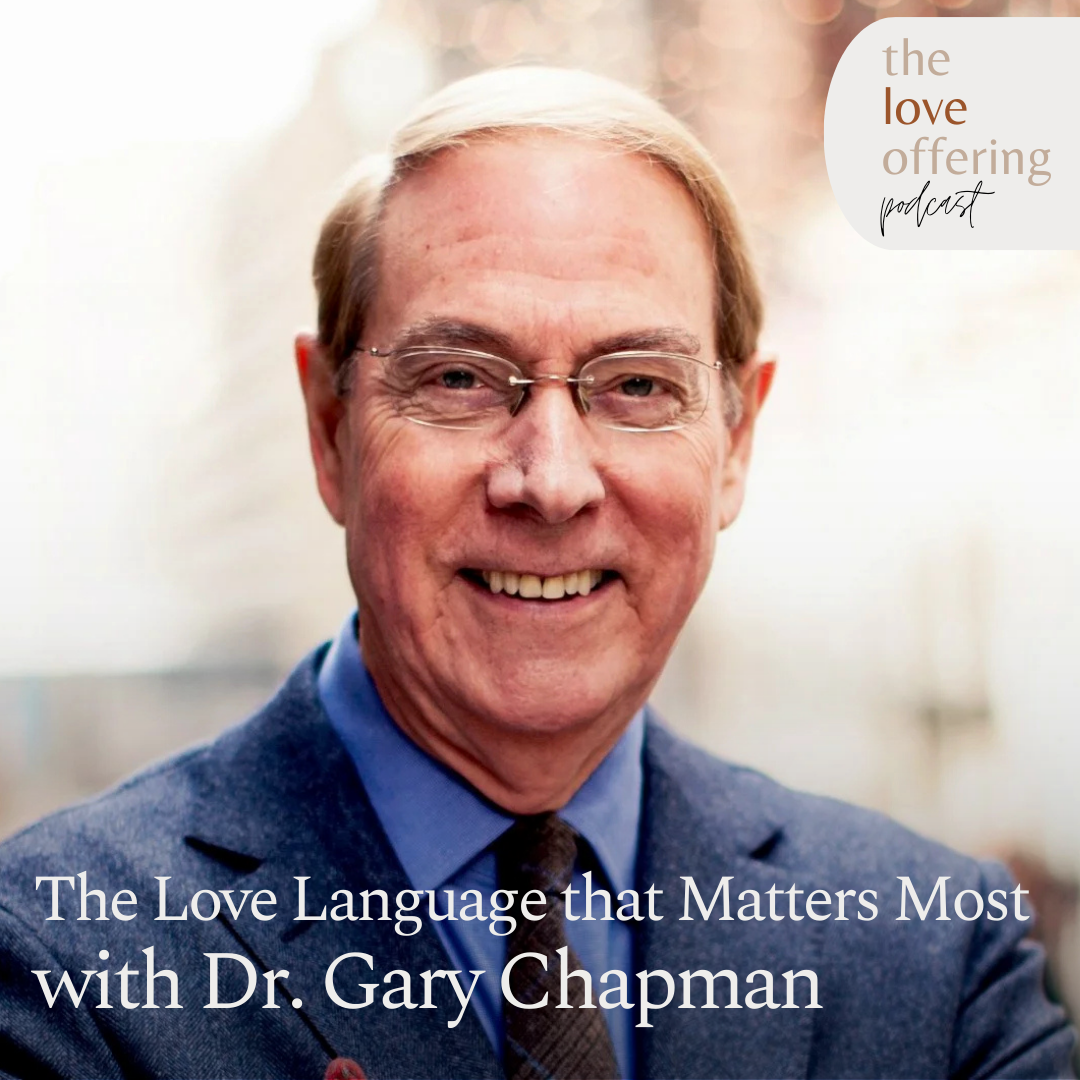
This week on The Love Offering Podcast, I had the joy of sitting down with Dr. Gary Chapman to talk about his newest book, The Love Language That Matters Most. For decades, his message about the five love languages has helped millions of people better understand how to give and receive love. But as he shared in our conversation, discovering someone’s love language is only the beginning.
Each love language has what he calls “dialects”—deeply personal ways love is expressed and received. Miss those nuances, and even the right language can fall flat.
It was such a rich and practical conversation. We talked about:
- Why love often gets lost in translation—even when our intentions are good
- How to personalize love so it truly resonates with the people closest to us
- What this looks like in marriage, parenting, friendships, and even caring for aging parents
- How to pay attention to the subtle clues our loved ones are giving us
One of my favorite reminders from Dr. Chapman was this:
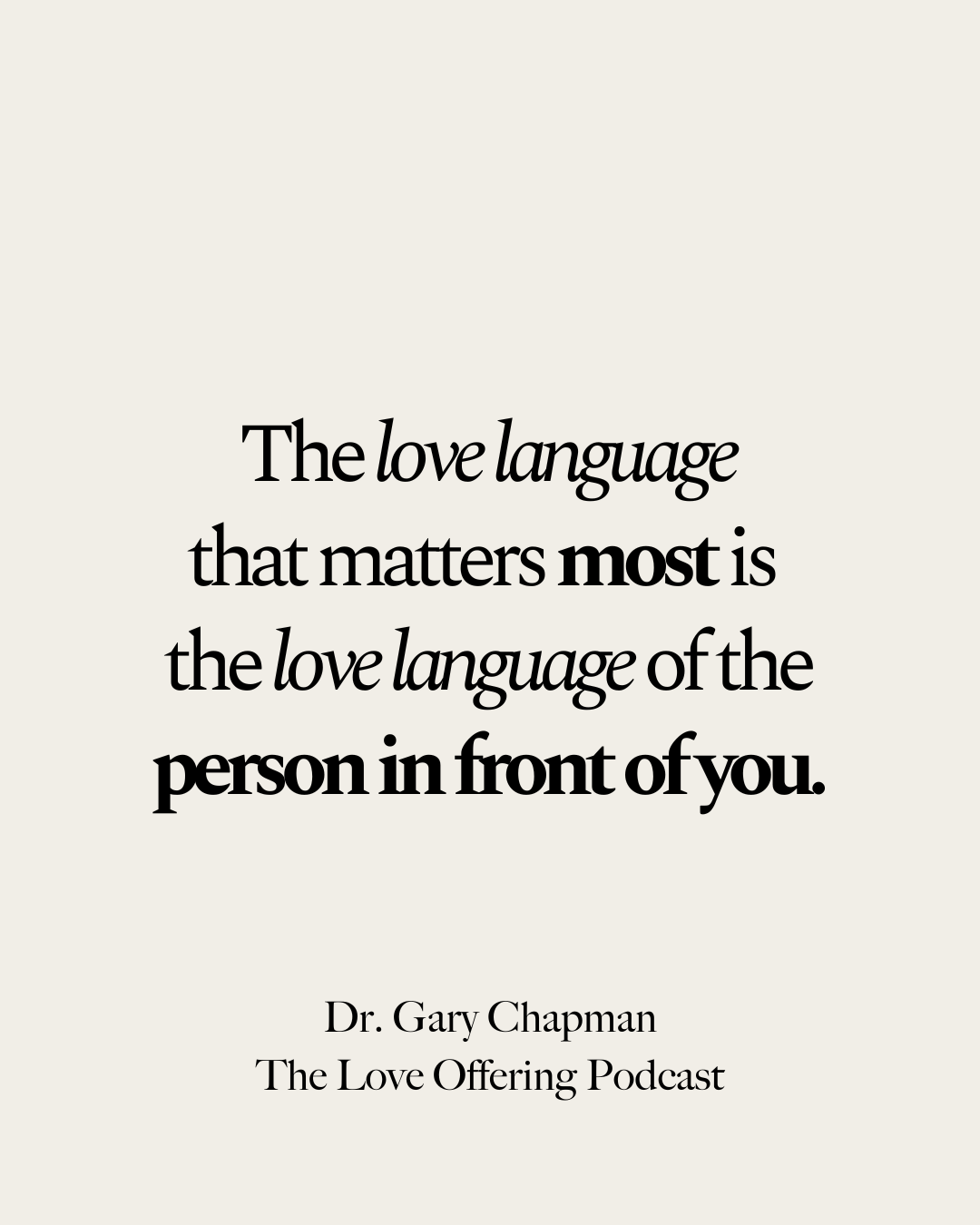
“The love language that matters most is the one your loved one is longing to hear.”
Isn’t that simple—and yet so profound?
As someone who cares deeply about loving well in our everyday lives, I found this conversation to be both grounding and hopeful. Love isn’t complicated, but it does require attentiveness. It asks us to slow down, to listen closely, and to serve the heart in front of us.
If you’ve ever felt misunderstood—or worried that someone you love feels that way—this episode will encourage you.
You can listen to our conversation HERE:
May the Lord give us eyes to see and ears to hear the hearts entrusted to us.
With love,
Rachael
Summary
In this episode of the Love Offering Podcast, host Rachael Adams welcomes Dr. Gary Chapman, renowned author of ‘The Five Love Languages.’ They discuss the transformative power of love languages in relationships, the importance of understanding and adapting to different love languages, and the spiritual aspects of love. Dr. Chapman shares insights from his new book, ‘The Love Language That Matters Most,’ emphasizing that love is an attitude and relationships thrive on progress rather than perfection. The conversation highlights the importance of empathy, selflessness, and open communication in nurturing healthy relationships.
Takeaways
The concept of love languages helps meet emotional needs.
Love languages can change over different life stages.
A full love tank is essential for a healthy relationship.
Love is an attitude that requires action and selflessness.
Relationships are built on progress, not perfection.
Understanding personality types can enhance communication in love languages.
Self-centeredness can hinder relationship growth.
The biblical concept of love emphasizes serving others.
Open communication is key to understanding each other’s needs.
Life’s meaning is found in relationships, not material things.
Chapters
00:00 Introduction to Love and Relationships
01:20 The Five Love Languages: A Transformative Concept
05:08 Exploring the New Book: The Love Language That Matters Most
06:27 Understanding Love Languages and Their Evolution
07:57 The Love Tank: Filling Emotional Needs
09:24 The Role of God in Love and Relationships
11:24 The Power of Selfless Love
13:26 Curiosity and Empathy in Relationships
16:03 Progress Over Perfection in Relationships
18:11 Personality Types and Love Languages
21:15 Navigating Conflicts in Relationships
23:28 The Biblical Concept of Love
24:22 Closing Thoughts and Prayer
Transcript (AI Generated)
Rachael Adams (00:04.32)
Welcome to the love offering podcast. I’m your host, Rachel Adams, author of Everyday Prayers for Love: Learning to Love God, Others, and Even Yourself. Each week, we dive into meaningful conversations about how to live out the greatest commandment, loving God with all of our heart, soul, mind, and strength, and loving our neighbors as ourselves, whether through inspiring stories, practical wisdom, or biblical truth. My hope is to encourage you to love boldly, live faithfully, and reflect God’s love in your everyday life.
Today, I’m honored to welcome Dr. Gary Chapman to the show. Dr. Chapman is an author, speaker, pastor, and counselor who has spent more than 30 years helping people build healthy, lasting relationships. He is best known for the five love languages, a New York Times bestseller for over three decades, with more than 20 million copies sold and translations in over 50 languages. In his newest book, The Love Language That Matters Most, How to Personalize Love So They Really Feel It,
Dr. Chapman, along with doctors Les and Leslie Parrott, invites us to move beyond simply knowing love languages to actually speaking them fluently with grace, intentionality, and compassion. Well, hello Dr. Chapman, and welcome back to the Love Offering Podcast. I’m so happy to have you again.
Gary Chapman (01:19.681)
Thank you. I’m delighted to be back.
Rachael Adams (01:22.606)
The first time we met to discuss the five love languages, I had read your work and used it in my own marriage for the past 20 years, and in my relationship with my children, who are now 16 and 14. I bring it up in conversation frequently, even now with my children, who have significant others. I’m trying to have these conversations. Okay. You need to determine your girlfriend’s love language. I want you to know how impactful this is on a daily basis for me, my family, and my community friendships. I’m grateful for you and the work you do.
Gary Chapman (02:02.731)
Thank you. I’m glad to hear your experience with the five love languages. I’m very encouraged by the response we’ve received worldwide to this simple concept, as it significantly addresses the emotional need for love.
Rachael Adams (02:21.004)
Yeah. Well, so start to tell us, guess, the original, the background story of this, because you’re all, you’re married and a father and all of the things. So, but I’d love to know the first inspiration, the first thought, did you realize at that time that God had imparted something so special and significant to you?
Gary Chapman (02:41.399)
I knew, when I wrote the book, that the concept would help people because I had discovered it in my counseling and had been using it for several years before I wrote it. Because couples will be in my office, one of them might say, “I just am not feeling loved.” I mean, you know, we don’t argue necessarily. I feel empty. And the other person would say, well, I don’t understand that You know, I do this and this and this and this and this. Why would you not feel loved? I realized there were sincere people. They were loving one, one, the other person in their mind; they were expressing love, but it wasn’t registering emotionally with the other person. And so after hearing several of those, I just, I thought, man, there’s gotta be an answer to this. And I read through a lot of notes that I had made when I was counseling couples, and asked myself when someone said, I just don’t feel love. What did they want? What were they complaining about? And their answers fell into five categories. And I later called them the five love languages and started using them. My counseling, if you want her to feel love, you’ve got to learn to express it in her language. If you want him to feel love, you’ve got to learn to express love in his language. I then began teaching it at our church, and it was very successful. Couples would come back and say, you know, Gary, this is changing everything. I mean, the whole climate is different now. And so it was at least five years before I had the thought of putting it into a book and writing in the language of the common person, you know, leaving out terms, psychological terms that many people wouldn’t understand. I knew it would help people, but I had no idea it would sell 20 million copies and be translated into 50 languages worldwide. It really surprised me that it went to other cultures. But at any rate, it’s a God thing. People ask me how I explain that? And I say, well, the short answer is God and the long answer is God. I couldn’t make that happen if I wanted to. But I think it addresses what everybody agrees is one of our deepest emotional needs. And that is the need to feel loved by the people who matter most in our lives. It’s been very encouraging to see how God has used it to help so many couples.
Rachael Adams (05:05.292)
Yes. Yeah. And to the point of it’s all over the world. Love is a universal love language, right? It is something we all want and need, and something God has put in our hearts from the very beginning. I look forward to continuing this conversation, but we’ll take a brief break to hear from today’s sponsor. And when we come back, we’ll talk more about Dr. Chapman’s newest book, how the love language that matters most.
Rachael Adams (05:36.306)
Welcome back. I’m talking with talking with dr. J Welcome back. I’m speaking with Dr. Gary Chapman about the language of love that matters most, and since this is your newest book, I’m interested to see how it differs for someone who already has a copy of the five love languages. Why are they gonna want this one, too?
Gary Chapman (05:56.42)
As I mentioned, if they’ve already read the original, they’ll love this book because I’m addressing issues people have asked me about over the years from the other book. I mentioned the concept of dialects in another book. There are different dialects of the languages, but I don’t address them. But in the new book, we discuss specific dialects within each of these languages.
We’re also discussing another point people have often raised with me. They say, Gary, how does your personality relate to the love languages? And over the years, I’ve said, “Well, it does relate.” I can’t give you specific answers. But in this book, we’re giving you answers to that and helping you recognize how your personality interfaces with that. Those are two key topics addressed in this new book, and we all face other issues as well. But it’s written for the person who’s already read the first book. If you haven’t read it, read it first, then read this one, because it helps you pinpoint how to communicate love effectively to the other person.
Rachael Adams (07:10.126)
You also have an assessment, and I had the opportunity to take it. And so my love languages now are words of affirmation, which was my highest, and then acts of service, which was a close second. But I mentioned this to you before we hit record. My love language 20 years ago, when I first got married, was quality time, but that was before children and in many other transitions. Do you find that your love language changes? Perhaps that’s something that maybe we should all be aware of?
Gary Chapman (07:50.478)
Yeah, I think there is a sense in which, for some people, it tends to stay with us throughout a lifetime. But I do think there are seasons of life in which another love language may become more important. For example, a mother with two preschool-aged children may not use the term “acts of service” in her language, but during those years, it will rise to the top. And so, yes, I think there are seasons of life, and I think there are circumstances.
Gary Chapman (08:17.187)
For example, your spouse hangs up the phone and starts crying, and you say, “Honey, what’s wrong?” And they say, I just received mother a word that my mother died. And they just, they’re weeping. Physical touch may not be their language, but in that circumstance, you embrace them. Probably the most powerful thing you could do at that moment. Yes, I think there are seasons and circumstances when the primary love language may change.
Rachael Adams (08:44.962)
Talk to us about our love tank. Can you explain this concept? It’s difficult to give love when you feel empty or void of love.
Gary Chapman (08:55.991)
Yeah. I use a car’s gasoline tank as a metaphor. If it’s full, you can drive a long way. If it’s near empty, you’d better stop at the gas station. So, it’s a simple concept: you have a love tank. And if your love tank is full, that is, you genuinely feel loved by your spouse. Life is beautiful. If the love tank is empty and you feel like they don’t love you.
Life can begin to look pretty dark, and much of the misbehavior in a marriage grows out of an empty love tank. We don’t feel loved, and therefore, you know, we either criticize the other person and make it even worse or even worse than that. get attracted to somebody else who’s treating us very kindly. That’s why I suggest a couple every two or three weeks. You just say to your spouse.
Honey, on a scale of zero to 10, how full is your love tank this week? And if they say anything less than 10, you say, okay, what could I do this week? would be most meaningful in expressing my love to you. And what they say may not be their primary love language that particular week. There may be circumstances they’re going through that make something else more important, but this is just a way to check in and make sure we keep the love tank full.
Rachael Adams (10:21.494)
Yeah, talk to us about the role that God has in this scenario, because God is love, and love is one of the fruits of the Spirit. Please discuss the spiritual aspect of this process.
Gary Chapman (10:38.733)
Well, I think it’s extremely important. In fact, my wife and I struggled greatly in the early years of our marriage. And I finally said to God, I don’t know what else to do. I was pretty desperate. We were both Christians, and we were in love before we got married. But I came down pretty soon after the marriage from that in-love experience. When I said to God, “I don’t know what else to do,” an image of Jesus on his knees washing his disciples’ feet came to mind. And I just heard God say, that’s the problem in your marriage. You do not have a Christlike attitude toward your wife. It hit me like a ton of bricks because I remember what Jesus said when he stood up after he washed their feet. And remember, this was just a few days before he was crucified. And he said, you call me teacher and Lord, and you are right. But in my kingdom, the leader serves. Now I want you to serve others the way I’ve served you. I want you to love others the way I’ve loved you.” And I wept and said, “God forgive me.” Because I was in seminary two weeks after we got married, I was enrolled in seminary, studying to be a pastor. And I was miserable in my marriage. I said, “Please give me the attitude of Christ.” In retrospect, it’s the greatest prayer I’ve ever prayed for my marriage, because God gave me a heart to serve her and to love her. I didn’t know anything about love languages at the time, but I started asking her questions. Three questions stand out. The first question was: “Honey, what can I do to help you?” Second question: What can I do to make your life easier? And the third question, what can I do to be a better husband? And I was willing to ask those questions. She was willing to give me answers.
I started doing those things, and it didn’t turn around overnight, but within three months, she began asking me those three questions. What can I do to help you? How can I make your life easier? How can I be a better wife? We’ve been walking this road a long time now, and I have an incredible wife. I’ve said to her many times, you know, honey, if every woman in the world were like you, there’d never be a divorce. And my goal in life has been to serve her so well that when I’m gone, she will never find another man to treat her the way I’ve treated her. She’s going to miss me. But yes.
Rachael Adams (13:09.054)
Hahaha! Do you all ever do interviews together? I’d love to hear her side of the whole story, too. But I believe you.
Gary Chapman (13:18.019)
We typically don’t. We want to know one here and there. And, uh, uh, right now she’s going through some physical problems and doesn’t have a whole lot of energy, uh, cause we’re getting on up in age, but we’ve been married now 64 years. So, you know, so she’s going through some things, but one of the things she says is, you know, honey, have to remember we are where we are. Okay. Whatever’s happening in your life, we are where we are. So let’s ask God to guide us through this stage of life as well.
Rachael Adams (13:48.599)
Yeah. Well, what a beautiful testimony and what a beautiful challenge for all of us who are married. I’ve been married for 20 years now, and you’re right: every season and circumstance changes, but the selfless, sacrificial attitude that God gives us through agape love is essential. When you ask those questions, it’s important to listen, be empathetic, and put their needs before your own. That’s difficult because we’re often sinful, fallen human beings who are selfish, honestly. And so, really, laying down our cross daily to serve the Lord and to serve our spouse. And again, going back to listening, being fully present, and seeing the person in front of us. So talk to us about that, especially when things are so busy, and relationships are strained. How can we approach our spouse or a loved one with more curiosity to help meet their needs?
Gary Chapman (14:48.855)
Yeah. We are, by nature, self-centered, and there is a positive side to that: we take care of ourselves. We eat, we sleep, we get exercise, and we try to take care of ourselves. But when it leads us to selfishness, which means we’re approaching all of life in terms of what can I get out of this? And we approach marriage that way. Yeah. I’m in this marriage for you to make me happy.
This is the common culture we share. And this is why you hear many people at the end of the day, when they come to the place of divorce, there’s, there’s, saying or thinking I’m out of here because you’re not making me happy. It’s selfishness. Love is not about me. Love is about you. And that’s why this book, you know, the title is the love language that matters most is the love language of the person in front of you, your spouse, your partner, you know, your friend.
What we’re saying is that it’s this attitude of love. It’s the attitude of love. This is where it starts for the Christian. It doesn’t start with a feeling. You know, the in-love experience starts with a feeling. And that’s fine. I’m not, I’m not anti-falling in love. I’m just saying that’s not the foundation for marriage. The biblical concept is that love is an attitude. Remember, in Philippians 2, it says, “Let this attitude be in you, which was also in Christ Jesus, who, though he was God.”
He didn’t demand his rights as God, but he emptied himself and became a man. And once he got on level ground, he stepped down even further to death on a cross. Let this attitude be in you. For a Christian, love starts with attitude, and then we find ways to express it. And that’s what this book will help you do, also. Even if you know the primary love language of your spouse, you learn the dialect of that spouse. That will speak even more deeply to that person. I’m excited about this book and what it will do to help people build on the foundation of the five love languages.
Rachael Adams (16:57.302)
Yeah. Well, we’re going to take another brief break to hear a word from today’s sponsor. When we come back, we’ll discuss how relationships are built on progress, not perfection.
Rachael Adams (17:10.774)
Welcome back. I’m talking with Dr. Gary Chapman about the love languages that matter most and in your new book, it emphasizes that relationships aren’t built on progress, relationships are built on progress, not perfection on grace and not guilt. So talk to us about it. We’re not going to do this perfectly, but we can. God’s mercies are new every morning. It’s more about effort: if we’re feeling we’re falling short in this area, how would you encourage listeners to keep trying?
Gary Chapman (17:46.02)
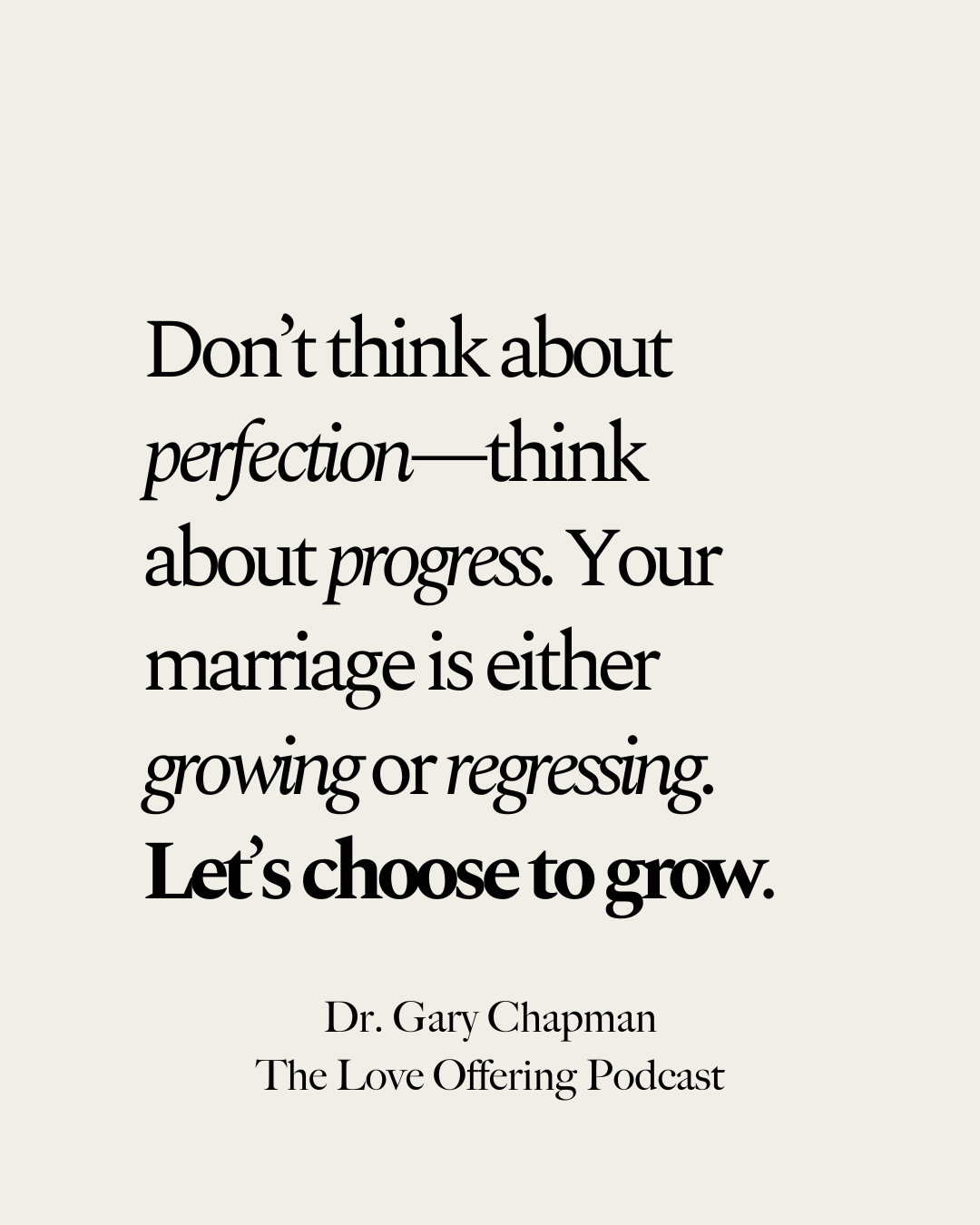
Well, none of us is ever going to be perfect because we’re sinful creatures and we have a sinful nature. But the concept is that we’re either growing or regressing. We’re not standing still. Our marriage is getting worse, or it’s getting better. It’s not simply standing steady. No, no, no. And what we’re saying in the book is: let’s focus on growth.
Let’s make progress. Don’t think about perfection. Think about progress. Is your marriage improving or getting worse? And if you feel like you’re a failure, ask God, “Where am I failing?” And he will bring it to your mind. And then you confess those things to God. Then you go to your spouse and say, “I’ve been thinking about us.” In fact, I asked God to show me where I have been failing in our marriage. He gave me some things I wrote down, and I’ve asked God to forgive me. With your permission, I’d like to share these with you and ask for your forgiveness. Whoa, I bet your spouse would listen. And now you’ve apologized for those things. And then you say, you know, I really am now, I’m asking God to show me how to love you in a more perfect, better way. And you know, this concept of the love language is, I think, it’s going to help me because I’d like for you to either read the book or take the quiz or whatever, you know, if you haven’t done it already. And I want to learn to love you. I want to learn to really love you. You just had a tremendous positive influence on your spouse by doing that. And I can’t guarantee they just automatically turned around. No, it may take some time to learn their language and to speak it over time. But there’s a good chance that somewhere along the line, they’re going to begin to reciprocate and say, hey, I need to be doing a better job over here. When you get it going that way, and both of you have an attitude of Christ and serving each other, you’re going to have a good marriage.
Rachael Adams (20:05.932)
You’ve mentioned dialect and personality several times. I’d appreciate it if you could elaborate on that. If somebody is maybe introverted or extroverted, or if somebody, what would be some of the other personality types that would be important, that would be a distinction that would change the love languages?
Gary Chapman (20:25.411)
One would be a person who’s very cautious about things and knows everything. very thoroughly cautious. The other is very curious and tends to jump into things to find out what it’s like. Some people are carefree. They’re just, you know, just real flippant, and others are very, very dependable and organized and so forth. But I just gave you an example of introversion and extroversion.
Let’s say your spouse’s language is words of affirmation. Well, if they are an introvert and you get this feeling, I’m going to really surprise them. I’m going to give them a birthday party, and in that part of the party, I’m going to tell them how wonderful they are and tell everyone how wonderful they are. So you’re going to surprise them instead of taking them out to dinner. You’re going to stop by a house that has 30 people in it, their friends.
And they’re going to be okay. They know they are in their mind, they know you’re doing something nice, but in their heart, they’re thinking, honey, why couldn’t we just have gone out to dinner together? Just the two of us. I don’t like you talking about me in front of others, but if they’re an extrovert, they would love it. They’d love that. You know, so knowing their personality is going to help you decide, you know, how, when, and where to express their love language. So personality has a really tremendous impact. Here’s a husband who’s really free flowing, and he knows his wife’s language is quality time. On Friday night, he says to her, “Honey, how about tomorrow?” We leave early to hike up Pilot Mountain and spend the morning together. And she said, “Honey, I’ve got Saturday already planned.” Honey, you can push that off to next Saturday. Come on, come on. And she doesn’t want to do that, even though that’s her language. See, she is the kind of person plan it ahead. That’s why a date night for her would be wonderful: now she knows that every Thursday or Friday night we’ll go out. And she’s planned, and it’s in the plan. But you know, he’s real free flowing. So he now feels rejected because she doesn’t want to go with him. And then she feels like he’s just steamrolling her, you know, depressing her to do something that she didn’t feel comfortable doing. So personality is important in that context, and that’s one of the things this book and the premium quiz you mentioned will help couples identify, given their personality and dialects.
Rachael Adams (23:19.298)
You know, in the example that you give, it really is difficult if you have in a married relationship, both of those kinds of personalities, you know, whose wins out, okay, on this Saturday, I want to do this. On Saturday, the husband wants to do this. And so you’re, but you’re both trying to lay down your cross and be sacrificial. How do you resolve the conflict in that? I need the counselor’s advice here.
Gary Chapman (23:42.52)
Yeah. Well, there will almost always be conflicts and personality differences. And I think what we have to recognize them and verbalize them, you know, and if you understand your spouse’s personality, then we’re going to have to adapt to each other and not force them to do something we would do, you know, the way we would do it. It’s just, it’s simply recognizing our humanity that we are different, and this is one of the differences. We’ll work together. You say, “Honey, I know you are always busy, and I just had a thought that maybe we could take a hike in the morning, but I know that may not work for you because you may have everything planned and all.” And I understand. So it’s being understanding rather than him feeling hurt and rejected. He’s expressing understanding about her personality, and he’s acknowledging, I know this may, it just came to me. I just thought it would be super, but it may not work. I understand that if we adopt a spirit of love, we’ll find ways to affirm their personality rather than try to force them to do something they don’t feel comfortable with. It takes effort.
Rachael Adams (24:57.262)
Or not try to change them to be more like you. You know, that’s the temptation I felt in a lot of relationships, too. Want to change them just to be exactly like you and your personality and speak your love language, right?
Gary Chapman (25:02.475)
Yeah, absolutely. And that’s not going to happen. You’re not going to change their personality. So it’s about recognizing that God has made us different. In fact, he’s made every single person different. Seldom do two Marys share the same personality, and they are learning to adjust to those differences. You know, and learning how to work, work with all of that is so important. It’s such an important thing, but we have to have the attitude. The attitude will change everything.
Rachael Adams (25:42.327)
Yeah, yeah. And back to you, it’s a choice. Love is a choice, and it’s an action and not always a feeling. And you’re right. God has created us all intentionally, and what a boring world it would be if we all had the exact same love language, personality, and other traits. I love this resource and everything you’ve shared, and we’ve talked about love throughout the episode. I’m wondering: is there a biblical concept of love that you think applies to this topic? I know we’ve already discussed this, but is there anything else that comes to mind?
Gary Chapman (26:14.625)
I think there’s nothing more important. You quoted the verse earlier in the program: “Love God with your whole heart, soul, mind, and strength, and love your neighbor as yourself.” Mean, that’s the Christian lifestyle, whether it’s marriage or any relationship. If we have the attitude of Christ, it means we live with the attitude: Father, today I want to enrich the lives of everyone I encounter. So give me wisdom and show me how to enrich the lives of the people that I encounter today at work or anywhere else. And we certainly have that attitude in the family. So yeah, I think that’s the lifestyle of a Christian.
Rachael Adams (26:59.566)
Yeah, absolutely. Well, tell us something you are loving right now. There are no rules for this question; it can be spiritual or not. Anything that comes to mind.
Gary Chapman (27:08.867)
I’m not happy with things. I learned a long time ago what the Bible says is true. Life’s meaning is not found in things. It’s found in relationships. As I mentioned earlier, I love my wife, whom I’ve been married to for 64 years. And now that she’s gone through some physical problems, I’m loving her even more and thanking God for all that she is still able to do and still does. She still cooks every night, but our date night, even though she’s often in pain. On a human level, she’d be the first person I would say I love right now. I love my children and my grandchildren as well, but the marital relationship is the most intimate relationship, I think, that any of us will ever have.
Rachael Adams (28:01.77)
Well, I love that answer, and I know I want to stay connected with you. I’m sure listeners will want to set aside time to take the assessment from both books if they haven’t read the first. So tell us how we can best stay in contact with you.
Gary Chapman (28:14.893)
They can visit 5lovelanguages.com to see all my books. They can order the books there. They can order them on Amazon. Yes, but on the website, you can take the premium quiz you mentioned.
Rachael Adams (28:33.326)
I would recommend doing that. It was insightful for me to do it again. I’d already taken the original quiz, I guess years ago, but this was new and had the new personality elements in it, and gave a really beautiful report at the end, and had some really nice videos with you and Dr. Less, and Leslie. It was very well done and insightful. So I would encourage everyone to do that. I’ll include the link for that in the show notes. But Dr. Chapman, would you just do us the honor of praying for us as we close?
Gary Chapman (29:03.213)
Sure. Father, you know what we’re talking about today. You know the people who are listening. And I pray that your spirit will touch the spirit of all those who are listening. And whatever you want to do through what we’ve talked about, you’ll put in their hearts. A next step toward the kind of marriage you want us all to have. Loving, supportive, caring relationship. I know that’s your desire. So help all of us take a step in the right direction. In the name of Christ. Amen.
Rachael Adams (29:39.806)
Amen. Thank you, Dr. Chapman. I appreciate you joining us today. You’re the perfect guest for the love offering. It ties in perfectly to the vision and mission of this podcast, and I just appreciate your wisdom and your life’s work, not just your professional life’s work, but your personal life work. I think that is just equally inspiring.
Gary Chapman (29:56.771)
Yeah, well, thank you. It’s always a delight to be with you.
Rachael Adams (30:02.178)
Thank you so much for listening to the Love Offering podcast. I hope today’s conversation encouraged you to love God, love others, and even love yourself with greater grace and intention. If you enjoyed this episode, please share it with a friend and leave a review. It helps others find the show and spreads the message of love even further. To connect with me, visit me on my website at rachelkadams.com, where you can download the Love Offering Calendar. A free resource filled with simple daily ways to love those around you. Be sure to pick up a copy of my book, Everyday Prayers for Love, as well as Dr. Gary Chapman’s new book, The Love Language That Matters Most. A special thank you to Life Audio for supporting this podcast and making it possible. To find more great podcasts, visit lifeaudio.com. Thanks again for joining us today. Until next time, let’s make our lives an offering of love.