Have you ever caught yourself dreading a birthday… or worrying about a new wrinkle or gray hair?
In our culture, aging is often something we fear, hide, or try to fix. We separate generations, invest heavily in staying young, and quietly send the message—to ourselves and others—that growing older means growing less valuable.
But what if we’ve been seeing it all wrong?
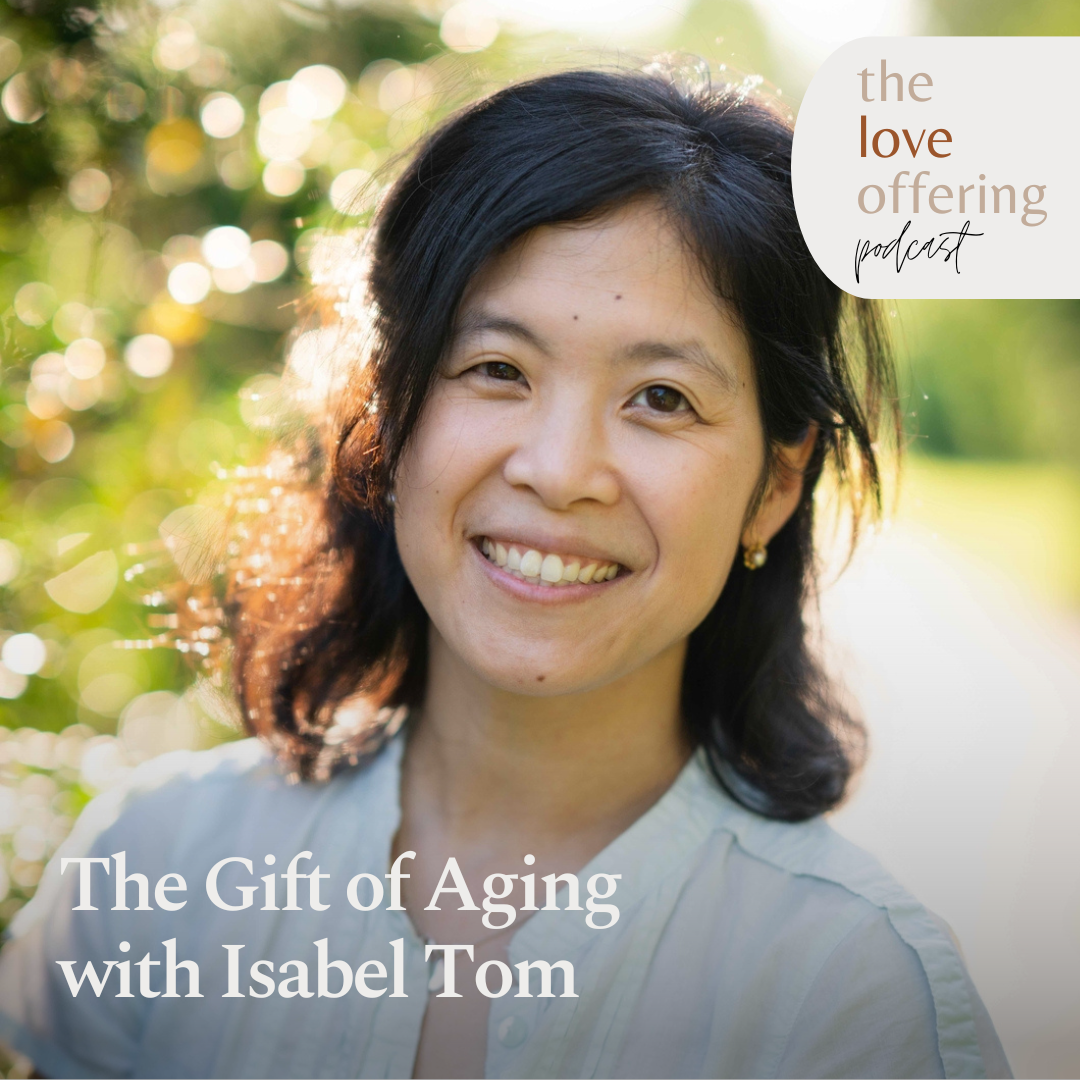
On this week’s episode of The Love Offering Podcast, I’m joined by Isabel Tom for a conversation that gently challenges our assumptions and tenderly reframes how we see aging. Our conversation is inspired by her book, The Value of Wrinkles, and it’s one I believe we all need—no matter our age.
Isabel grew up living with her grandparents and has spent over a decade serving older adults. Her perspective is both refreshing and deeply convicting. Together, we talk about:
- What the elderly offer us that we truly cannot live without
• How cultural beliefs about aging shape the way we treat ourselves and others
• Why loving older generations can profoundly change our lives
• Practical, meaningful ways to care for and honor those who came before us
This episode isn’t about fearing the future—it’s about honoring faithfulness, wisdom, and the beauty of a life well-lived. It’s about remembering that every season matters and that love doesn’t diminish with age—it deepens.
I hope this conversation encourages you to see aging (your own and others’) with more grace, gratitude, and hope.
You can listen to the episode now wherever you get your podcasts.
With love,
Rachael
Takeaways
- Honoring the elderly enriches our lives.
- Intergenerational relationships offer unique perspectives.
- Aging is a privilege, not a burden.
- Simple gestures can deeply impact older adults.
- The elderly value relationships over material things.
- Bridging generational gaps requires intentionality.
- Older adults have much wisdom to share.
- Caring for elders is pleasing to God.
- The beauty of aging is in the wisdom gained.
- Connecting with elders can be a form of worship.
Transcript (AI Generated)
Rachael Adams (00:01.026)
Welcome to the Love Offering Podcast. I’m your host, Rachel Adams, author of Everyday Prayers for Love: Learning to Love God, Others, and Even Yourself. Each week, we dive into meaningful conversations about how to live out the greatest commandment, loving God with all of our heart, soul, mind, and strength, and loving our neighbors as ourselves. Whether through inspiring stories, practical tips, or biblical truths, I hope to encourage you to love boldly, live faithfully, and reflect God’s love in your everyday life.
My guest today is Isabel Tom. Isabel grew up living with her grandparents and has spent over a decade of her career serving older adults. In her book The Value of Wrinkles, she challenges our cultural beliefs about aging and argues that honoring and caring for those older than us is one of our greatest privileges. So, Isabel, welcome to the Love Offering Podcast. I’m so happy to have you.
Isabel Tom (00:56.418)
Hi Rachel, it’s great to be here.
Rachael Adams (00:58.99)
Your book, The Value of Wrinkles, challenges many of the negative cultural beliefs about aging. Tell us what inspired you to write this book, and why you think that this message is so needed today.
Isabel Tom (01:11.794)
Well, I mean, it kind of started when I was born. I grew up in a multi-generational household. So I grew up living in a house with my parents, my two older sisters, and my grandparents. I lived in the same household as my grandparents until I got married at 26 and moved out. And I think all those years that I lived with my grandparents, I can’t say that I really appreciated living with them, just their presence and the blessing that they were to me.
Isabel Tom (01:40.642)
When I graduated from college, I started working in the senior care and senior living sectors across all levels of care. Also ended up working in hospice care, and my work as I was learning at work, all the things that I was learning about older adults, I started to connect that and look back at my own loved ones at home. I just realized that God had placed me in a wonderful, really wonderful environment growing up and professionally. And he just blessed me with people around me who, to me, actually reflected what God is like and how he delights in us and just loves us and adores us.
Rachael Adams (02:22.766)
I’m excited to continue this conversation, but we’ll take a brief break to hear from today’s sponsor. And when we come back, we’re going to talk about what the elderly offer us that we cannot live without.
Rachael Adams (02:37.792)
Welcome back. We are talking with Isabel Tom about the value of wrinkles. So, Isabelle, in our society, we often separate generations. Seniors live in their own communities, and young people rarely interact with them. And we tend to glorify youth. So, how has this impacted our culture, families, and personal relationships?
Isabel Tom (02:59.142)
Well, I think when you separate the generations, well, one, when you are with people your own age, it’s easier to connect because you have things in common. But when you are separated, you often don’t have the perspective of other generations. So if you skip a generation to like my grandparents’ generation and older adults, what I find, and this is in the church and also outside of the church. When I am around older adults, and when you have a relationship with a good number of older people, you start to see life differently. You know, they talk about different things. I think it helps you gain a long-term perspective. I didn’t realize this as a kid, but I would see my grandparents and watch them. watched them. lived, uh, they were 68 and 71 when I was born. And by the time they passed, they were 98 and 102. I watched them, but I didn’t intentionally try to learn from them; I realized I was watching them as they were nearing the end of life and in decline. And when you see somebody who is, let’s say, struggling, let’s say walking is no longer easy, that’s something that you may not see among your peers. Maybe in high school, none of my peers, yes, they broke a leg or something, had an injury, and maybe couldn’t play sports, but this was something that was completely different. And so it gave me, I think it has given me a greater appreciation for what I have, my good health, everything from, you know, I’m in a Bible study with older woman, and they talk about their kidney stones and their back and the surgeries they have to have. And it really helps me, I think, appreciate where God has placed me now. It helps me to be content with what I have and just gives me a long-term perspective. So I think that’s just one of the things in terms of when you have this intergenerational environment, the benefit of it.
Rachael Adams (04:52.066)
Yeah, actually, yesterday I was leaving church and we have a Thursday morning Bible study and there is an organization that meets right after us and it’s called the Young at Heart and it is some elderly men and women that were coming and they were all bringing in a dish and they were also happy but then there was a van that unloaded full of nursing home residents and they were all coming out with their their walkers and just even getting out of the car was difficult walking down the sidewalk was difficult. They had to have an aid, and it was such a perspective shift for me: I realized there’s such value in them, and I just thought, I don’t want to walk faster than them. You know, as I’m walking down the sidewalk, like, would that be disrespectful, and you know, wanting to open the door for them, but then I even thought, did they want to do it themselves? And, you know, like it just it was a it was interesting how just seeing them and witnessing the way they were, even what they were doing and how they were walking into the room, but they were also happy. They were taking their time, not in a hurry, smiling, and talkative. And I thought, gosh, there are some secrets to life here. And just to, it made me want to attend the Young at Heart meeting. I thought I wanted to sit with them. So I imagine, like, as you’ve been working in nursing, did you say you work in a nursing home or assisted living? You used to.
Isabel Tom (06:20.604)
I don’t right now, but I have worked in independent, assisted, and skilled nursing care, which is what people know as a nursing home. I’ve definitely been in that setting.
Rachael Adams (06:32.758)
Yeah. And so, as you have sat in those rooms and talked with those people, what is it that you think they value the most?
Isabel Tom (06:44.882)
Hmm. One thing I think is that they don’t value things as much. You know, it doesn’t matter. You can try to find the perfect gift, but they know, somebody who’s older knows that, you know, the value of actual tangible things is not, it doesn’t mean that much to them, but I think as they age, they value good health because that allows them to be independent. They value relationships, and I think that’s why family is so important to so many older adults. If they don’t have close relationships with their family, I think that can be challenging because the social support someone has as they age often shrinks. And so I think that can be difficult because community, especially in the church, know, just Christian community is so important, right, for us to be encouraged, for us to grow and to not have that or not have that as much or maybe not to have that as accessible as it used to be, you know, if you can’t drive anymore, if you maybe if your hearing is no longer as good as it used to be, maybe you aren’t able to participate in Bible study or conversations as much anymore. And so I think, it’s the things that we take for granted that, as somebody gets older, they begin to appreciate more.
Rachael Adams (08:12.35)
In my book, Little Goes a Long Way, I tell a story about my husband’s grandmother, whose name is Anne, and they moved into a nursing home, not because she needed to; she was actually mentally and physically okay, even though she’s in her 90s, but her husband had Alzheimer’s. And so they moved into this nursing home. And then her husband ended up passing away there. And they were there during COVID. As a family, it was very difficult because we wanted to support her. And so she, texted us and she said I’ve left my window open if you want to come and talk and so we all Got we all as a family got there got our lawn chairs and sat on the grass And then she had her window open and I just thought how many people there are lonely that have their windows open and just longing for someone to come and visit and to have a relationship with them. And she even sent us a text the other day and said, I just really would love a hug right now, you know, now that we are able to do that. And so it is those simple things that I think we can love the older generation well by visiting, and maybe even the physical touch they may not be getting. Do you notice any of that? Does that resonate with you?
Isabel Tom (09:27.06)
Absolutely. I gave a talk yesterday at a Fellowship of Christian Athletes meeting for high schoolers. I was just reminding them that I always tell younger people they have a superpower, because we are considered younger than your grandparents or even your aging parents. But when you are younger, you have the ability, through very simple gestures, to bless an older person. just like you were saying, just saying hello, just giving a hug. And I would say, you know, even calling a grandparent or an older friend, literally calling them for two minutes, is going to mean a lot to them because it means that you stopped, you took some time, you paused in your day to recognize and acknowledge them. And so, yes, I think it’s those little things that are actually very big things.
Rachael Adams (10:19.374)
I do notice that my family has been very fortunate to have a lot of older generations to pour into us. And I often feel guilty because I feel like I’m not reciprocating as well as I’d like to because I feel so busy. And like our next-door neighbor, Miss Doris is in her 90s. And she’ll bring us baked goods all the time, or letters or gifts for certain, you know, holidays. And then we have an elderly gentleman that we call Mr. Jim, who is also in his nineties and every time I see him, he gives me a Bath and Body Works lotion because he walks around the mall and like he sees something that’s on sale and so he’ll give it, you know, on Sunday mornings, he’s always the one that opens the door and then he gives me a lotion. And I just think it’s beautiful to me how generous and thoughtful they are. They remember birthdays and celebrations, and I always get cards from them and even Ms. Doris next door. Says every night she gets out on her porch and looks, and it almost makes me tear up. She says she goes out to her porch, looks toward our home, and says a prayer for us every night. And that’s our neighbor, you know, that’s not even somebody that’s our family. And so I think it’s a gift to slow down and be thoughtful, and to be generous with your time and the gifts God’s given you. It’s just such a blessing. I would say I have been blessed by the older generation in many ways. And it includes my grandparents. I think about the ways and the things that they’ve passed down, and makes me think about what it is that I’m passing down. I don’t know. Does that evoke any thought in you as I’m talking?
Isabel Tom (12:05.466)
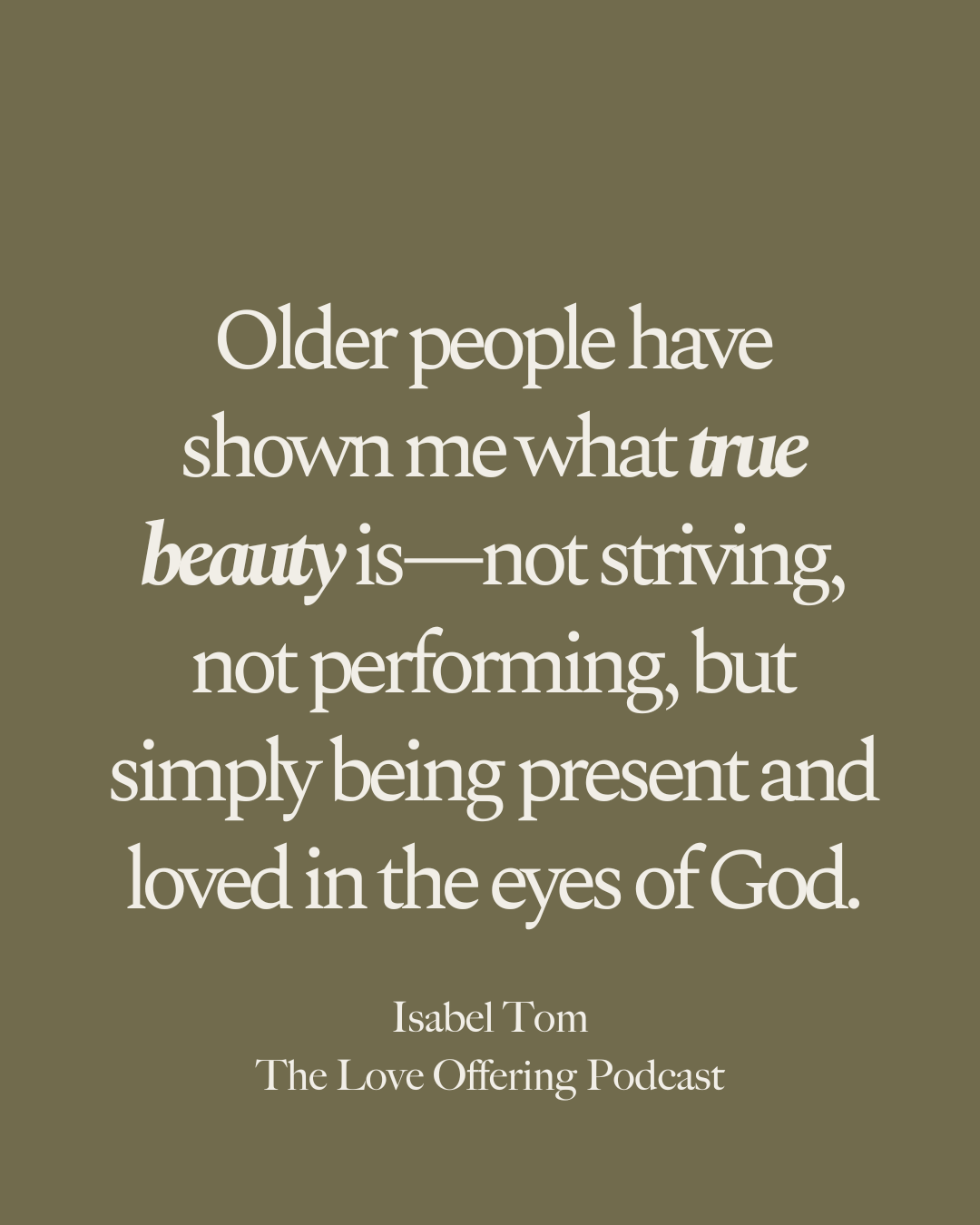
Yeah, well, what it makes me think of is just, you know, I think even believing old, you know, older people, I think they all need to be reminded of how precious they are in God’s sight. You know, we think of children that they are precious in God’s sight, but I think even, you know, just like you were saying, they have slowed down enough to think of you. And that, to me, reflects how God looks at us and how he is slow enough. And if we slow down, we can enjoy that, right? And so what they have allowed me to do is really slow down. Like I have three kids, and I know you have kids, and life is just, I have a kid sick at home, he’s been home all week, right? But when I am around my older friends, especially the older ladies in my Bible study, there’s just something, there’s like this need to perform is no longer there. I believe just my presence is enough. And that to me is a really beautiful thing. And what it teaches me is what beauty truly is. And that’s something my grandma taught me. When I look at it, yes, it’s great to be presentable and look nice and everything like that. But I know one day, you know, my body is also going to fade and is not going to be as strong as it used to be. But I’m going to remember that my beauty is not based on my outward appearance. And I’m going to remember the women in my Bible study, my grandma, and many other older people in my life; they have shown me, I believe, what true beauty is in the eyes of God. I don’t feel the need to strive as much when I am around them. So for me, it’s almost like a healthy practice, just like you need to slow down by doing yoga or whatever. I try to ensure I have people of all ages in my life. I need to be more intentional about having older people in my life. But that’s a way that I am able to, I feel, be able to see things the way that God often sees them.
Rachael Adams (14:19.148)
Yes, I have been fortunate to be part of our Bible study on Thursdays. It’s very intergenerational. We have young moms that have just had babies, and they’re nursing, and then alongside a woman in her 90s that’s like, will you please turn up the video because I can’t hear because of my hearing aid, you know, and so what’s the gift, and that is the wisdom the wisdom that is being able to be shared. Some of us young moms will say, “We’re going through this with our kids or husbands.” Then the older ladies will say, “When I went through that, this is what we did.” I’m so thankful and feel fortunate to have that opportunity. And so often we would split into small groups, and the younger would gravitate to one side, and the older to the other. And they still do that on some level, but gosh, we’re just really trying to bridge the gap and to bring, you know, a lot of times our 9 a.m. services, the contemporary service, or 11 a.m. services, the traditional, and they never were, they were never talking. And so we’ve been really intentional about like, gosh, there’s such value in connecting these two generations.
Rachael Adams (15:25.22)
I know that you agree with that wholeheartedly. You’re really passionate about that concept.
Isabel Tom (15:30.95)
Yeah, I don’t think it’s necessarily easy because, as you said, you have to be intentional about it. And I think that is one of the barriers to why we don’t naturally gravitate towards people who are a lot older than us or a lot younger than us, because we don’t see that we have things in common. It’s just harder to connect. But I think it’s more like a translation. As a parent, I have to help my kids, and I try to help younger people connect with the older generation and see that.
Yes, you actually have a lot in common, and as a parent, it may take me explaining something. Let’s say Mrs. Smith is like this: she may be limping a little bit because of what happened. She just had a knee replacement. Isn’t that so cool that you can get a new knee? You know, so it’s just sometimes it takes translation in between a connector to, or really, an intentional effort to bring the generations together. And also maybe some perseverance, you know, it may not happen the first time you bring the services together. It may not happen within three months, but conversations and relationships do evolve. And there’s just, there’s a different type of relationship that you can have with somebody who is much older than you.
Rachael Adams (16:53.9)
We’ll take another brief break to hear a word from today’s sponsor. When we return, we’ll continue discussing practical ways to care for and honor the elderly in our lives. We’ve touched on this briefly, but I’d like to hear more. I think many of us are unsure about how to care for and connect with aging loved ones. So, what are some practical ways that you have done that in your own life, of how you’ve shown honor and care and love to the elderly in your life?
Isabel Tom (17:23.634)
Sure. There are, so after publishing my book, it’s been about five years, I decided I needed to provide something more practical because I think it is something that is harder for people, especially if they don’t have exposure to a lot of older adults. In 2023, I hosted a grandkid investigator camp online. My kids don’t live with their grandparents the same way I lived with my grandma and grandpa. I wanted them to have the same benefit of a relationship with their grandparents. But I realized that kids are interested in things that are different than their grandparents. One thing is that they have very short attention spans, at least my kids do. I’m not sure if yours do. And so whenever they would talk on FaceTime, it would be like this dizzying video, and their grandmothers would be like, whoa, whoa, whoa, I can’t handle this. I developed a grandkid investigator kit that enables kids to take the initiative and ask their grandparents questions. older people want to share their story and their legacy, but often it comes out as a five-hour story.
Or they’re like, wait, wait, wait, wait, and then I didn’t tell you this. And maybe it’s not consolidated enough. So they lose the kids’ interest. And so in creating these different missions, so I have as Operation Marshmallow, Operation Time Travel, it allows kids to hear different sound bites and also to pull out these details about their grandparents’ story or about their grandparents’ life or about who they are now, things they enjoy now, to the point that they’d understand it. For example, I recently brought a young man, about 12, to visit an older lady at a nursing home. And he was asking her questions from the grand kid investigator kit. And the lady said something, and he wasn’t fast enough to write it down on paper. He said, Hold on, you’re speaking too fast. You’re so athletic. And this is like a 92-year-old lady. And she was like, Whoa, I haven’t been called athletic in a while.
Isabel Tom (19:41.016)
And the boy responded, “You still got it in you.” And I just feel like those little moments to be able to, you know, by creating a resource like that to help kids have those moments and to bless an older person. mean, just to be called athletic, that’s just probably something that an older person or anybody wants to hear, you know? And it all comes down to this, whether you’re doing a mission or whatever. I tell people that when you ask them, you honor them. So when you ask someone questions, when you ask an older person, “How are you doing?” That is acknowledging them. And so often in this world, I think our older friends are just, we’re rushing past them. We’re in the store, we’re rushing past them, we’re driving, we’re going here and there, and this program and that program. And so just to stop and to say, are you doing? And if you want to go deeper, you can ask if you ask about their story or you can learn more about them. When you ask them, you are honoring them. And so that’s just kind of a motto that I go by, and I try to remind people.
Rachael Adams (20:53.422)
I love that so much. And so I think, you know, we both have many loved ones in our lives; it sounds like those are the older ones, and we’ve been very fortunate in that. But for someone who doesn’t have someone older in their life, what advice would you give to help them seek out a meaningful cross-generational connection?
Isabel Tom (21:13.926)
Well, I think if you really want to start opening up, know, just start paying attention and see if there are older people in your congregation. I know there are a number of people in our congregations who are widowed and so, or they are single, and maybe they don’t have family. And it doesn’t mean they have to be 90 years old, but you know, anybody older than you, know, somebody who is 10 years older than me, I can learn so much from somebody, you know, and that’s the same having having children in our lives, right? It really enriches our lives. I would also suggest looking around your neighborhood, especially in our area. If it snows, it’s a chance for our family to serve someone else or to see if there is a need. And I think you mentioned something before about opening the door, and you’re wondering, like, should I open the door? Do they want the door to be opened? And I always say, just offer and let them decline. Let them have the joy of saying, No, I don’t need that. Thank you very much. No thanks. But simply being asked is a very kind gesture. And then I would say the last thing is that there are senior living communities everywhere, serving many older adults. If you look at the statistics, I don’t have the exact number on hand, but the number of older adults in our country and around the world is rapidly growing.
And so if you find a senior living community, even the best ones, even the ones that are marketed as the best, they don’t get very many visitors. Just had a lady who I was doing, working with on the grand kid investigator program at this nursing home. And she said, honestly, we don’t have many family visitors. I think those are all opportunities to volunteer and be a friend to people who would appreciate your friendship.
Rachael Adams (23:14.094)
I love that. And, you know, the reality is, I guess if the Lord allows us to live that long, we will be in that position someday. And how much we would appreciate someone coming to visit, spending time with us, and smiling at us. And, I think so often, I know I’ve learned through my book, a little goes a long way, about just significance. Once people retire and their children are out of their home, and they’re empty nesters, and it’s kind of in their bodies, they’re not physically able to do what they want they were able to do, they start to wonder, like, okay, what is, what is my value? And do I still have significance even in this stage of my life? And I wrote it from a 30-year-old’s perspective right in the midst of motherhood, but I’m finding that the older generation really does struggle with this. I appreciate your point that there is significant value in our wrinkles, and I’m already seeing them on myself. I’m receiving this message as a bell myself, but I think age is something many of us may fear. How would you suggest that we shift our mindset to embrace aging as a privilege rather than something to dread?
Isabel Tom (24:23.932)
Well, there’s a phrase that one of the organizations I work with uses: “aging equals living.” And, you know, my dad passed away, it’s gonna be 10 years in April. And if he were here, you know, he’d get to live and see his grandchildren. And I think that’s the reality. Sometimes we can complain and say, “Man, I’m getting wrinkles; my hair is getting white.” You know, this is so hard, but when God gives us another day, I mean, that’s a blessing to see things that way. This is definitely a culture shift that would have to happen. I have older people who see my boo,k and it says the value of wrinkles and most often the time they laugh at it. That, to me, is really sad because they don’t see their own value. It is my mission not only to help the younger generation value the older generation, but also to help the older generation value themselves. And I think that is just a reality. We have anti-aging, like you can’t have any anti-anything these days, right? If you said anti this, then you are starting a riot, but somehow it’s been allowed that we can say anti-aging, right? And if you think about the number of products out there that are anti-aging products, that’s all, you know, skincare, we’re like, people are flocking, and billions of dollars are put into that. And just imagine how that makes somebody who’s older, who is older, how it makes them feel. I think that’s one reason it’s important to stay close to the truth of God’s word and what he says. He says that man looks at the outward appearance, but the Lord looks at the heart. And that’s why my older believing friends are really valuable to me because they help me remember that. That’s usually the direction I go.
Rachael Adams (26:29.39)
I love that you brought up the Bible because I’m interested to see, like, what else does the Bible say about aging? Is there anything that comes to mind regarding the Bible and this generational concept we’re discussing?
Isabel Tom (26:44.72)
Yeah, so, you know, I’ve been working in senior care for so long, and my story is that I grew up in a multi-generational household. I wrote this book, and a couple of years later I read the typical verses about wisdom and similar topics, but I wanted to read to you 1st Timothy 5.4 because it really convicted me. It says, but if a widow has children or grandchildren, these should learn to put their religion into practice by caring for their own family. And so repaying their parents and grandparents for this is pleasing to God. And that really convicted me because I have two widows, as my mother-in-law and my mom are now widows. Regarding the part about grandchildren, I’m an adult child. I need to make sure I can do all these glamorous things with my book and go out and speak, but I also need to remember to honor my own parents. And then it occurred to me that it says “grandchildren,” because I think a lot of times kids think that in the church: “I’ve got to become a missionary.” I have to wait until I can drive. I have to go to a developing country. I’ve got to become a pastor to please God and to do his work. But right here it says that if a widow has children or grandchildren, and I don’t know very many places in the Bible where it talks about grandchildren, this is specifically with the command, and it says you should care for your own family. And so that’s why, when I talk to grandchildren specifically in the church, I remind them that when you honor your grandparents, when you care for them, when you send them a card, guess what? You are pleasing God. Similarly, it is very easy to do. It’s a very simple gesture, even just asking your grandparent to sit next to you or giving them a gift, a very simple gift for the holidays or for their birthday, you’re pleasing God when you do that.
Rachael Adams (28:47.822)
What a beautiful thought. I think that goes into the question I’ve been asking all my guests this season: Is there a biblical concept of love that you think applies to this topic? I think you answered that well, but is there anything else you’d like to add to that?
Isabel Tom (29:03.57)
I think it’s just, you know, I think it’s a way to worship God. This is a way to love him with all our heart, soul, and mind. I believe there is a benefit that comes from loving our elders. There’s a blessing that comes from it. Not only does it please God, but he has us do that because the relationship you have with your family is something we will cherish. It’s something worth investing your time in.
Rachael Adams (29:34.402)
Yeah, absolutely. Isabel, is there something you are enjoying right now?
Isabel Tom (29:40.042)
I love that I live in the DC area. I’m loving that the sun is starting to shine again, and it’ll be daylight saving time. It has been like a cold and very dreary time, and I’m waiting, I’m waiting for spring.
Rachael Adams (29:58.638)
Me too. It’s the same here in Kentucky, and the sun is peeking out today, and I’m thanking the Lord for that, too. Also, I know I want to stay connected with you. I’m sure listeners will want to pick up your resources, so tell us how we can best do that.
Isabel Tom (30:15.378)
Sure. So I had mentioned the grandkid investigator kit. If anyone wants a free mission, they can get one by visiting valueofwrinkles.com/FreeMission. And I’m also on Instagram at Isabelle C Tom. You can visit my website at valueofwrinkles.com. There are many ways to connect with me.
Rachael Adams (30:34.998)
Awesome. Well, I will be sure to include those in the show notes. Would you pray for us as we close?
Isabel Tom (30:40.924)
Sure, absolutely. Dear Lord God, I thank you for this time and for the listeners of this podcast. I hope today’s episode reminds them and opens their eyes to the older people around them. And I pray that you would use the older people around us, especially the older believers, to show us the way you look down on us, the way you adore us, and the way you delight us. Thank you for giving us people of all generations, helping us lean into those relationships and love the older people and loved ones in our lives well. In Jesus’ name, amen.
Rachael Adams (31:23.968)
Amen. Isabel, thank you so much for being my guest today, and thank you, everyone, for tuning into the Love Offering podcast. If this episode resonated with you, I encourage you to grab a copy of The Value of Wrinkles and begin cultivating deeper relationships with the elderly in your life. There’s so much we can learn from them, and they have so much love and wisdom to offer us. Thank you for joining today’s podcast. Let’s continue spreading love together, and until next time, let’s let our lives be an offering of love.
Connect with Isabel:
https://www.valueofwrinkles.com/