Nowadays it seems like everyone wants to be “successful”—but how many of us actually feel it?
We may know that true success is found in following the One who made us. And yet, in our increasingly polarized and comparison-rife world, many of us find our hearts yearning for an ever-elusive kind of success: in money, power, influence, or accolades.
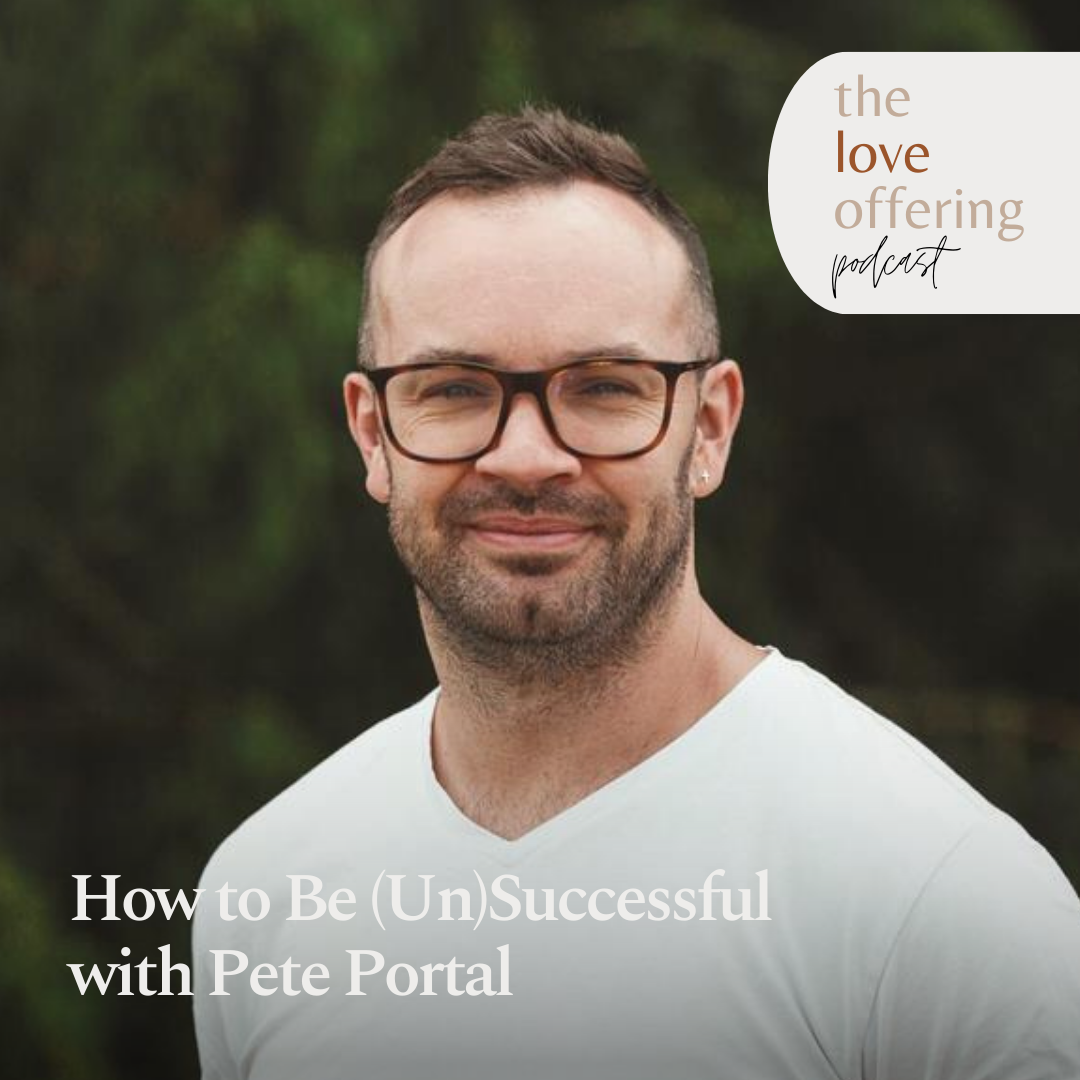
My guest on this week’s episode of The Love Offering Podcast, Pete Portal, helps us reframe our understanding of what it means to flourish. In his new book, How to Be (Un)Successful: An Unlikely Guide to Human Flourishing, Pete invites us to consider that success is not about what we have—but about how we live.
This conversation is an opportunity to redefine success, choosing:
* Love over efficiency
* Depth over volume
* Real friendship over cold transactions
Jesus’ life and teaching are the perfect antidote for a world sick with the wrong sort of success. And He invites us again to experience a success that truly satisfies our souls.
I pray this episode encourages you to live a life of flourishing, right where you are.
Listen to the Episode Here
With love,
Rachael
Summary
In this episode, Rachael Adams welcomes Pete Portal, who shares his journey from London to Cape Town, where he leads the Tree of Life, a 24/7 prayer community. Pete discusses his transition from a career in children’s television to a life dedicated to mission and justice in Manenberg, a community facing challenges like gang violence and poverty. He reflects on the concept of success, challenging societal norms by emphasizing depth over volume and love over efficiency. Pete’s insights into faith, community, and redefining success offer a refreshing perspective on living a life aligned with one’s values and purpose.
Transcript (AI Generated):
Rachael Adams (00:02.049)
Hello, Pete, and welcome to the Love Offering Podcast. I’m so happy to have you.
Pete Portal (00:07.333)
Rachel, hi, how are you doing? Thanks for having me.
Rachael Adams (00:10.792)
I’m doing great. I’m here in Kentucky in the United States of America. So tell us where you are recording from right now. Where do you live?
Pete Portal (00:20.757)
I am currently hiding in our spare room in our home in Manenberg in Cape Town, about 20 kilometres east of Cape Town in South Africa.
Rachael Adams (00:31.182)
Okay, well and I, so what time is it there? Right now it’s 11 a.m. my time. What time is it where you are?
Pete Portal (00:38.499)
Yeah, it’s just gone 6pm here. So my wife’s feeding the kids and hence me running away and shutting all the doors and escaping.
Rachael Adams (00:47.165)
Okay, well so have you always lived there? Is that born and raised or something else brought you to Cape Town?
Pete Portal (00:54.697)
No, you will probably notice that I don’t sound South African. I’m English. I’m from London originally, but have lived in Cape Town now for the last 16 years. So I’ve done all my, and I’m 39, so I’ve done all my sort of proper adulting here on the southernmost tip of Africa. Yeah. But I do head back to London fairly periodically, but this is home now.
Rachael Adams (01:20.802)
So you originally had a career in children’s television in London. I’d love to hear more about that.
Pete Portal (01:27.749)
Yeah, that’s right. mean, I just, really couldn’t think of a better way of spending my life than being a kids TV presenter. That’s what I wanted to do. And so I had a friend who was a director and producer at CBBC. That’s Children’s BBC in London. And he got me a foot in the door and I was working on a bunch of shows just as like bottom of the ladder runner and assistant and production, this and that, you know, just doing all the jobs no one else wanted to do. But it was about six months into that then just getting to know people in the office, I realized absolutely everyone in that level of work had exactly the same dream to be the next big thing in kids TV. So I thought, you know what, God’s got that covered. Maybe I’ll try something else. But yeah, that seems like a lifetime ago now.
Rachael Adams (02:19.724)
Yeah, yeah, but actually, when I was in college, which was 20 years ago, I lived in London for six months and I loved it there. I loved it there. It was at Regents College and got to study abroad and then visit 13 different countries while I lived over there, but I never made it to Africa or South Africa. So I still have quite a few places on my bucket list to visit and Africa is one of those places.
Pete Portal (02:29.105)
No, no way.
Pete Portal (02:49.115)
Well, right. And the thing about London, right? What a great hub for short European flights all over, you know, for cheap. But the thing about South Africa, it’s not really on the way anywhere, you know? It’s kind of like you got to be pretty committed to just being here. Yeah.
Rachael Adams (03:05.656)
That’s right. Yeah, well, so tell us more about you’re involved in something called Tree of Life. It’s a 24-7 prayer community that you lead. So what does a typical day look like for you and your ministry?
Pete Portal (03:19.633)
Well, yeah, it’s a difficult question that because there isn’t really a typical day, but, you know, just to give a bit of context, Tree of Life, as you say, 24 seven prayer is international and interdenominational movement that has been praying night and day since 1999. So we’ve just celebrated 25 years of intercession and it’s focused on three values of prayer, mission and justice. So the conviction being that if we pray, prayer leads us to mission and mission needs to have justice at the center of it. so Tree of Life is a church community really in really this kind of forgotten area of Cape Town. Cape Town is on pretty much everyone’s bucket list, pretty much every travel blogs top 10 places to visit in the world. And yet, Manenberg, the community that we have moved to and live in, is pretty much the center of gang life and struggles with drug addiction, poverty, criminal activity, and a whole bunch of other things. There’s a whole bunch of historic reasons we could go into for that, but our conviction is that if Jesus lived in Cape Town today, based on what he said in John 1.46, what Nathaniel said, Nazareth, can anything good come out of Nazareth? And of course Jesus did. And the implied answer is yes, absolutely. Good things can come out of places that people overlook and curse. And so we believe that if Jesus lived in Cape Town today, he would live in or near Manamberg. So we run a home for guys coming out of gangs, drugs and violent crime, and a home for abused and vulnerable women and their children. And we’ve actually just bought a center that we’re gonna run as a healing center for the whole community to just host night and day prayer, trauma counseling, family reconciliation and a whole bunch of other things. But yeah, I’ve been here 16 years and this is home now, you know?
Pete Portal (05:36.635)
That’s a little snapshot of our life. But as you can imagine, there’s no particularly typical day.
Rachael Adams (05:43.092)
Yeah, yeah, absolutely. So how has living among those struggling with addiction and gang affiliation, how has that shaped your perspective on faith and community and success?
Pete Portal (05:58.203)
Well, the way I put it is I was brought up in good middle-class family in the UK. I went to boarding school, went to Edinburgh University, enjoyed the trappings of privilege my entire childhood and growing up as a young adult. And living in Manenberg has made me realize, I think, the poverty of privilege. And what I mean by that is that I moved to Manneberg unable to do a whole bunch of really quite basic things. don’t know, hanging a door, wiring a plug, mixing cement, you all these sorts of things that actually my upbringing and education never taught me. Now, apart from just learning how to be a bit more useful in life, what it’s also done is made me realize what an incredible leveler the gospel is, because the fact of the matter is, each one of us is living with various kind of deficits, traumas, pain, and all that sort of thing. And for me as a middle-class Brit, know, growing up, I turned to perfectionism and this sort of need to succeed and kind of internalized love being conditional on my success. And what I’ve realized coming to Manenberg and living with those who have grown up with in poverty and abuse and turning to drug addiction and violent crime to kind of medicate the agony of life. What I’ve realized is actually we’re all struggling with similar things, just very, very differently contextually manifest. And so when we come to Jesus, we come to him with our lack, with our brokenness, with our dysfunction, and we all find healing at the foot of the cross, whether we turned to people pleasing affirmation and success driven initiatives, or whether we turn to crystal meth and shooting people. And it’s such a jarring divide in one sense of our lived experience. And yet at the same time, at the center of it all is the Holy Spirit freeing us from ourselves, leading us into life in its fullness and using each other through reciprocal relationship to kind of expose in us, should I say, like cultural assumptions around Jesus or the kingdom of God, which actually just aren’t true. But doing life with people not like oneself enables one to see blind spots in a whole new light. So it’s been a process of unlearning would be my surmise.
Rachael Adams (08:47.298)
Well, I guess on that same topic you’ve actually written a book about kind of being unsuccessful in some ways. If your book is called Stop Trying to Be Successful and in it you challenge society’s definition of success. So how do you personally define success and how has that evolved over time?
Pete Portal (09:08.965)
Yeah, it’s worth saying that the book you talk about that’s coming out in the US in February was released in the UK called How to be Unsuccessful. But the US publishers said, no, no, no, no, we’ve got to change the title because the US audience, the US market will not buy a book with the word unsuccessful on the cover, which I thought was kind of ironic based on the message of it. But I would conceptualize, I would define success ultimately as working out what your God given unique contribution to the world is and giving your all to pursuing that with great faithfulness. Because the world is trying to form us into this guise of success which is characterized by kind of noise and numbers and narcissism, right? The number of zeros after your followers. know, like podcasts, I do my own podcast and it’s a labor of love, you know, but you wanna look at the analytics, I’m sure as you do, and see how many people are we reaching and how can we widen our reach and all that. And it’s really good stuff, of course, with a message to transmit. But the world deforms us into this idea of needing to kind of justify our existence through, quote, successful endeavors. And what I look at when I read the gospels, when I see Jesus’ life, Rachel, is someone so uninterested in those questions. So uninterested in a 51 % majority, so uninterested in how he comes across to the right people. And actually wastes, if you want, a whole bunch of his time with those on the margins of society, with this ragtag bunch of unschooled, ordinary men and a bunch of women as well who followed Dernman and were part of his inner community. And so then I’ve got to look at my own life and think, well, what have I been told success means? It means a high-powered job. It means a large house. means being on the boards of various endeavors. means in the Christian world, it means if you’re leading a church, bums on seats. means church growth. means replicable strategies. It means scale. It means marketable this and that. It means good online presence. All of this.
Pete Portal (11:31.451)
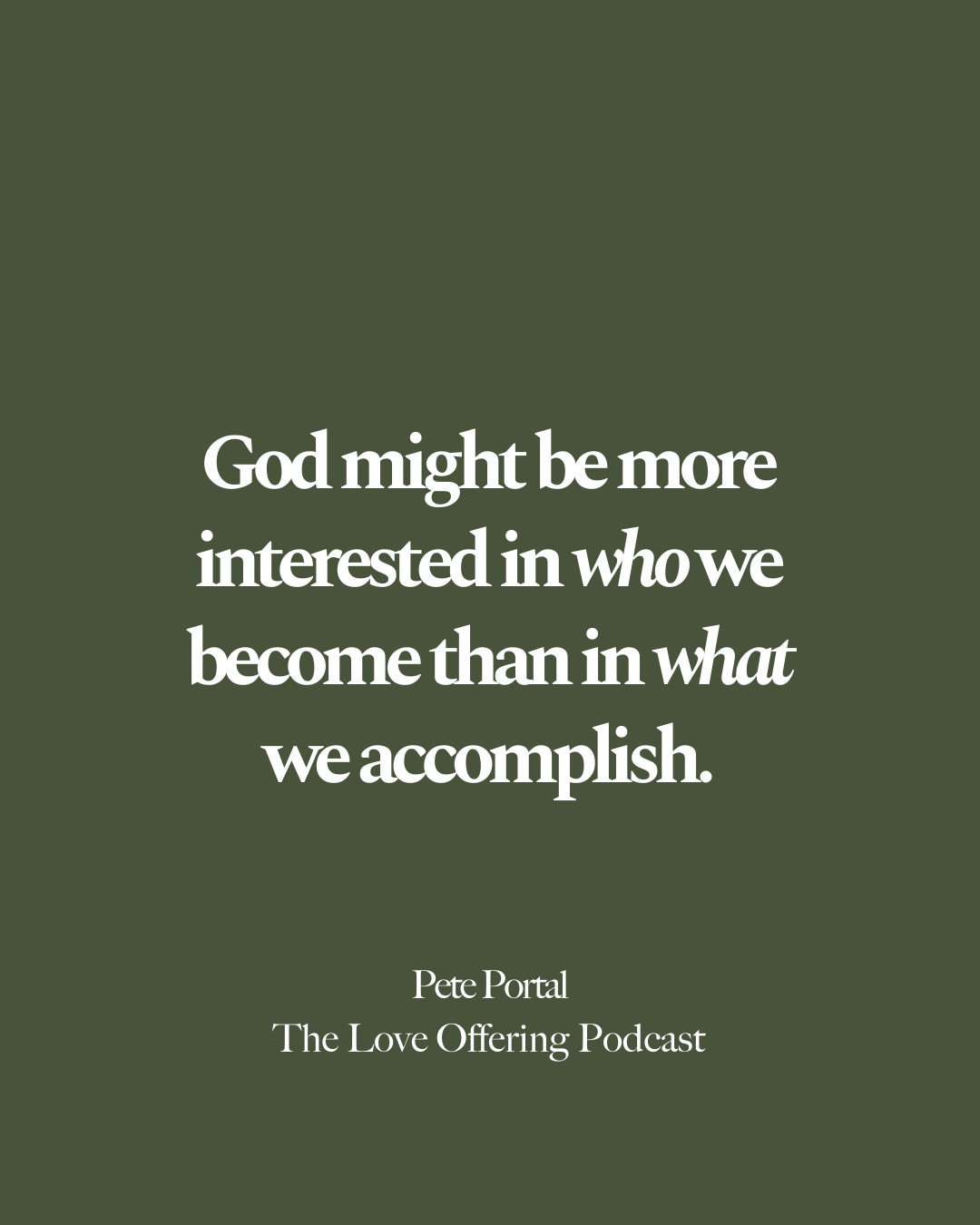
And I think basically the book is just a little pushback to those of us who follow Jesus and who may have swallowed the pill of Western kind of success. And just to say, well, when Jesus used the analogy of the kingdom of God being like yeast, he picked the most deliberately unshowy, unremarkable looking thing. Just if I had yeast in my hand, you’d hardly see it on the camera, just brown dirt. And yet when kneaded into dough makes everything around it rise. Or mustard seeds, tiny, again, barely noticeable, negligible in their impact as is. But if you plant them and water them, then they create shade and growth all around them. And it’s no coincidence, I think, that Jesus used such analogies to describe the kingdom of God in our world where, like I say, everything’s all about width all about width, where he goes, I think, all about depth. And so my final thing on that is that I think God might be more into who we become rather than what we accomplish. Or as Dallas Willard once said, God is more into weighing Christians, not counting Christians.
Rachael Adams (12:48.556)
Wow, I think that that’s so impactful and it really goes against everything that the world tells us. And so I’d love for you to dive more into Jesus’s life. You gave to the parables and the things that he taught. How did he live out this message of kind of more simplicity and living with people in the margins and the least of these?
Pete Portal (13:15.613)
Well, what he did in John 10 was give us this conception of abundant life, right? So he talks about the thief coming to steal, kill and destroy. And yet he says, but I have come so that the good shepherds come so that you may have life and life in its fullness. And ultimately this is what the marketers, this is what the church growth strategists, this is what everyone is trying to aim at, is life in its fullness, right? So then we’d be wise to say, well, how does Jesus conceive of this? And if you read on in that passage, over and over again, he says, the good shepherd lays down his life for the sheep, over and over, four or five times, I think, the preceding like 10 verses, Jesus conceptualizes life in abundance, a fullness of life, and the giving up of life for others, which is so counterintuitive and jars so much with the fixation of individualism and a kind of me-centered, I’m the center of the story type mindset. And actually then, if we were to relate that back to the classic kind of social justice chapter in Isaiah, Isaiah 58, where God is calling out his people for religiosity with superficial religiosity with no depth. And then the second half of the chapter, he says, you know, isn’t this what true fasting, true worship looks like to give your food, your home, your clothes, not the church’s stuff, not some compassion ministry, but our own stuff, to whom the poor, who he calls our own flesh and blood. So we need to remember the poor, as Paul said. We literally need to remember a dismembered part of the community of God. And what Isaiah promises, and this is the amazing thing, is that orienting our life towards those the world has put last and putting them first is actually God’s prescription for our own human flourishing. Because if you read on in the second half of Isaiah 58, it says, your light will shine, then your righteousness will go before you, then your darkness will turn into the noonday sun, then you will call out and you’ll hear God say, here I am. So that means our darkness, our depression, our whatever will become light. We will hear the voice of God clearer our righteousness will go before us, the justice of our cause will be advocated by God Almighty himself, will be like a well-watered garden. All of these things are just this beautiful, Edenic picture of a flourishing life, which is the result of, God tells us, orienting our life towards the world’s, the people, the least, the last, and the lost. And so I think, you know, that 16 years into this journey, having moved to this township with some of the worst and scariest statistics in South Africa, which is one of the most violent nations on earth, what I found is this to be true. And it goes against all the upward mobility and the myths of quality of life that we’re peddled by Western marketers.
Rachael Adams (16:49.346)
You you briefly mentioned before the importance of love over efficiency and depth over volume. So how do you practice these values in your daily life especially when when it’s such a fast-paced world?
Pete Portal (17:02.971)
Yeah, well, one of the big ones is slowing down. I spent an hour and a half, a couple of days ago with a young Muslim man who was looking in at Jesus and at faith and was confessing to me the heinous crimes that he’s committed in his past and trying to get free from it and praying with him for the Holy Spirit to heal his heart. And he’s so open to Jesus and he’s so convinced of the depravity of his gang past and needs no convincing that he’s a quote, know, filthy sinner or whatever, thing like that. Not that we, that’s the language we use, but often the churches here will, you know, condemn such people. And what love looked like for me there was wiping my afternoon and recognizing that sitting and listening and being, listening with my kindest ears, because honestly, some of the stuff that was being said was shocking to me but seeing the face and the image of Jesus in this young Muslim man confessing his sin and sharing Jesus with him, praying together and committing to walk on an 18 month journey with him, at least initially, of discipleship to see him freed from some of the flashbacks and the guilt and the oppression. So I think a great definition of love is that love is a waste of time. It is getting over our over-scheduled lives, slowing down and truly seeing people. Because we can’t truly see people unless we see them through God’s eyes. We no longer view people as the world views them. And don’t forget, of course, that God’s first name in the Bible was El-Royi, the God who sees. And that was given to him by Hagar, who was this thrown out, destitute slave woman. And she’s the one who had the revelation first in scripture that God sees us. And so when we know that we are seen by God and dearly loved, then we can slow down and not have to fall for the myth of busyness, because busyness is just counter for importance. just is just us trying to make us believe that we’re more important than we are and sit with somebody in pain and let them tell their whole story, judgment free. That’s what it looked like for me this week. Next week it will be different, but yeah, that’s just a little snapshot of a couple of days ago.
Rachael Adams (19:41.92)
It goes back to what you were saying about there’s no typical day for you. Every day is different. But what I’m hearing from you is it’s a different way of approaching relationships. That you’re trying to see people as everybody’s made in God’s image no matter what they look like or where they’re from. And so how would you say that your experiences doing what you’re doing has impacted your relationships, even with inside your own home, with your wife and with your children and then those even outside of.
Pete Portal (20:15.239)
Well, I think the first thing is that whether in the world or in the church, what I have noticed is that relationships tend to be transactional, where we’re trying to leverage or carry favor or I’ll give you this, you give me that. Nothing wrong with that particularly. But if that’s the only thing that’s going on, then ultimately relationships have turned into cold transactions in order to we get this visiting speaker at our church in order to attract a crowd, in order to grow numbers, in order to boost their profile or whatever. And again, none of that’s bad per se, but if that’s all that’s going on, then that is pretty superficial. That’s the first thing I’d say is really going hard after reciprocity. And what I mean by that is that traditionally people who look and speak like me, who’ve come from a place like me to a poorer community in Sub-Saharan Africa tend to rock up with a combination of, I don’t know, clothes, food, hugs, and opinions, and give, and from a place of power and privilege. And so what I’m learning in being here in Manamberg, and many people close to me would probably say learning very slowly and learning rather badly, but learning nonetheless is to first listen, to recognize that, for example, betrayal is really just someone’s immature expression of love. We have to deal a lot with betrayal, working with those coming out of active addiction and removing ourselves from the center of their stories, recognizing that when they relapsed or when they stole, it wasn’t because they hate us or because we’re somehow the center of their story, but simply that they sacrifice their deepest desire, which is to get clean and know Jesus, for their strongest desire in that moment, which was to use crystal meth or whatever it might be. And so I think I’m learning to hold relationships a little lighter. I’m learning to expose my latent entitlement to feeling like I should be walking with someone from the point of meeting them all the way up to like them meeting Jesus and getting saved and full of the Spirit and becoming an evangelist and then starting a ministry and recognizing that no, no, no, like often we’re just part of somebody’s walk for a year or two here or there. And if they come full circle and come back to us, great. yeah, so getting over my entitlement to be the center of other people’s stories, going hard after reciprocity, so putting myself at a point of need rather than having all the answers for people. But then also the final one, we lost a dear friend a couple of, about a month ago, who was shot and killed and recognizing the fragility of life and the fragility of relationships. And generally, it’s a cliche, but it’s a cliche for a reason, regretting the things that we don’t do well and things we do do. And so trying to really lean into that and love well. Those are some of the things I’d say I’ve learned.
Rachael Adams (23:41.95)
I’m feeling very convicted but in a good way and so I think this conversation is already impacting my heart and there’s so many things that you’ve said that I wish I was taking notes on and so I’m going to go back and listen to many of this episode again. When you were talking about Jesus as the antidote to the world’s view on success, I’d love for you to share another story about where you’ve embraced this upside down success and how it transforms someone’s life community.
Pete Portal (24:13.629)
An example from our life. What I mean I think really it’s kind of everything. It’s spending however much time somebody requires you to spend on them, whatever else, know, whatever other pressing obligations or responsibilities you have. I think it, what it looks like for me, just to give an example around like online social media and kind of online engagement, is when I look at, for example, the story of John chapter eight, the story that’s typically called woman caught in adultery, but I think should really be called religious leaders caught with stones in their hands. And when I read that, what I see is Jesus acting as the most incredible non-anxious presence in what was a kind of ancient near Eastern version of the culture wars, because the Pharisees dragged this woman to Jesus. Notice they don’t drag the man to Jesus as well, because of course if she’s committing adultery, then the man is as guilty as she is. They drag her to Jesus and he disarms everything. He refuses to send that condemning tweet or that condemning post or whatever, and rather asks them a question to redefine the entire narrative. And so he’s not into virtue signaling or cancel culture. And in fact, you could say that the whole kingdom is not a call out culture, but is a call in culture because when he called his disciples to follow him, he called them into something that he was doing. And then really just remodels the entire question that they’re asking of who’s in the wrong with, guys, isn’t there a better way of doing this? And so with us, we often get caught, I think, between churches who and between theological paradigms where some people would say, we’re not political enough and we need to do this and that. And then others who say we’re not supernatural enough and we’re too with the poor and too social justice-y and we need to be more revival-y and all of that. And we kind of get caught in the middle not being enough for either group, as it were and yet what I see with Jesus is that he re-frames the questions people are asking by being an exemplar of a third way, of a way of peace, of a non-judgmental way that calls the lady out of her sin, but refuses to condemn her. And so I think that’s what we’re trying to do in Cape Town where a lot of suburban churches having their glory encounters and their thick carpets in their nice big buildings would say to us, you’re too social justice. And a lot of kind of more, maybe progressive activist type Christians on the left would be saying to us, you’re too evangelical. And we say, I don’t know. But all we’re trying to do is act as a sign that another world is possible where love is put at the center. And that’s kind of what Jesus did at every opportunity. So we are failing at doing it, of course, we are inefficient. We are hopelessly hypocritical as I think everybody is, but we’re able to admit that and that we’re on a journey and that the spirit’s transforming us as we give it our best shot.
Rachael Adams (28:13.838)
So what do you hope as people listen to this message and read your book? What do you hope that they take away from stop trying to be successful and how would you encourage the person listening right now that just feels exhausted by the pressures of worldly success?
Pete Portal (28:28.913)
Well, you used the word I was thinking of, it’s exhaustion. I hope that people will read the book and breathe a sigh of relief. God. know, you, C.S. Lewis talks about us bonding over this kind of, this realization. So when we’re talking to someone, go, what? You too? No way. I never knew, you know? And so, and I think we often bond and find life over confession and sharing weakness. And there’s so much weakness that I share in that book. But at the same time, the message is not how to be a sad loser. know, it’s not like, you know, that’s not the point of the book. It’s not like just don’t try anything and then you’ll never fail. It’s saying that actually nothing is beyond redemption. It’s saying that your greatest earthly pain that you think might preclude you from any kind of meaningful contribution to the world could just be your life message, you know, like grief turns into grief counseling, drug addiction and gang membership turns into evangelism and drug treatment ministry. God will redeem anything that we give to him. The pressure’s off, that’s the other thing. I think I grew up, I don’t know about you, but I grew up, I came to faith at age 15 in the year 2000. I grew up in this kind of generation of being told we’ve got to be world changers and we’ve got to be this and that and a kind of hurrah Christianity. And it’s exhausting. You don’t have to be. Jesus will change your world around you as he changes the world inside you. But we don’t have to justify our existence through successful endeavors. And for me, that is incredibly good news.
Rachael Adams (30:15.596)
Yeah, for me too, but I’m just wondering, and I don’t mean this critical, so please hear me say this, but people are probably looking at it. Maybe both of us and saying, well, you all both have books. You all both have podcasts. You’re running a ministry that is leading thousands of people to salvation and changing your community. And so in our eyes, that is successful. Right. And so I think for the, maybe the person listening that is I’m thinking of the woman that is at home with a toddler and never leaves her house and hasn’t showered today and ate a peanut butter sandwich for lunch. You you look at, you’re like, well, that’s great for you all. You all are changing lives. What am I doing here in my own home? And first, I would say, well, gosh, you’re shaping and changing a human being. You’re shaping the next generation. But do you have anything to say on that? The person listening that may just.
Rachael Adams (31:08.174)
Even looking at us and saying, you are successful compared to what I’m doing.
Pete Portal (31:15.025)
Yeah, I would say that the way I’ve spent the last four hours of my day was by completely messing up, putting up our steel frame paddling pool for the kids, failing to backwash the sand filter and managing to completely ruin about 40,000 liters of water, which I’ve now had to waste and have to start again with my four-year-old daughter, Simi, in a tantrum in her swimming costume, desperately ready to swim. Picking up play dough off the kitchen floor and doing my back and getting a plumber in to fix a toilet because I was convinced it was absolutely irreparably damaged. And within about 90 seconds, he fixed it and charged me an extortionate call out fee. So that’s been my afternoon. You know, like it’s both and, you know, we could do, we could equally do a whole podcast on, you know, my other thing at the moment is I turn 40 next June and I’m currently fully planning having a midlife crisis and what my meltdown will look like and my inability to be able to engage with and embrace the aging process. So there’s plenty of insecurities, anxieties and all the rest of it. And that’s absolutely all part of it and I think to be honest, I think one of the things that I feel, where are we now? It’s Thursday. Yeah. It’s almost the end of the week. If I look back at this week and think where have I actually done? Not as well as I could have done. You know what it would have been? It’s probably in quality time and parenting with my two children. They’re four and two, and they’re exhausting at the moment. And so for the stay at home mom who’s, focusing on her children and giving them her best, even if it doesn’t feel like that then not that it’s a competition, but she’s beat me hands down this week.
Rachael Adams (33:14.574)
Yeah. And this is not touting a book that I’ve written, but it’s a little goes a long way. And I really am convinced in this upside down culture of Jesus and what God values. And I think that we’re going to get to heaven one day and be shocked at all of the small unseen moments that God used to impact eternity. I’m convinced of it. And I think that your message speaks so much to that as well.
Pete Portal (33:37.403)
Yeah, absolutely.
Rachael Adams (33:41.978)
And so this is as we start to come to a close, one of the questions I’ve been asking all of my guests is, and you’ve actually talked a lot about love already, and so I wonder if there’s anything else that comes to mind. Is there a biblical concept of love that you think applies to this topic today?
Pete Portal (33:59.035)
Yeah, I I think I heard a great definition of love by somebody, forget who, that was, he said this, love is giving somebody the power to crush you and trusting them not to. And when I look at Jesus and the way he loved his disciples, and we’d say, how on earth would the son of man, God incarnate, not manage to see 12 fully fired up disciples after three years of heaven meeting earth and miracles and raising the dead and all the rest of it, he still raised the Judas, you know? Well, he gave Judas the power to crush him and trusted him not to, and Judas still did. And, you know, when we look, to be honest, at Jesus’ offer of forgiveness and salvation, you know, throughout world and cosmic history, billions of people have rejected that. You know, so what do we give him? One star? But at the same time, know, his life of, like I say, a rabbi teaching fishermen and zealots in this little corner of the Near East sparked a worldwide movement of Holy Spirit, reconciliation, prayer, church planting, world-changing stuff. So then what do we give him? Five stars? You know, like He gave people the power to crush him and trusted them not to. And then when they did and Pilate and the religious leaders and everything crucified him, he redeemed everybody’s brokenness into most glorious cosmic act we will ever see. And so that for me is just the most amazing expression of love.
Rachael Adams (35:46.164)
Absolutely. Well Pete, tell us something you are loving right now.
Pete Portal (35:51.933)
What am I loving at the moment? I am loving over 35 soccer league that started last week and it’s affectionately called walking soccer. And we have a bunch of us playing in a league and it is horrific and hopeless and very, very slow, but has given me a reason to work out once a week at the moment and build community and have some hilarious experiences along the way. So don’t come and watch, it would send you to sleep. But I’m absolutely loving it at the moment for trying to keep the dad bod in check.
Rachael Adams (36:30.542)
So do you call it soccer over there? I know we do in the US, but I thought it would be football over where you are.
Pete Portal (36:36.985)
England calls it football, South Africa calls it soccer. So I’m caught in the middle. So yeah.
Rachael Adams (36:41.888)
Okay, yeah, okay, great. Well, so I’m gonna purchase a copy of your book. I’m so, think that I struggle in this area. I’m so perfectionistic and entitled and achievement oriented and can get really caught up in a to-do list and get caught up in busyness. And so I know I need this message. I’d love to listen to your podcast and stay in contact with you. So tell us how we can best do all those things.
Pete Portal (37:09.319)
Yeah, and your description of yourself, Rachel, is exactly the sort of person that the book was written for. So if you hate it, then I don’t know what to say. but yeah, exactly. People can look at they can follow the unsuccessful podcast is on Spotify, iTunes, all of that Apple podcast, they can go to Pete portal.com
Rachael Adams (37:18.188)
Yeah, I’m your avatar.
Pete Portal (37:34.421)
And there are talks and there are, you can order books there. They can go to treeoflife.org.za and that’s our ministry in Manneberg with a whole bunch of videos and stories and fun stuff to see what we’re doing day by day. Yeah, and sign up for newsletters to actually pray for us and you know, we cover people’s prayers, we need them. So those would be the three ways to stay in contact.
Rachael Adams (38:04.206)
If you’ll humor me, I’m just thinking about as we’re raising our children, how do we encourage them to, because there are so many pressures to get the trophy and to make the team and to be a part of this club and plan for college and make straight A’s and you know, this, even as parenting our kids, what is that, how has that changed the way you’re parenting your children?
Pete Portal (38:28.624)
My goodness, I haven’t, you know what, I’m so bad at it, I haven’t even thought that far. How old are your kids?
Rachael Adams (38:34.702)
Yours are younger. I have a 15 year old that’s almost 16 and then a 13 year old. So mine are at the right middle school, high school age where there is a lot of pressure on them.
Pete Portal (38:40.793)
Yeah, so you are in the thick of it.
Pete Portal (38:47.611)
Yeah, for me at the moment with my daughter Simi who’s four and my son Luca who’s two, like we haven’t even got there. Like, you know, just sharing and kindness and not kicking each other is like a huge win at the moment. So, but I can only imagine. I would love to hear your tips on it at some point because it fills me with a preemptive dread trying to work out all of those things. I’ve got no wisdom on that whatsoever.
Rachael Adams (39:14.296)
Okay, we’ll get ready. Well, once I figure it out, if I do, then I’ll pass along the tips to you. So I would love for you to pray for us as we close today.
Pete Portal (39:19.229)
Please, please.
Pete Portal (39:25.629)
It’ll be an honor. Sure.
Pete Portal (39:31.239)
Lord Jesus, we just believe that you are the hope of the world. We believe that the life you lived was what we should aspire to. We believe, Lord Jesus, despite how we might feel right now in this moment listening to this, that you are inwardly working in us, sanctifying us, making us more like you. I pray for everybody listening, Lord Jesus, that you would just help reframe what success looks like. Father, to live for that audience of one, to be filled with your Spirit in the most unremarkable as well as remarkable ways, to find you on platforms, to find you on the floor, to find you in nappies, to find you in boardrooms, wherever it might be. Jesus, we believe the incarnate God, you by your Holy Spirit are with us. So come Lord and bring hope through whatever has been said in this podcast to set people incrementally, just a little bit more free on our road to following you faithfully in this world. For your glory we pray, amen.
Rachael Adams (40:45.086)
Amen. Well, thank you Pete for today and for encouraging us to stop trying to be successful.
Pete Portal (40:53.283)
Absolute privilege, Rachel. Thanks for having me on.
Connect with Pete:
Read the Show Notes: