Have you ever felt like life is just too much—too loud, too fast, too overwhelming?
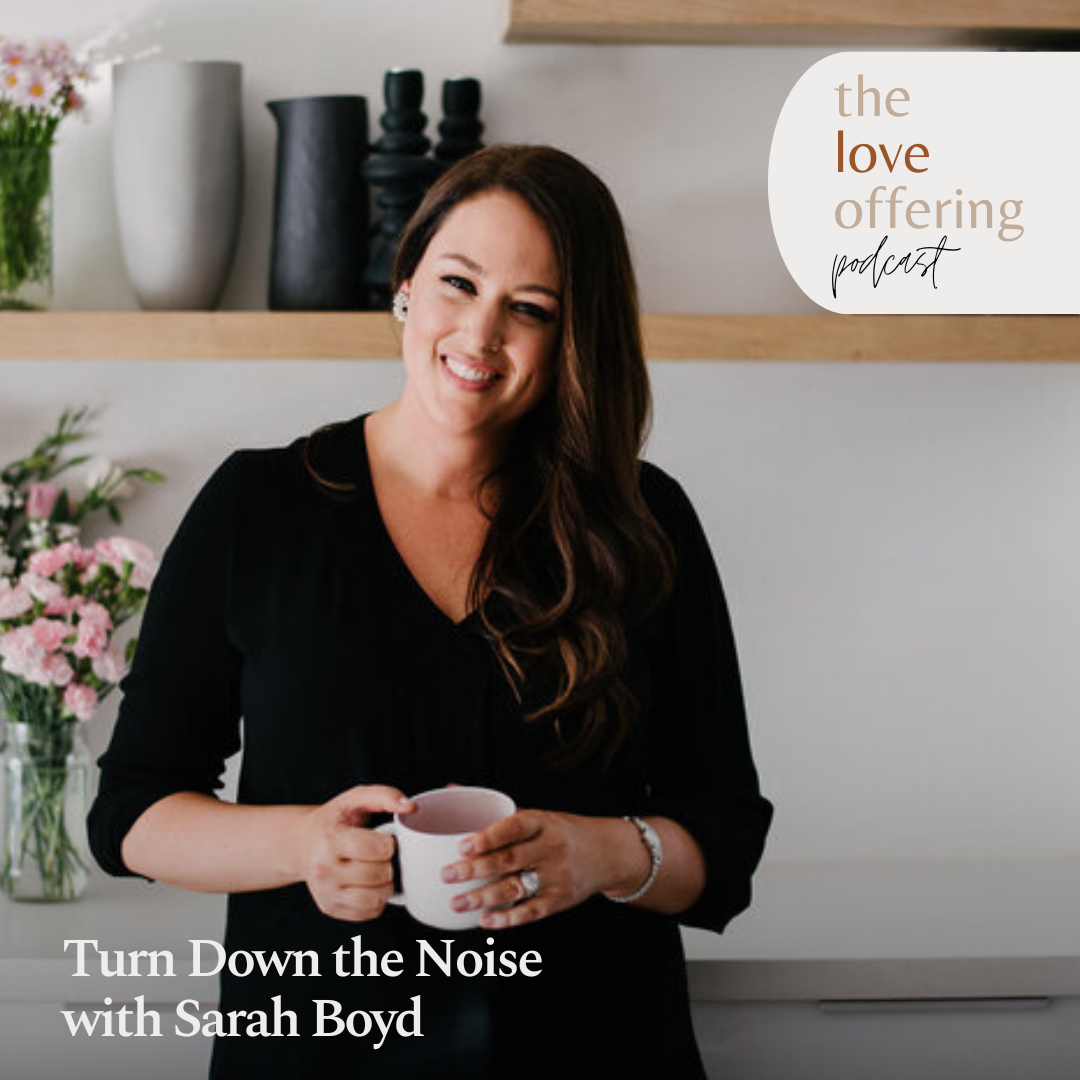
You’re not alone. This week on The Love Offering podcast, I sat down with Sarah Boyd—child and adolescent development expert and founder of Resilient Little Hearts—to talk about her new book Turn Down the Noise. In our noisy, overstimulated world, Sarah offers a breath of fresh air and a clear path forward for parents who long to create calmer, emotionally healthy homes.
We talk about:
- Why overstimulation is affecting your child more than you think
- What’s really happening in your brain during those tough parenting moments
- How to reduce stress without sacrificing your family’s values or responsibilities
- What to do if you or your child are highly sensitive
- How to develop emotional maturity without perfectionism or guilt
- Simple routines that make space for connection and resilience
Whether you’re parenting toddlers or teens, this conversation is full of compassionate wisdom and practical help. You don’t have to live in constant chaos. There is hope—and it begins with one small change.
Summary
In this episode of the Love Offering Podcast, host Rachael Adams welcomes Sarah Boyd, a child and adolescent development expert and founder of Resilient Little Hearts. Together, they explore the challenges of modern life, focusing on how to build resilience in both children and adults. Sarah shares insights from her book, “Turn Down the Noise,” offering practical advice on navigating overstimulation and chronic stress. Tune in to discover how to create emotionally healthy environments and foster resilience in your family.
Transcript (AI Generated)
Rachael Adams (00:01.396)
Welcome to the Love Offering Podcast. I’m your host, Rachel Adams, author of Everyday Prayers for Love. Each week we dive into meaningful conversations about how to live out the greatest commandment, loving God with all of our heart, soul, mind and strength and loving our neighbors as ourselves. Whether through inspiring stories, practical tips or biblical truths, I hope to encourage you to love boldly, live faithfully and reflect God’s love in your everyday life. today. I’m excited to welcome Sarah Boyd to the show. Sarah is a child and adolescent development expert, founder of resilient little hearts and the author of turn down the noise, a compassionate and practical guide to help our children and ourselves navigate overstimulate overstimulate overstimulation and chronic stress in a fast-paced world. If you have ever felt overwhelmed by the noise of modern life or wondered how to raise emotionally healthy kids in today’s environment, this conversation is for you. Well, hello, Sarah and welcome to the Love Offering Podcast. I’m so happy to have you.
Sarah Boyd (01:04.795)
Hi Rachel, I’m really excited to be here, I appreciate it.
Rachael Adams (01:09.152)
So you and I, connected quite a while ago, a mutual friend of ours connected us and you’re in Australia. I’m in the States and you’re like, okay, our time zones, our time zones were not working. And so you luckily came to the States and are here. And so it’s a little bit better. And I’m so thankful that we were able to connect because I’ve already enjoyed getting to know you and I’m excited to, to share you with the listeners that don’t know you yet.
Sarah Boyd (01:36.724)
you’re so kind. Yes, I’m kind of I’m sorry if my audio quality isn’t amazing. I’m in a little Airbnb unit at the moment. lived in the States for about eight years and we’re back in Australia at the moment just for some family reasons. And so I just like I so respected Rachel was amazing. She’s like, I would love to have you but I really want to be there for my kids in the family time. And I was just like so respect that I loved that it was just like she’s was you were already having a boundary I’m like it’s it’s so in line with what I write about so but I will say I am so glad that we get the opportunity to actually chat today.
Rachael Adams (02:18.014)
Yes, yeah, me too. I told you before we hit record, I felt like your book is so timely and such a needed message for me. And I know for everybody that’s listening today, because the world is so noisy and it’s just, everything is just vying for our attention. But before we get into that, I want you to talk about the resilient little hearts. Tell us more about that ministry.
Sarah Boyd (02:39.724)
Yeah, so my background is in psychology. I’ve got a master’s in educational psychology and a diploma in the neuroscience of leadership. And so I’ve always been passionate about helping or understanding our children and adolescents and helping them thrive. But around the time that I was completing that master’s, I also had a pretty significant life event where I was diagnosed with cancer. It was, I was 27 years old and it was an aggressive form of thyroid cancer. And I went through 18 months of treatment and it was so fatiguing that I couldn’t work. It was just one of those pivotal life moments where it really kind of shook the foundation that I was standing on. And by God’s grace, the treatment worked in my situation and I was in remission. And as soon as we were given permission, we started a family because that was something that we really wanted to do and we had our two children. And it was really the combination of both my academic background, but really the life events of going through something significant and becoming a mother, which is life changing for many people, that made me realize just how important it is, as much as we want to protect our children from the world. And I think it’s a mother’s heart to just want to comfort and not have them go through anything hard. Unfortunately, we can’t do that. And so what we actually need to do is to equip our children in resilience and emotional health. And that’s essentially the main work that I do now is helping parents and professionals that work with children to create environments and to help children grow skills to grow in their resilience and emotional health.
Rachael Adams (04:28.758)
That’s so valuable. and I imagine I wish that I had you to talk to when I was, mean, I still am raising my kids, but the younger that they were. And I, I think that just me as a mom, it’s so nice to have you as, as that resource and as that sounding board. And then even for our own hearts, I mean, it’s, are overstimulated as well as our kids. And so we need that resiliency, too, no matter what age we are. Right.
Sarah Boyd (04:56.654)
100%. And as much as my kind of work, you know, is focused on children and adolescents, because of the studies that basically say the number one factor to have our children and teens grow in resilience and emotional health is a connected relationship with a healthy adult. And so a lot of my work actually revolves around how can we as adults, whether you’re a parent or you’re a professional that works with children or you’re a grandparent, Auntie, uncle, your neighbor on the street, how can we all become healthier and give that health as a gift to other people in our lives?
Rachael Adams (05:35.154)
Yeah. So you talk about overstimulation as an invisible epidemic. So what do you mean by that? And why is it so critical that we begin paying attention to it for ourselves and for our children?
Sarah Boyd (05:48.62)
Yeah, so I think that most of us are aware that we’re stressed or overstimulated, that the world today has become faster than we maybe would like it to become. And we’re maybe aware of it, we have moments where, whether it’s our own or our children’s screen time or our own stress about schedules, but sometimes we’re just not aware of how much it’s actually impacting our nervous system or how it’s impacting our mental and emotional health. And so whether it is the increase of technology, which has been a huge influence on the world going faster and us feeling like we need to keep up, but also to so many environments, whether it’s schooling or work, financial pressures, so many other areas have become more pressured as that’s increased. this overstimulation is, a world that we’re living in now. We used to live in a world that had built in boundaries. So I grew up in a generation where the stores weren’t open on a Sunday or they weren’t open after work finished for most people at five or 6 p.m. and then that was it. There was no ability to access work after that. And even though all of these things have brought amazing possibilities, like I wouldn’t be able to have this conversation with you if we didn’t have the technology and that’s such a blessing. But because we no longer have boundaries built into the environment that we live in, it comes back to us to be aware of what’s going on and to build in the boundaries ourselves so that we and our family can thrive.
Rachael Adams (07:26.774)
So we’re going to take a brief break to hear from today’s sponsor. And when we return, we will dive into what neuroscience teaches us about emotions and how we can begin to respond differently to those hard parenting moments.
Welcome back. are chatting with Sarah Boyd about her book, Turn Down the Noise and in it you explain the neuroscience behind how our brains work in moments of stress and overstimulation. So can you help us understand why we sometimes overreact and how we can break that cycle?
Sarah Boyd (08:01.014)
Yeah, so the neuroscience of overwhelm is really interesting. If you put it simply, which it’s not simple, but there’s two main parts of the brain. There’s our limbic brain, which is our emotional center of our brain. So it is the one that has all the feelings when someone cuts you off in traffic and you have that feeling come up or you have a child talking back to you and you have that feeling come up. It’s our limbic brain. The other side of our brain is the prefrontal cortex. And that’s the side of our brain that makes us a healthy, wise human being. It navigates all our emotional regulation, our self-control, our clear decision-making. It hopefully makes us a mature human being. And so there’s a couple of different things. Our limbic brain, I liken to our trusty family car. It’s the one you want to take on that long road trip cross country, it’s dependable, it doesn’t need as much gas as maybe other cars. Whereas our prefrontal cortex is much more like a race car. You might think about those days that you just feel like you’re on top of it and you’re just being so productive and clear thinking and it can help you perform or produce really clearly. But the thing about the prefrontal cortex is that it takes a lot of energy in terms of glucose and oxygen, so it only performs well for a short period of time, even a few hours before it needs a short break to be able to recalibrate. The other thing to keep in mind is that a child’s prefrontal cortex isn’t completely developed until they reach maturity up to about 25 years old. So in the case of children, where they don’t have the interconnection with their prefrontal cortex yet. And in the case of us, when as adults, when our prefrontal cortex, we’ve just used up the energy. Basically what we’re left with is our limbic brain, meaning that every feeling that we have is just coming out. There’s no self-regulation or self-control or all of that sort of stuff. And so that’s why as adults, we often tend to feel like we lose our patience more likely at the end of the day rather than at the beginning of the day because we’ve had hopefully had some sleep or some breaks or if we’ve used up all this energy in a particularly hard situation or at work it’s why then we go to the next situation and feel like we just can’t think clearly we’ve maybe got some brain fog and so a lot of it just comes back to an awareness of that as a start. Sometimes it’s just, you you can’t do anything about it, but just that awareness that you can. And if you can do things about it, it’s about trying to have whether it’s small breaks throughout the day, boundaries where you’re not pushing yourself on a daily basis too much that can help you keep energy in your prefrontal cortex.
Rachael Adams (10:59.83)
I’m just thinking about even in our, in our marriages, you know, we’ve like worked all day and then you come home and you’ve come your dinner or something and then something random, something so small happens within the family. And then one of us like loses it. And it’s like, wait a minute. I’m really not even mad at you. Like this is ridiculous, but yeah, it’s like, that’s sometimes why our family gets the worst of us rather than the best of us. Do you find that?
Sarah Boyd (11:27.66)
Absolutely, and that’s because a lot of our emotions are kind of like a volcano. It’s like every little thing, we don’t give ourselves enough credit as humans for how many times we are navigating hard things. We are holding our tongue. We are being kind when we, you know, should, could have responded differently. But every time we do that, we’re using up that energy that we use And so it’s kind of like climbing. If you think of volcano erupting is a 10 out of 10. Every time we’re doing that, if we’re not also having breaks or doing things that are restorative, that number is climbing from a one to a two to a three and then to explosion. But a lot of the reason why I noticed this is I noticed it even in myself. When I was writing the book, I’m one of those people that wish I had someone that could come into my house and cook dinner every night. It’s not my specialty. And I always just stand and think, what am I going to feed my children? But it was one of those stressful times of night. been a really hard day at work. The kids were going through some things and I found myself really reactive. And only two weeks later, we were away on vacation where I didn’t have work. I slept well. We got to do things. And the same situations that I was in, cooking dinner, navigating children fighting. I wasn’t reactive. And then I just realized how much of it is due to, think exactly to your point, we think, is this just about the moment? And is there something about this situation or the thing that they said that really got to me? And sometimes, but also it’s actually just tiredness and exhaustion and just not having anything left. And so it’s really about, you know, it’s normal that all of us go through that on a day to day basis. It’s not something to feel guilt or shame about. But it is something if you’re feeling like it’s happening a lot and you’re not happy about it, you might want to have a look at, hey, are there some things that I can do to kind of help me get more energy towards the end of the days.
Rachael Adams (13:29.866)
You know, something you said it’s we’re being reactive rather than maybe proactive, you know, there in the way, guess the ways what I’m hearing you say is the ways we can be proactive is by number one, being aware that this is happening. Number two, trying to take breaks and, then maybe even just communicating to our family. Hey, I need a minute to regroup. Like give me a minute and then I can come back and I’ll be better. I don’t know. mean, talk to us about like being proactive so that we are not so reactive in ways that we’ll regret, right?
Sarah Boyd (14:04.426)
Yeah, yeah, absolutely. I mean, I love that example. We have verbiage in our home and I use it a lot. Like, I need some space guys, mum needs five minutes or I think, you know, do you need to take some space? That’s words that we use. You can use any type of words. Being proactive for me is I’m really intentional about transition points in the day. So I only work school hours and then I pick my kids up from school I’m intentional to try to not to check my email or something like that just before I’m picking them up because I know that if I see something in that that’s stressful, I’m gonna be reactive. And that gives me a small window, whether it’s five or 10 minutes to just calm myself and have that break. And that’s just a small example because I think what the bigger conversation is, is that we now live in a world Maybe we always did, but with technology, it’s been escalated where we’re so encouraged to be productive all the time. So I think, you know, a lot of people talk about, what are those small moments in your day? You could use that to get ahead, to post your social, to do an email, to call the person. And while that’s fine, if you’re not also aware of where you’re up to with your energy and your bandwidth and what you’re navigating, what you’re doing is stealing little moments that your brain is actually restoring. And so as technology has increased and the thing about technology has no limits, like it can go, it doesn’t need to sleep, it doesn’t get emotional, it doesn’t have hard days, it just keeps producing. And there’s almost this unconscious thing that we feel like we need to keep up with that. I need to keep producing, I need to keep, you know, we feel guilt that we need sleep or we need a break sometimes, or we need to talk to a friend or we need emotional support. And it just this thing that happens unconsciously. And part of what I’m hoping this work does is help take that guilt off and help people know like God created us as humans for a reason. We’ve had limitations from the beginning, even in the garden where everything was good, we still had limitations as human beings. And as we honor those limitations, we will find that we are accessing the life that God’s created us to live even more.
Rachael Adams (16:27.008)
So when we do take, okay, so we say, okay, I need space. I need to take it just a minute. Give mom a minute. What, what does that look like? Because a lot of times we will go and I’m going to go get on my phone, you know, and I’m going to mindlessly scroll or I’m going to watch a show or I’m going to read a book or like, is that how we should go take a minute? Just, or what do we do when we go take some space?
Sarah Boyd (16:49.87)
Yeah. So absolutely, ideally, you don’t want to go to your phone. And that’s something that I know a lot of people, you know, are, you know, and I even do it, I am aware of all this work. And I find myself there. The problem with going to your phone, apart from the fact that screens are stimulating, is that for most of algorithm driven social media, you’re not just being fed the things that you would like to see. So maybe when we go for a break, we’re actually going to a screen because we want to see something funny or uplifting or inspirational. Like we’re looking for that feeling. And for the most part, what we’re being fed is a little bit of that, but also fear-based narratives or other things that are happening. And so unfortunately it just, there’s that element as well. So you want to ideally do something that moves your nervous system into what psychology calls rest and repair. So it is, After you’ve had a stress, you wanna do things that make your physical body feel safe. So you can do this through water therapy. So it could be as simple as taking a cold drink of water or having a hot cup of tea or coffee. Running your wrists, these are pressure points on your hands, on your wrists, under cold water for a few minutes. Like if you’re at work or you’re in a situation that you’re starting to feel heated or stressed, you can just say, just gonna go to the bathroom or restroom for a moment and just run your hands on the cold water. If you have lots of time, go have a shower or a bath or something and calm yourself down. Or it’s things that are grounding, walking barefoot outside, standing on the grass, looking at nature, talking to a friend that is a safe person.
Sarah Boyd (18:42.486)
And so sometimes these breaks are really small and all we can do is something small. And other times we want to think about across a day or a week or a month, are we doing things that connect us? Praying, journaling, just all those, I suppose, analog things that connect us back to ourselves, to God, to the people that we love. They’re typically the things we want to look at when we take breaks.
Rachael Adams (19:05.558)
I love those great practical examples. And like you said, it’s not just for us, but it’s for our family too. So we are going to take a break now, speaking of breaks. And when we return, we’ll talk about the role that God has in this whole scenario.
Welcome back, Sarah. You know, you mentioned before we took our break about maybe prayer is a way that we can, can take a breather or create some space. Talk to us about the Holy Spirit’s role in, in this whole scenario and God’s role in it. What role do you feel like he plays? And you also mentioned, are kind of two questions in one, he set boundaries as well. So talk to us a little bit more about the spiritual side of this.
Sarah Boyd (19:51.97)
Yeah, a lot of it comes back to, know, we were designed to live in connection with God and with other people. He designed us with limitations so that we honor that and so that we’re, in effect, we’re dependent on Him. So often we start to live our lives and even though we confess that we’re dependent upon Him, sometimes out of our fear or insecurity or just even going on autopilot, we might find that we feel like the world depends on us. We have to keep going. We have to keep producing. And that’s what I love about even the practice of Sabbath. And that’s one of the practices I talk about in the book. And it really isn’t just about, you have a day aside set apart for God that’s holy and that’s important. But one of the things about Sabbath is when God gave the 10 commandments to the Israelites, Sabbath wasn’t just a part of the Genesis story. It was a part of him helping them recover from years of being in slavery, years where they were feeling like their way of being in the world was producing all the time. And then, so he gave the 10 commandments and he said, keep the Sabbath holy. Because it’s almost a reminder that our lives don’t depend on us. And I know for myself, I can just, I’m an A type personality. I can just get moving and into it and I can forget and I can take pressures on and burdens on that God didn’t ask me to do. But it’s a re-reminder of that I need to trust him. He is the author and finisher of my story, of my children’s stories, of the people in my life stories. And so how I use that and see it, I often see, this is just a visual picture that I use, but when I’m in my like hurry and hustle and stress, It’s almost like God’s just standing there, the Holy Spirit’s just standing there waiting for me to realize that he’s there, to realize that he’s there to help, to answer questions that I have, that I don’t need to go to my phone for answers, that I can go to him. And actually just taking those moments to really invite him back in, in just the daily, ordinary moments of our lives, of just inviting him into those spaces.
Rachael Adams (22:11.815)
I don’t know who to attribute this to, but I’ve heard before that if the devil can’t make you bad, he’ll make you busy. Have you ever heard that?
Sarah Boyd (22:20.52)
Yes, I have. It’s so true.
Rachael Adams (22:22.812)
It’s so true, you know, and it’s where we don’t have time for the Lord and we’re just so, and we’re, and I do think, and you mentioned this before, the world wants us just to continue to produce and exhaust herself and continue to strive and earn favor and earn love and one affirmation and all of these things. And then we’re just exhausted. So talk to us about just the woman that maybe feels exhausted, anxious, and like she’s just behind. words of encouragement would you give her?
Sarah Boyd (22:52.608)
Yeah, well, first of all, I would say it’s not you. There’s not something wrong with you. There’s nothing to feel guilty or ashamed about. I think it’s the culture and environment we live in now. And many times there’s not things we can do about it. As much as we talk about situations and boundaries, some of us are facing situations right now of crisis or demand that we just have to keep going. But it does, it leads to exhaustion. I would just one of the practices I talk about, there’s a lot of practical work tips and practices in the book. But one of the things that I’ve had the most amount of people reach out to me about is a practice called loving detachment, which is basically where we stop feeling like and I think women in particular struggle with this. know I struggle with this feeling like it is our job to hold up the world for everybody else that if we were to take even an a five minute break or even an hour break or if, you know, some point in the year we even took a day break and actually just did some things that were life giving for us and that we would feel like things wouldn’t hold together. And loving detachment is a practice where we say, I’m surrendering that feeling, that anxiety back over to God and we cast our cares back to him. And then when you are able to do that, what I would encourage the woman that’s exhausted is to actually feel empowered to build some boundaries in that will help you thrive. mean, the old adage that we always hear, and this is particularly true for women and mothers is put your own oxygen mask on before you help others, except it’s not what we feel like we do. have this, sometimes it feels like this drive to just, Now I’m going to put everyone else’s oxygen mask on first and then I will do mine. But the way that we operate in family as the women, where we operate in community and society, we are life bringers to the people around us. And if we are not thriving, what do we have to give out of it? We don’t, you know, when the Bible talks about guard your heart for out of it flow the rivers of life. Do we have that river in us?
Sarah Boyd (25:13.984)
And so it’s not about feeling guilty or bad if you’re in a season where you feel like you don’t, but about looking for it again, because that’s how I believe the generations grow stronger, is that as we grow and mature, we are able to pour into the next generation. have that wisdom, we have that love, we have that generational legacy to give to them, and that’s how they grow stronger.
Rachael Adams (25:38.677)
I think what you were just saying, you know, so many of us, think have this mom guilt or this, this feeling like I can’t, I can’t go take a bath. Like that makes me feel like I’m being lazy or I’m putting my needs in front of my family’s needs. And that’s something that I, or I can’t go away to on a girl’s trip or I shouldn’t, you know, go out to eat with a group of girlfriends. When my family’s at home eating a baloney sandwich, you know, you know, like there’s this guilt, but yet. You know, I think that when we do take time to do those things, we come back a better version of ourselves that our families actually probably appreciate, you know, or if you do take the time to read your Bible, you know, that your family can tell a difference in you and they probably want to be around you more. Do you think?
Sarah Boyd (26:25.032)
Yes, absolutely. I think if we’re always pushing ourselves to the bone, we’re not machines. we’re all, myself included, the worst version of ourselves when we are exhausted and we are stressed and we all are reactive and we all have those things. And so it can, it’ll look different in every season. You know, I don’t want your mums of littles to feel like they have to go away for a week and that’s the only way that they can get rest. I do share quite a few things in the book about how to do it practically, but I do want women to, we do have this thing and I think part of it is this love and this sacrifice of the way we’re wired to give, but I do think it can push over a threshold where we’re actually not helping anyone by this kind of self-sacrifice of what we’re doing. And sometimes I remind myself, you God’s called us to lay down our life for other people, but he’s not called us to be the savior of their world. You know, we’re called to be people who give our lives away for others, but we don’t have to, we can’t save their world. That’s his job. And so reminding myself of my place is something that I try to regularly do.
Rachael Adams (27:40.212)
Yeah. So what is noisiest most in your life right now? Where do you, where do you sense the most noise?
Sarah Boyd (27:47.598)
For me, our family has just gone through a big move. We were living in the States and at the moment we’ve just moved back across to Australia. So that for me has been a lot of noise, a lot of logistical and helping people in my family through emotions. I was joking to you before you hit record that you write the book that you know I needed to open my book again. What did I say again? What did I learn a few years ago? So that’s probably where I felt the most noise of trying to support a lot of transitions in our life.
Rachael Adams (28:21.558)
So how are you turning down that noise?
Sarah Boyd (28:25.844)
Yeah, so for me, there are a few practices that really helped me and I’ve known this three different years. For me, the practice of spending time with God and journaling has been just something that really personally helps me of feeling like I can pour out my heart unedited to God, just like David does in the Psalms and say all the things that I wouldn’t maybe say out loud. And actually pouring it out and allowing him to fill that space has been a huge thing. We’ve been really intentional as a family to just make sure, like, what are the things that we need to do, whether it is just the afternoon routines or whether it is the amount of activities that we have on, to make sure that everyone is kind of coping with the load. Because I know neurologically, change takes a huge adjustment period and a lot of energy. So I’ve been careful not to sign us up to too many things too early on in order to help that. And then just some of the things that, yeah, I know have helped me in previous seasons and are helping me now.
Rachael Adams (29:32.535)
It makes me think that we’ve talked to some about boundaries, the word no, it’s sometimes we again, go back to going back to the word guilt. We feel guilty to say no, you know, especially I found here in the Southern culture of the United States. It’s like we want, we want to be nice as a Christian woman. It’s like, I want to say yes, I want to be hospitable. I want to, you know, keep my doors open. want, you know, all of these things, but sometimes no is the best answer. That’s, that’s what’s going to be better for us long and for our family. So no is a valuable and not a bad word.
Sarah Boyd (30:07.188)
Yeah, absolutely. It’s not a bad word. it is, you know, hopefully it’s one of those things that if you say a no, it’s a healthy, loving no. And I mean, I love that you say that because sometimes we think love means always yes, but sometimes love means no. I mean, we know that in parenting, if we said yes to everything that our child asked us for, that’s not love that would just, I don’t know, live on candy or never go to sleep or, you know, our love is shown in the boundaries that we also show them this is how you live a healthy life. And I do think there’s a cultural thing. I do think the pressure is stronger for women sometimes of that, no, but we can say healthy and loving no’s.
Rachael Adams (30:56.63)
Yeah. How do you think that Jesus modeled this behavior? How do think he turned down the noise, so to speak?
Sarah Boyd (31:04.074)
Yeah, we see a huge example of Jesus where he would minister for days and then he would withdraw and he would withdraw sometimes by himself and God and sometimes with the people closest to him. And I think that that rhythm, I mean even the rhythm that we see in Genesis where, know, God, he’s the creator, he has no limits, he has no need for a seventh day of rest, but he gave that and we see Jesus doing that as well. And so I think it’s just, they’re modeling for us a way of living that we wanna be giving. I’m not advocating for pulling away and never giving and being a self-focused life, but I am advocating for, have we got that balance? Are we getting withdrawing like Jesus did and would pray and be away with God? And sometimes he would be just with his disciples. That is the work. And when we think about our families and that time that we have with our families, if you think about it similarly to Jesus with his disciples, it was those disciples that carried his message to the next generation. And so his investment in that time that he had with them matters. And that’s why I want parents to feel empowered. The time that you have with your family matters and all the other things you can do, whether it’s extracurricular activities or community activities, they’re all good. There’s nothing wrong with them. But if we’re doing those things at the detriment of time with our family and we never have time with our family, those things aren’t the thing that’s going to invest relationally, emotionally and spiritually in our children.
Rachael Adams (32:42.582)
That’s so good. It’s going to have a generational impact for sure. So tell us, is there a biblical concept of love that you think applies to this topic today?
Sarah Boyd (32:54.242)
Yeah, it’s such a good question. I think the biblical concept of love that I think about is actually trust. When it says in Proverbs, the trust in the Lord with all your heart and don’t lean on your own understanding. It is really that surrender of trusting him of we can do all our doing and then we just need to trust and say, God, I’ve done all I can and I’ve given all I can. I’ve invested all I can. I need to trust you to be the savior in this situation and in our people’s lives. So to me it would be trust.
Rachael Adams (33:27.67)
That’s so good. So tell us something you are loving right now.
Sarah Boyd (33:33.662)
I am loving the summer and my family and I are on vacation together so I’m loving just some extra time with my kids and getting to see some friends and some special things. So I would say for me it’s that at the moment.
Rachael Adams (33:49.527)
Me too. Summer, it’s just, it’s been almost like a exhale for us as a family, like to slow down and to shut out some of the noise and just kind of get back to the roots of everything. It’s, been so nice.
Sarah Boyd (34:04.398)
that’s so good. know there’s something about it, isn’t it? Where it does just feel it’s such a good word for it at that exhale of like, I can breathe for a moment.
Rachael Adams (34:12.47)
Yeah. And how do we carry that over into the next season? That’s the key, which is that’s why we all need to go get a copy of Rebook and stay connected with you. I know I want to, so tell us how we can best do that.
Sarah Boyd (34:27.434)
Yeah, so you can find the book wherever books are sold. It’s called Turn Down the Noise. And you can find my work at Sarahboy.co or Resilient Little Hearts either on websites or social.
Rachael Adams (34:42.871)
I will include that in the show notes, but would you do us the honor of praying for us as we close?
Sarah Boyd (34:48.8)
I would love to. God, I just thank you for this time together and every single person who is hearing the sound of my voice. God, I pray that your felt presence would come into their ordinary day today and the heaviness that they’re carrying, the worries about the people in their world the stress about situations that are happening in their world. God, I pray that as we give them and surrender them to you, you would give them a sense of your presence near them and your presence within the situation. And we commit all of these things to you. Amen.
Rachael Adams (35:24.006)
Amen. Thank you so much, Sarah. I appreciate you speaking so much life into us and helping us to breathe a little bit and turn down the noise.
Sarah Boyd (35:33.384)
Thank you so much for having me. It’s been a joy.
Rachael Adams (35:37.13)
Thank you so much for listening to the love offering podcast. hope today’s conversation encouraged and inspired you to love God, love others, and even love yourself a little more. If you enjoyed this episode, please share it with a friend and leave a review. It helps others find the show and spreads the message of love even further. To connect with me, visit me on my website at rachelkadams.com. Don’t forget to pick up a copy of my book, Everyday Prayers for Love and Sarah’s book, Turn Down the Noise. They are both available wherever books are sold and are meaningful resources to help you build a life of peace, presence, and purpose. A special thank you to Life Audio for supporting this podcast and making it possible. To find more great podcasts, visit LifeAudio.com. Thanks again for joining us today. Until next time, let’s make our lives an offering of love.
Connect with Sarah: