We all long for relationships that are life-giving and joyful—but too often, they leave us feeling stuck, frustrated, or even broken. If you’ve ever wondered Why do I keep repeating the same patterns? Or, how can I finally move forward in freedom?—you are not alone.
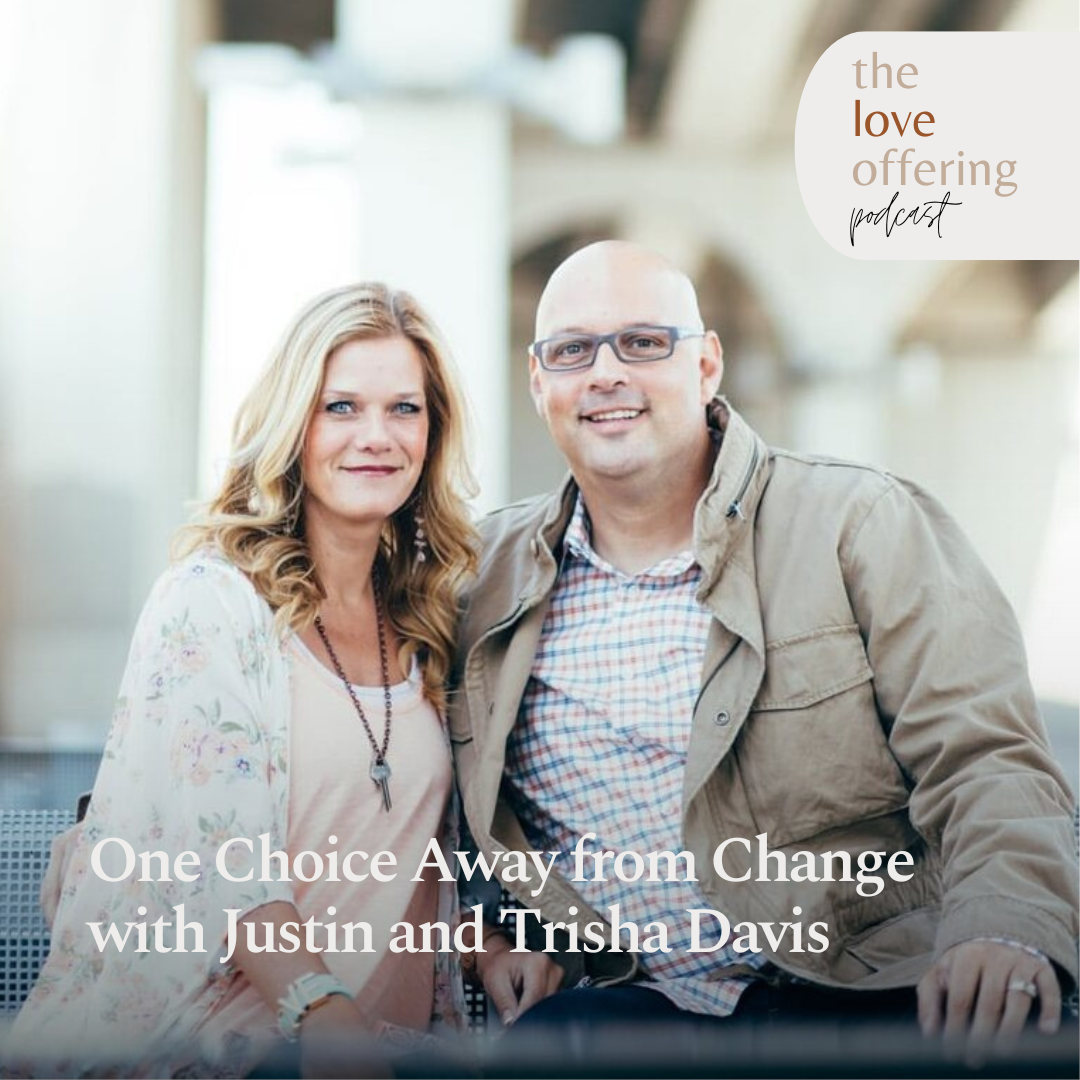
This week on The Love Offering podcast, I had the incredible privilege of sitting down with Justin and Trisha Davis, authors of One Choice Away: A Journey to Break Free from Fear, Shame, and Dysfunction. In this honest and hope-filled conversation, we talk about how to identify and overcome the behaviors and thought patterns that sabotage our relationships and steal our joy.
Drawing from their powerful story of healing and redemption, Justin and Trisha offer practical encouragement to help us:
- Understand the deeper reasons behind the choices we make
- Stop letting the past dictate the present
- Break free from our go-to sins and dysfunctions
- Walk confidently in the identity and hope God has for us
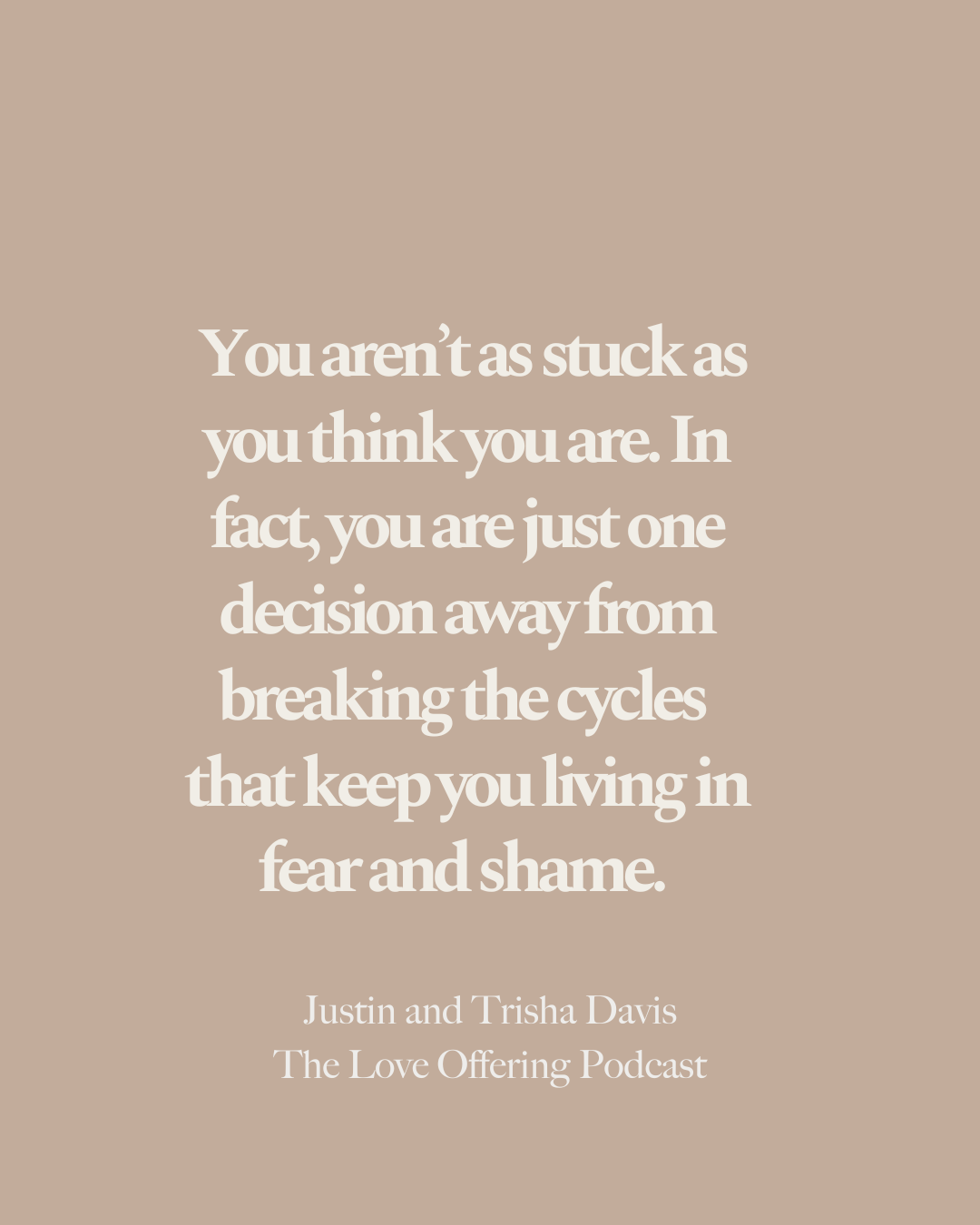
Because the truth is: you’re not as stuck as you think you are. You’re just one choice away from healing, growth, and renewed relationships. Whether you’re facing challenges in your marriage, friendships, family, or even your work life, this message will meet you right where you are.
🎧 Listen to the episode now: The Love Offering – Rachael Adams – Christian Podcast
Let this be the day you choose to trust God with your heart, your healing, and your hope.
With love and hope,
Rachael Adams
Host of The Love Offering Podcast
Summary
In this episode of The Love Offering Podcast, Rachael Adams welcomes Justin and Trisha Davis to discuss their latest book, One Choice Away: A Journey to Break Free from Fear, Shame, and Dysfunction. Through powerful storytelling and biblical wisdom, they reveal how every person is just one surrendered decision away from healing. They talk about breaking unhealthy relational cycles, parenting with grace, confronting fear and shame, and walking in God’s restorative love. This honest and hope-filled conversation will remind you that no matter how stuck you feel, change is possible—one choice at a time.
Chapters
00:00 Introduction to Love Offering Podcast
00:28 The Journey of Justin and Trisha Davis
03:00 Understanding Relationship Cycles
05:50 The Importance of Self-Awareness
09:03 Parenting and Breaking Cycles
12:04 Making Choices for Change
15:00 God’s Sovereignty and Our Choices
17:59 Fear, Shame, and Transformation
21:04 Empowerment Through Choice
24:01 Identifying and Breaking Destructive Patterns
26:57 The Role of Promises in Change
29:50 Hope and Healing in Christ
32:56 The Power of Love and Community
35:56 Conclusion and Prayer
Transcript (AI Generated)
Rachael Adams (00:00.909)
Welcome to the Love Offering Podcast. I’m your host, Rachel Adams, author of “Everyday Prayers for Love,” where we learn to love God, others, and even ourselves. Each week, we delve into meaningful conversations about how to live out the greatest commandment: loving God with all our heart, soul, mind, and strength, and loving our neighbors as ourselves. Through inspiring stories, practical tips, and biblical truths, my hope is to encourage you to love boldly, live faithfully, and reflect God’s love in every area of your life.
Today, I’m thrilled to welcome Justin and Trisha Davis, authors of “One Choice Away from Change: Break the Cycles that Hurt Your Relationships and Hold You Back.” If you’ve ever felt trapped by repeating patterns in your relationships, your work, or your personal life, this conversation is for you. Their story of healing and practical encouragement will equip you with the tools you need to break free from dysfunction and move toward God’s transforming power.
Well, hello, Justin and Tricia. Welcome to the Love Offering podcast. I’m so happy to have you both.
Justin & Trish Davis (01:00.834)
Thanks for having us. We’re excited to be here.
Rachael Adams (01:03.245)
We already had such a fun conversation. We found some commonalities, as well as areas where we disagree slightly.
Justin & Trish Davis (01:08.174)
We can agree to disagree.
Rachael Adams (01:12.249)
We’re talking sports. As we’re recording, it’s March Madness, and we have different teams that we’re both rooting for. But it’s okay. This is going to be such a good conversation still, and y’all are so much fun already. And so I’m excited to dive into your book, What’s One Choice Away From Change? What inspired this message? Can you share a little about your journey and how God has used your story to shape this message?
Justin & Trish Davis (01:39.724)
You know, we got a joke now that we’re, I’m about to turn 50. So we’re like, we’re old people. Now we get to look back and say, ‘You know, looking back on our lives, Justin and I met at Bible college.’ I grew up in a very inner-city, diverse area of Julia, Illinois. Justin grew up in a rural community outside of Indianapolis, Indiana. And we fell in love with the idea that, together, we could change the world through the local church and Jesus on our side. We just had this belief that if we loved each other and loved God, we would live a life of rightness. And so, we were in ministry, doing student ministry, and we planted our first church. However, 10 years into ministry and marriage, our marriage imploded, and it began a journey that continues to this day. And so through our marriage story, we were separated for two months, and we got back together through intense counseling. And it began unearthing stories within us that we didn’t even know we were carrying from our childhood, as well as decisions that informed us individually, which also informed our marriage. And so over the past 20 years, we’ll celebrate 30 years of marriage, which is crazy. We got married when we were 12, just in case we were wondering. It began this journey of understanding, like, how do we get stuck? Not just in marriage relationships, but in all relationships. Why do we keep doing the same thing over and over and expecting different results? You know, why do our decisions not only keep us stuck, but they also begin to hold us back from the person God has called us to be, and begin to create damage in our relationships?
Rachael Adams (03:30.901)
In the book, you discuss identifying the cycles that harm our relationships and hold us back. So why do you think we fall into these cycles, and how do they impact our lives?
Justin & Trish Davis (03:41.302)
One of the things that we began to realize is that we never struggle with anything new, right? As you examine the relationship cycles in your life, whether that be in school, work, or with friends, most of us have these patterns of behavior, and we often think that the problem lies with the other person. So we switch jobs because we can’t stand our boss, or we drift away from friends because we think that those people don’t know us how they should know us, or in our marriage relationship, if you’re married, you feel like, man, why does my spouse always do these things that annoy me? What we began to realize is that the common denominator is us. And so if we can have self-awareness and begin to understand some of the beliefs, some of the messages, some of the preconceived ideas we have about our relationships and our relationship with God, That self-awareness piece, quite honestly, it’s the most important, it’s often the most overlooked because we’re consistently looking to blame other people for the issues that we have rather than taking an inventory. And so the hope was to use our story and to use the last 30 years of our marriage relationship to help the reader maybe hold up a mirror and see themselves in this book and say, man, if they can find a breakthrough, if they can find freedom, then I know that God has that in store for me.
Rachael Adams (05:14.635)
Yes, this is truly powerful. I’m excited to continue today’s conversation, but we’ll take a brief break to hear a word from today’s sponsor. And when we come back, we’ll explore how to overcome the past’s influence on our present and move forward in God’s healing.
Welcome back. I’m talking with Justin and Tricia. And so you all say that understanding why we make confident choices is the key to breaking these destructive patterns. Can you speak to how God has revealed those reasons in your own life and how the process led to healing?
Justin & Trish Davis (05:50.582)
One of the things that most of us identify with is what happens to us. We know, okay, this is what happened. What we sometimes fail to understand is why this is the case. Motivation and our motives drive a significant portion of our behavior. And so the hope of the book isn’t just to identify what is happening in your relationships, but to help you understand: why do you keep making that destructive choice? Why do you keep giving in to insecurity? Why is fear such a significant part of your life and your relationships? Why do you carry unforgiveness, bitterness, and resentment? Why? And so, if you can understand the why, then that’s where transformation begins, because then God can come in to those broken places in your heart and say, okay, now that you know why, let’s choose something different.
Rachael Adams (06:45.945)
Do you have anything to add to that, Trish? It was good stuff. You should write a book on that.
Justin & Trish Davis (06:49.303)
Now I thought, ‘That’s good stuff.’ I was in it with you. Was good. As he was talking, we shared the story of messages that are spoken over us or words that are spoken over us, which become the messages we live from. But often, we have no idea that that’s the posture from which we’re living. And so, for many people, viewing our past and understanding it is like, ‘My gosh, I do not want to go there.’ I was hoping you could recommend a book that allows me to start right where I am today and move forward from there. However, the beauty of looking at your past is that, if we view it as excavating our lives, we can see it as a source of discovery and self-discovery rather than a place of ‘I wish I had missed an opportunity. And that was the beginning process, where we came alongside the reader to say, ‘Okay, if the beginning of making one choice to break cycles in my life begins with telling the truth, how do I do that?’ And that begins when we look to our past and ask, ‘Okay, what shaped us?’ What are our beliefs? Where did we get them from?
And I tell this funny story about it, it’s weird to me, but as a little girl, I didn’t know I was dyslexic. I didn’t find that out until I was like 35. And I was, I believe, in first or second grade, and I was invited to do the spelling bee. And I’m like, well, I know I don’t read very well, so I’m pretty sure I can’t spell. Still, I’m going to give it a go. so it was like, we used to have what we called the school cafeteria, where it was like, you ate there and had little stage the whole school is there, spelling bee starts, my name is called, and I go up to the mic and they say bus. I’m like, in my brain, I’m like, I know how to spell bus. And so I get close to the mic and I’m like, B, U, S, long pause, S. And everyone started to laugh. And it was a moment, as a little girl, that was just this simple moment.
Justin & Trish Davis (09:03.362)
Those laughs, what I heard was that I was stupid. And that stayed with me for a long time. And it informed the adult that I had become, and the reasons why I would often insert myself too much or not enough, you know, those extremes. And so, breaking cycles begins with a willingness to tell the truth, which often starts with a desire to excavate your past.
Rachael Adams (09:31.351)
Yeah, I’m just wondering as you’re talking, how has this whole process of what you have discovered, how has that informed the way that you have parented?
Justin & Trish Davis (09:42.03)
One of the things we realized as we were writing the book was that we hadn’t even told the story in the book, as it was almost as if it had only become apparent after we turned in the manuscript. We were reading through the book, and one example that came to mind is from when our kids were young. We have five children, and our oldest is turning 29. That’s hard to say. Twenty-nine, twenty-six, twenty-two. And then we adopted Jalen and Janaya eight years ago, and they’re now 17 and 15. When our two older boys were little, Trish and I would pray with them every night, and we would inevitably say, ‘You’re going to be a world changer, or God’s going to use you to change the world.’ And our oldest son seized on that and ran with it. And on his 18th birthday, to my disapproval. He got that phrase tattooed on his arm. And I now have a tattoo, and I gave him a hard time about it. He tells me every day how hypocritical I am. But that was how much it meant to him, right? He tattooed it on his arm, and it’s in Trisha’s handwriting because she wrote it in a letter to him during her senior year of high school. Our middle son, who is no longer middle, but our second-born, carried that as a weight, feeling he could never live up to it. And so something that inspired our oldest son, words of life we felt like we were breathing into our kids, became words of expectation and disappointment. If he doesn’t change the world, God will be disappointed in him. My parents will be disappointed in me. So understanding that sometimes it’s not even our intentions that can bring wounds into a relationship, because our intentions were great. It’s how someone receives information. And so just being aware of that and understanding that when you begin to look for cycles to be broken, God brings you an awareness. And so I’ll never forget, it was just three months ago that I called my 25-year-old son and said, ‘ I never realized this. ‘ We had a beautiful conversation about it because it was just this new awareness. And it’s helped us understand each other in our relationship in a deeper way, as he’s now an adult.
Rachael Adams (12:04.695)
Yes, it’s truly amazing how every decision, every choice, and every word spoken does matter. And that can feel weighty. Like, and so where’s grace in this process?
Justin & Trish Davis (12:20.236)
Yeah, I think of the mom, know, we, I think there’s motherhood and then there’s like, like, you know, gives the definition and then there’s like a B definition called guilt life. Like we can easily tune into that mom guilt. And what we don’t want people to receive from this is that your words do matter. Still, God has given your child their DNA, their brain, their heart, mind, soul, and their fingerprint. With these, they can take those words and infuse them with their relationship with Christ, becoming who God is calling them to be. And so we can shed that Messiah complex of feeling like we’re going to get it wrong, because we’re. The beauty of that conversation with our middle son, Elijah, was that he was willing to go first by being honest about how his past had affected him. The job for us was, were we going to be humble enough? Were we going to bring that agape love that is sacrificial to own something that I could have said, dude, why would you think that? AKA, why are you digging on my parenting? I was a pretty good mom, but it was as if I had missed the opportunity to realize that his story wasn’t about me. My words were the conduit for how he felt, but it was his journey. And so it’s learning to strike that kind of balance between the leadership that God has given us as moms, but not Lordship. So that grace comes in when we have it, it is truly powerful. Having three adult kids, I’ve come to realize the power of saying, ‘Gosh, I’m sorry.’ I just went off on you or you know, I I not an excuse But you know, here’s kind of how my day was and it just that understanding I believe it’s you know, when the Bible tells us that it’s in our weakness. He’s strong; I think that’s true in motherhood, as when our kids see us from a posture of feeling, ownership, and restoration. That’s what keeps us from getting stuck in cycles. We go from parenting from cycles to parenting on a path where we enjoy the journey rather than the destination that we hope our kids know. Whatever picture you have for your kid, cause you know you have it, we can parent for that rather than just being in the present for where they are now. And it just makes life fun even in the challenges.
Rachael Adams (15:05.751)
We need to be aware, introspective, and pray, and perhaps ask trusted people in our lives what our ‘why’ is. And then we’ve got to be really honest and vulnerable with the people around us. Now, let’s discuss how to break these cycles through our choices. So can you all share a specific decision that you made that helped you move toward healing?
Justin & Trish Davis (15:29.646)
There are five cycles that we identify in the book. As we have spoken with people over the last few weeks, it has come as a surprise to them. They were expecting it; oh, I thought you were going to teach me how to communicate better. I thought you were gonna teach me how to resolve conflict. And those are the outward expressions of the inward cycles that we struggle with. We struggle with conflict resolution because we often face insecurity or fear.
And so we identify these cycles as more heart conditions. One of the things we wanted to do is set the reader up not to feel overwhelmed, because sometimes we feel like we have so far to go that one choice seems too insignificant. However, as you pointed out earlier, Rachel, one option can indeed change everything.
You know, my asking Trish to marry me was one choice, but it changed the whole trajectory of our lives. The school we attended altered the entire trajectory of our lives. So don’t minimize the one choice that you can make. You don’t have to have everything figured out. You don’t have to identify every cycle if you make that one choice; that’s where grace comes in. Because we’re trusting in the power of the Holy Spirit, we’re trusting that our Heavenly Father sees us, hears us, and meets us in those moments where we can say, ‘ Okay, God, I don’t have the strength to run a marathon. ‘ Still, I’m just gonna take one step and know that, as you said, Trish, in our weakness, he becomes strong.
Rachael Adams (17:09.273)
Discuss God’s sovereignty and plan, as well as our role in partnership with Him and our participation in that plan. You know, like I think that there’s one train of thought that’s like, God, doesn’t matter what I’m going to do. God’s will is what is going to be done, and he’s going to turn everything for good for those who love him, no matter what choice I make. Do you know where I’m going with that question? Yet, we do have to take some initiative, and we will be judged eventually in eternity based on the choices we’ve made. Could you discuss that balance with us? That’s a lot to wrestle with.
Justin & Trish Davis (17:49.056)
I feel a little anxious here because I’m currently in graduate school, and one of my classes is systematic theology, so I feel like you’re delving deeply into theology here. I think Trish can also speak to this. I’ll give you a hopefully brief answer, because I typically go into detail. But one of the things I love about God is that I think there’s God’s perfect will and God’s permissive will. And one of the things I’ve realized in my life is that there’s no decision I can make and no sin I can commit that can stop God’s will. I’m not that powerful. And so it’s not necessarily getting everything perfect. It’s aligning your heart with God’s heart and saying, Okay, I know I blew it. I know I messed up. And our story is indicative of that because, you know, I blew our family up. I blew our life up in 2005. And we never thought we’d return to ministry. We never thought—I felt that God would never use me again. I’d failed morally, and I’d never seen a pastor restored. You know, most pastors who fail were insurance salesmen in our town. And so, knowing that even in some of the biggest mistakes and the ways I blew it, God turned that around and used it as almost a megaphone to shout about His grace, His restoration, and His redemption. So, I think that if you’re looking to live a perfect life in order not to disappoint God, God is not going to love you any more than He already does. And his love for you is complete, regardless of your choices. And so it’s more of understanding his grace that enables us to give grace to ourselves and to those that we love the most.
Rachael Adams (19:49.133)
Yeah, that was a good answer. And as you were talking, I was thinking about a quote from C.S. Lewis that says, The road to hell is a gradual one. Kind of like the, you know, I think there’s this pendulum, like we’re one choice away from something bad. We’re one choice away from something good, you know? And so we, but we do have a choice. That’s what free will is, right? That God gave Adam and Eve the choice. Yes.
Justin & Trish Davis (20:09.516)
Yeah, it’s the greatest gift, right? Like that is the gift. The choice is the greatest act of love that God has given us. It’s the choice that Jesus made on the cross. It’s also the choice that Eve made. Mean, she, just one question, you know, of just answering one question, did God say, and we know that she had the presence of God. It was literally, she could have said, ‘Hold up, let me ask my God.’ But it just took one question to ask, ‘Is there a different choice?’ And so, the preferred choice of God is that we walk in the cool of the day with Him. But he gave us the choice of the two trees, the tree of the knowledge of good and evil, right? Or the tree of life. But choice is the act of love. And so every day we get to choose not the right path, but we get to choose God. And when we choose God, when we’re on the path with a very broken world where we have those cruel whispers of Satan, did God say you are a good friend? Did God say you are a good mom? Did God say your marriage is good because you know, your friends, they’re going on vacation every other week. Did God say that you are, you know, worthy of a call because you’re just changing diapers all day, or you’re just a student, or you’re just, you’re just. And so, where we get stuck is that we begin to believe those lies that our circumstances value us and how we handle those circumstances, as opposed to experiencing those circumstances, which solidify our understanding that we are a child of God. He knows the hairs on our heads, our days are ordained. There’s a freedom in just walking in that truth, to your point, God doesn’t care. You aren’t more loved because you have a relationship title.
You were already loved, but he genuinely cares about you and your relationships. And so, it’s about finding that balance and nuance of valuing the gift of community, while also valuing the gift of your identity in Christ. And we’re just going to get it wrong sometimes. It’s just part of the human condition. We saw it with Eve and, you know, we’ve seen it. If you read the book, you’ll be like, Wow. Okay, like, they’re messed up. I can’t be more messed up than that. Exactly. It’s a self-esteem book for the reader.
Rachael Adams (22:55.641)
Yeah, but yeah. You know what you were talking about, Trish? It makes me think about how we make these informed decisions and choices. And I think a bit, and I don’t want to put words in your mouth, but we have to know what God’s word says. And then as believers, we have the Holy Spirit residing in us to guide us and counsel us, teach us, and hear his voice. And then it’s up to us to be obedient. So, cause sometimes I don’t know about you all, but like, I know the right choice to make and I still don’t make it. Make the other choice, you know? So, it’s a battle between our flesh and the enemy’s lies, and we’re trying to be obedient. I don’t know. Does that evoke any thought in you?
Justin & Trish Davis (23:37.992)
I some of it is we do, even when we know that there’s probably a better choice to make, I think that’s where we get most stuck is when we don’t know or we have been sold like false theology of what we understand or how we understand God, especially, you know, one of the cycles we talk about is unforgiveness.
I’ve never met a person who, to be honest, just bought a book on how to be angry and bitter. It just happens. But you know, over the past 30 years of ministry of walking alongside people, trying to walk out forgiveness, I’ve come to recognize, I mean, we both have how people try to make the right choice, and they forgive and forget because that’s what they think forgiveness is. And then bitterness starts to well up again, and resentment takes hold, and now guilt and shame are part of the mix because you thought you had already forgiven. Some of that involves making the right choice. However, as to your point, Rachel, we must be willing to empower ourselves. And sometimes we feel like empowerment may be a sign of weakness, or there is so much information out there. You can scroll just one scroll on social media and get five different perspectives. So it can be really noisy. And so, part of it’s that it’s not formulaic, but it’s just one thing leading to another, and it begins with telling the truth. It starts by acknowledging the truth about where you are, but then it’s about empowering yourself.
And first and foremost, God’s word is awesome. But then, we also went to counseling; we still have counselors, and God bless them, they work for their money. You know, we have friendships where we allow them to speak life into us, and vice versa. Guess what I’m trying to say is you don’t have to do it alone and when we don’t feel like we know what the next step is to make or we Felt like we did and then we made it and then the relationship blew up anyway the defeatism of like well, I Technically feel like I did the right thing in it. I lost anyway, so peace out. I’m just not going to have friendships anymore. We go to extremes to go, I’m just, I just don’t want to be a part of life like that.
Rachael Adams (26:10.679)
Yeah. We’re going to take another brief break to hear from today’s sponsor. And when we return, we’ll discuss how to move forward in the hope of becoming who God calls us to be.
Welcome back. We’re discussing our choices with Justin and Trish Davis and breaking destructive cycles. So you’ll talk about leaving behind our go-to sins and dysfunctions. So how do we begin to identify those areas in our lives and take practical steps to move away from them?
Justin & Trish Davis (26:43.488)
One of the things that has been helpful for me, as I’ve tried to help other people see these destructive cycles, is to examine the promises that you’re making but not keeping. Perhaps for you, it’s that I’ll never speak to my kid that way again. I’m never going to treat my wife that way again, or I’m never going to, know, whatever that is, whatever the promise you’re making, I’m not going to look at that website. I’m not going to watch a movie like that. Like whatever behavior you want to stop, but then you keep coming back to it. For instance, I’m never going to argue or talk to my spouse like that when we argue; that’s a good place to start. That’s an indicator that there’s a repeated behavior in your life that needs to be changed. And for us, it went a lot deeper than that. As you mentioned, at the very beginning of the interview, some of the things that we struggled with in our marriage and family weren’t just behaviors; they were long-standing family dysfunctions that we wanted to identify and address. And so, in 2021, Trish and I, within six days of each other, discovered that our dads were not our biological fathers through Ancestry.com. Everybody’s going, wait, what? Did you- I do want to say, yeah, we are not related. Our dad isn’t the same person. So, there’s no, but yeah, I want to take a minute for people to go, ‘wait, what?’ Because, you know, yeah, it was a lot bigger bomb than we have time to unpack. Yeah. However, it did mark an almost inflection point for us personally, particularly in certain aspects of our lives, our marriage, and our families, which now make so much more sense. Patterns of deception, patterns of hiding, shame, guilt, like bigger things than, you know, I said a cuss word today at work, and how we wanted our family to be different moving forward. And so really the heart of the book isn’t just to help you behave better in your relationships. The heart of the book is to help you become different through the power of Christ, so that the relationships around you become different, even if somebody else doesn’t choose to be different; the relationship is transformed because Christ is transforming you. And that we weave that story through the book, not necessarily as the focal point, but to help the reader understand there’s probably not a bigger identity crisis that you’re going to face than this crisis and to see what Christ can do in the heart of someone who’s fully surrendered to be able to transform some of the deepest wounds that we could ever experience and to stop the perpetuating aspect of those wounds to carry on in our family.
Rachael Adams (29:50.297)
Yeah. It reminds me of the now, breaking free from generational cycles. And as you were talking, I was thinking about the Atomic Habits book and how he talks about, you know, if you are on an airplane. You start in California, and then if you’re just 1% off in your direction, you could end up in, say, Washington, DC, or New York. And it’s true. It’s just a slight change, a little choice over time that can change everything in your life, your children’s life, and your grandchildren’s life. And that’s powerful to think about. And something you mentioned, Justin, was talking about fear and shame. And, actually, Trish, I think you mentioned this too. And I think those two things often keep people stuck in these unhealthy cycles. So, how can someone listening today take that first step in choosing to believe that they’re not as stuck as they may think they are?
Justin & Trish Davis (30:43.51)
When I started just taking a deep dive into the topic of fear and the role that it plays in our lives, like what does God say about fear and how many times, once you get it, it’s kind of like when you get a car. You’ve never noticed that car before. Now that you have that car, everybody else on the road has that car. And it’s the same thing with fear. Once you examine the word and then delve deeper into the Bible, you’ll find it everywhere. And so, like, what does fear play a role in our lives? And what’s interesting is that we often talk about the heart and the head, but many of the things we experience are physically felt. There’s a visceral, there’s a physiological response going on. And with fear, we have like a tiny part of our brain called the amygdala that affects, it’s the, you know, I don’t, nobody’s ever taught us this, but it’s like when you’re driving in the car and you stop and your arm goes out to hold the person.
Now, one of my kids is six nine. I’m not holding him back, but you better bet that my arm goes out. So empowering us to go, okay, what are these emotions? That is, you know, when we call gravity a problem, like we can’t change gravity. It just is what it is. And the way that God created us, the physiological makeup of us, we’ve got this response in our amygdala that when we feel fear, it’s that fight or flight. And for most of us, you’ve heard that. And then we realize, okay, I’m either going to fight or flee. But what we don’t know is that fear often brings us to an awareness that we’ve never had before. And we can allow fear to dictate what will happen next, or we can view it as a crossroads to say, ‘Okay, I am aware that something needs to change.’ I am aware that this has been brought to my attention. What do I want to do with it? And so, you, the person listening, I know when I talk with a lot of young girls in college, there’s just such a pressure to figure out life before you graduate. Not wanting to waste money and feeling, you know, like, and we think, okay, well, once we get to that next season of life, then all of that fear will go away. And then we get into that next season, and we bring our fear with us. Part of that is encouraging the reader to acknowledge that this isn’t about never feeling fear. Then we give a false sense of how God created us to be, and then we’re always disappointed. Still, it’s at that moment that we can use fear as an opportunity to grow ourselves. Still, having the tools to do so, it’s empowering yourself to go when I feel fearful, I have a choice to make, and even though it’s one degree away from what I Was going to choose that could change the trajectory again, so that when I go through that experience again, I feel that hurt again. I feel like that abandonment again, whatever it is that you fear. You are teaching your heart and mind, your physical and logical self, to say, ‘Okay, fear doesn’t get to have the last word.’ I don’t have to live from a place of fear. I can live from a place of freedom.
Rachael Adams (34:16.249)
It’s truly empowering to think that we have a choice today. I’m just mindful of the woman listening today or the man who is feeling really stuck or just looking at his life and being disappointed with where he is right now. But you have a choice to make today: first choose God, then spend time with Him, and listen to His Holy Spirit. And then you have a choice whether or not to be obedient to what he’s telling you to do. And I think that’s what I am taking from today’s episode. I don’t want anyone to be discouraged, but what an empowering experience. You can change things, right?
Justin & Trish Davis (34:56.046)
Yes, one of the hopes of the book is that we want the reader to feel like, ‘I’m not as stuck as I thought I was.’ And God doesn’t view me as the sum of my failures, mistakes, or repeated cycles. God opinions me not as I am, but as I can be. And that’s the beauty of the cross, right? That God is making all things new. And so there is this freedom that we have to step into the identity that God has for us. We don’t have to stay stuck. One of the things that Trish says in the book that I love is that when we feel helpless, it can lead to a state of hopelessness. And neither of those things is from God. Helplessness is not from God, and neither is hopelessness. And so, there’s hope and help, and His name is Jesus. He longs to meet you not where you pretend to be, but where you are, and that’s where transformation can start.
Rachael Adams (35:56.973)
Yeah. Trish, you mentioned that God chose to send his son Jesus, and then Jesus chose to die on the cross for u,s and just what love that that is. as we’re thinking about that, is there a biblical concept of love that you’d like to share with us today that you think applies to this topic?
Justin & Trish Davis (36:18.606)
It’s gonna sound super odd, but there’s this moment of Jesus on the cross where Jesus, you know, if we can just put it in the context of all that he has been through. We know that his mom has been there the entire time. So there’s this moment where I can’t imagine the weariness of Mary seeing her baby boy on the cross, and then just out of all that’s going on, Jesus takes this moment and he looks at his disciple and he says to the disciple, This is your mom, this is your son. It’s like this: I love you so much, I want you to let go of me, but I want you to know that you loved me well and you deserve to be loved. And so the disciple whom I love is going to love you. And it’s just this moment of it. None of that conversation makes sens,e that he was about to take on the weight of the world literally. That his love for his mama was so. It was just this. It’s just a kind of love that there’s nowhere else in the Bible that you see.
Jesus says in an intimate, personal one-on-one conversation, ‘I love you so much; I do love the world.’ Still, I love you, and the disciple whom I love is now going to be your protector. It’s just a reminder that if Christ is able and willing to love in such a hard place, where He’s fully human and fully God, how much more does He love you now that He has walked out of the grave and declared us new? There’s power. And maybe what you need to hear today is that God is so in love with you. Like the ability for God to see his son’s love in that way is the same humanity and the same Holy Spirit that lives in you, so that you both can receive that love and give it.
Rachael Adams (38:39.929)
Yeah. Thank goodness. Thank goodness. I’m so grateful for that truth. So tell me, what’s something you’re loving right now other than basketball, Justin?
Justin & Trish Davis (38:49.976)
Well, March Madness, Rachel, is going to be my choice. As we record this, we are two days away from heading to Florida for spring break. And I’m loving the fact that for five days, I’ll have my email turned off. I don’t have my phone turned off, but I’ll turn off some apps and spend time with our families. I’m loving the idea of that. That’s so good. I was thinking I love chocolate chip mint ice cream for 31 flavors. It was so much smaller, yeah, I’ll take the ocean too. Yes, I will do both. I love them both. We have a special ice cream shop that we visit every year. So we’ll go in there next week?
Rachael Adams (39:24.697)
You enjoy having ice cream on vacation. So yeah, I yes. Yeah, you’ll get that. Yeah. Well, I know you all have some prayers in your book as well. And so, as we come to a close, I would appreciate it if you would do us the honor of praying for us.
Justin & Trish Davis (39:52.226)
God, we come to you today, knowing that you had in mind every single person listening to this podcast right now, as well as those listening to this conversation. And God, your love knows no bounds. And so God, would you help the listener not see themselves by their mistakes or by their past, by the choices that they’ve made, but see themselves in light of who you are?
They are chosen, they are loved, they are redeemed, they are set apart. And God, no matter how dysfunctional they feel like their relational life is, no matter how messed up they feel like their childhood was, no matter how hopeless they feel about a relationship ever being healthy, I pray that you give them one choice they can make to take a step toward you, a step toward health, a step toward transformation. They don’t have to have it all figured out. Free them from the burden of that and let them know that the one choice they can make is the choice to see you, to embrace you, to trust you, and to know you. We pray this in Jesus’ name. Amen.
Rachael Adams (41:00.089)
Amen. Well, Justin and Trisha, I appreciate you all so much for being here and sharing your story and your wisdom. If people want to stay connected with you, as I do, please let us know how we can obtain a copy of your book, listen to your podcast, and keep in touch with you online.
Justin & Trish Davis (41:16.238)
Yeah. Our book, ‘One Choice Away from Change,’ is available on Amazon or at any bookstore. We also have a website called refinus.org. A more straightforward way to access it is by typing in ‘Justin and Tricia, and Tricia and Justin.com‘. And it’ll send you there as well. We have a podcast called the Let’s Get Real podcast, where it’s not a marriage podcast. It’s just that we talk about life, love, and leadership, and a lot like this conversation today, we share stories and bring friends and their stories to learn from each other about those different areas of life, love, and leadership.
Rachael Adams (41:54.403)
Yeah, well, awesome. Well, thank you so much for joining us, and thanks to everybody else for joining us today. If this conversation has encouraged you, would you take a moment to share it with someone who may be feeling stuck in a cycle of relational pain or personal struggle? If you aren’t as stuck as you think, you’re just one choice away from change. Thank you for listening to the Love Offering podcast. If you’ve enjoyed this episode, please leave a review and visit me at rachelkadams.com for more resources, including the Love Offering Calendar and the What Makes You Lovable Quiz. Don’t forget to pick up a copy of Everyday Prayers for Love and Justin and Trisha’s new book, One Choice Away from Change. They are available at any bookstore. A special thank you to Life Audio for making this podcast possible. For more inspiring shows, visit LifeAudio.com. Until next time, let’s make our lives an offering of love.
Connect with Justin and Trisha:
https://www.justinandtrisha.com/