The mamas are many. The day, hot.
A miracle happens.
It happens outside Jinja, Uganda, at the dorms, where we house teenage mothers who are going back to school.
It happens in the wide-open space between the red brick dorms and the piggery.
Ivory tents rise high like a wedding. Blue plastic chairs are laid out in rows, carried on the backs of boda-bodas or motorbikes. And the pregnant mothers sit, row after row in colorful cloth, some wearing hijabs, others rosaries, others scarves around their heads. The teenage mothers walk around in school uniforms, giggling to each other. Caterers are cooking lunch by the outdoor kitchen. Large metal pots hang over charcoal fires, holding fish sauce, rice, matoke, and beans.
I’ve flown to Uganda with teammates. We arrive at the dorms at nine. The mothers have been coming since sunrise.
The pastors in their white-collared Lulu shirts scribble down names on lined paper, registering each mother as she arrives. At one point my friend Norah asks to see the names. Later she confirms them, line after line, starting with the last name, ending with the first.
The gate to the compound is open and village children stream in with big smiles, eager to see the white muzungu or foreigners, and the bulging mamas in bright colors spilling out of tents like flowers.
The chairs fill. The praise team arrives and the dancing begins. Our Uganda director calls it The Blessed Mama Dance. The women sway in the heat in their pregnant bellies, some of them so ripe they look like they’ll split open in the sun.
The air smells of charcoal and beans and sweaty bodies. Occasionally, the leaves on the banana trees stir. Mostly, they hang limp.
We stand on a makeshift stage, overlooking the crowds of women, trying to move our arms and legs in awkward dancing. Finally, the women pull us down with them and there is laughter and twirling and colors whirling like a kaleidoscope.
There are 800 mothers, surrounding a pile of 500 mama kits.
The kits are simple, made up of things we take for granted. Without them, though, no Ugandan mother can give birth within a hospital. The kits contain two plastic sheets – one for the woman to lie on, one for the medical items: surgical gloves, a bar of soap for washing hands, a roll of cotton, new razor blades to cut the umbilical cord, gauze for wiping the baby’s eyes, one suction bulb for cleaning the baby’s airway, and a swaddling blanket to wrap the baby in.
This isn’t our first mama kit outreach. There have been others, in the slums and refugee camps, with hundreds giving their lives to Christ. But never have we had so many mothers compared to kits.
The dresses sway and the preachers preach and the women fall on the ground, shaking, because demons come out in the open, here in Africa. The delivered mamas lie still as a corpse, only to rise and keep dancing. This is Africa.
The night before the outreach we’d prayed a small prayer, not knowing what a big prayer it actually was. We’d asked God to bless, to multiply, the mama kits, but the word “multiply” was like an afterthought, like a kiss on the back of the head. There was no travail.
I’m not even sure we knew what we were asking. I’m not sure how much belief there was behind the word “multiply,” because it was just a nice word we chose, more like a “Bless You” after a sneeze. A gratuity, as if God depends on our vocabulary or even our prayers.
In America, if we pray for a miracle and don’t get it, we go to the doctor. Or to the store. Sometimes, we pray for a miracle en route to the doctor or the store.
In the villages of Africa, people pray for a miracle because without it, they will die.
It is time for the meal. We’ve purchased enough rice and beans for 500 people. Not 800, plus village children.
But the caterers dig deep into pots and pile the plates high. And we help the teenage mothers serve the plates to the children and the mamas.
“I saw it with my own eyes,” Norah tells me later. “At one point, when I went back to get two more plates to hand out, I looked into the pot and it was empty. It was empty. Yet she, whoever was serving, reached in with her mug and came out with a full mug of food. And that continued for at least two more rounds, because another woman was behind me the second time I went through and she said, ‘There’s no food in there.’ And I said, ‘I know – there was no food the last time I came through. But watch what happens.’”
Every mouth is filled.
And then, it is time to distribute the kits.
Our director tells me she can’t even look. She turns away because she doesn’t want to see women go without.
A pastor grabs the clipboard, steps toward the kits; he asks Norah to come and help him hand them out. One by one, he calls out the names. One by one, the mothers come, always taking one, sometimes two kits, saying they’re having twins.
I watch, and somehow, the pile doesn’t go down. My friends watch. They also say the pile isn’t going down.
We reach the end of the list of names. Still, mama kits remain.
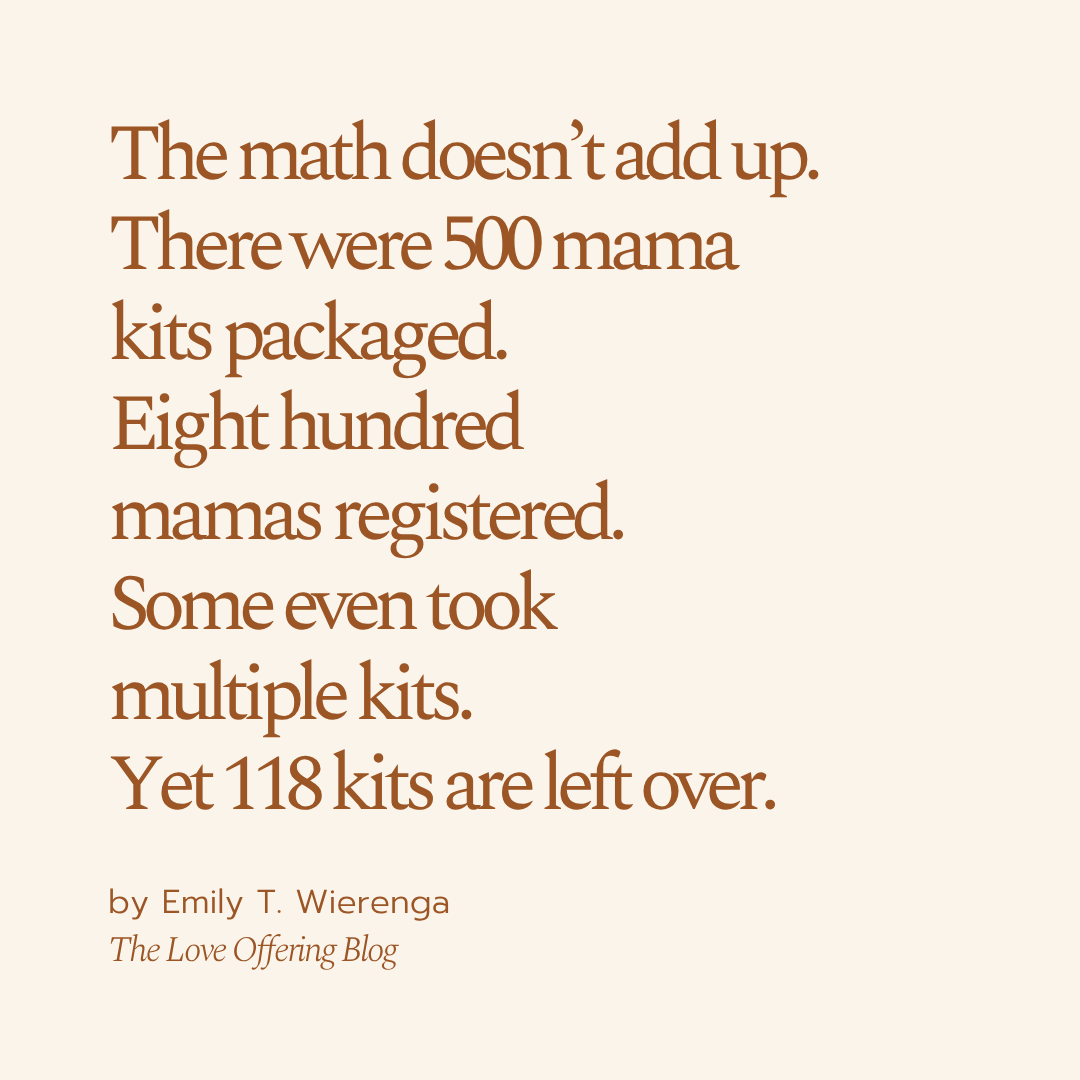
The math doesn’t add up. There were 500 mama kits packaged. Eight hundred mamas registered. Some even took multiple kits.
Yet 118 kits are left over.
It’s a story I’ve heard since I was a little girl, this one of the loaves and fishes. It’s the story of Jesus on the hillside with the thousands, breaking bread and fish and feeding stomachs. It’s a story that happens twice in Scripture, one with the 5,000 and the other with the 4,000, one with the Jews, and one with the Gentiles. Neither number, however, includes women and children.
This story, however, is all about the women and children.
The white tents empty like a sigh, of dress and rosary and hijab and belly. The caterers pack away stainless steel pots, the charcoal fire is snuffed out, the tents are taken down and plastic chairs stacked to teetering heights on boda bodas.
Yet the kits remain. A pile of miracles.
Enough for another outreach.
An excerpt from Emily T. Wierenga’s memoir, God Who Became Bread.

{If you enjoyed this blog post, you might also like this episode of The Love Offering Podcast, where Rachael chats with Mike Novotny about his book, What’s Big Starts Small, and the six threats Jesus lists in the parable of the sower and the seed–pride, pain, worries, wealth, wants, and not waiting–and the corresponding strategies to overcome them. If you’re wondering why your faith isn’t working in some aspects of your life, today’s episode is for you. You can listen to the episode here.}
About the Author:
Emily T. Wierenga is an award-winning writer and commissioned artist. Her new devotional, Commune with Me (Whitaker House, 2026), pairs with her latest memoir, God Who Became Bread. Both are available on Amazon or wherever Christian books are sold. Other books include Atlas Girl, Making it Home, and Chasing Silhouettes: How to Help a Loved One Battling an Eating Disorder. Emily founded The Lulu Tree, a nonprofit serving vulnerable families around the world. She lives with her husband and three children on a farm in northern Alberta, Canada.