“Give us this day our daily bread.” Matthew 6:11 (ESV)
When the Cupboards Are Empty
Not long after I was born, my dad lost his job during one of the recessions in the early eighties. When he wasn’t out applying for work, he mowed lawns to keep our family afloat. Those days left a deep mark on my parents. Even thirty years later, my mom still tells the story of opening the cupboards one evening and wondering how on earth she was going to put dinner on the table. Then came a knock at the door. It was some people from the church, standing there with a carload of groceries. “We thought you could use these,” they said.
Sometimes an unexpected check would arrive in the mail, often in the exact amount needed. Other times it was something strange: a surprise tax refund, or a reimbursement for a double payment no one had noticed. Each time there was a need, provision came from somewhere. Nelson’s parents insist it came from someone.
When Have You Needed Daily Bread?
What about you? When was the last time you wondered where the money or the food was going to come from?
Maybe it was a stretch of unemployment. Or one of those charming IRS letters informing you that—due to a tax oversight—you owe Uncle Sam an absurd amount of money. Or maybe you’ve experienced the dreaded triple-whammy: the washer, water heater, and car all breaking down in the same week.
It’s in these types of situations that we tend to overreact, imagining futures where a single misstep creates a disastrous domino effect. In this swirl of anxiety, we confuse what feels true with what’s actually true.
This is exactly where the prayer for daily bread meets us—in the tension of ongoing dependence, inviting us to take a posture of radical trust. It’s not a prayer that denies fear, but neither does it bow to it.
Fear will tell us that need is an enemy when, in fact, it’s a doorway to more greater closeness with God. It’s how he pulls us nearer and trains us to trust in his provision.
Praying in the Plural
This trust in God’s provision isn’t meant for our comfort alone. It’s meant to spill over into the lives of those around us, because when Jesus teaches us to pray for daily bread, he doesn’t say my bread. He says our.
God’s provision isn’t limited to what we receive. It includes what we give, and that comes through in the plural.
Our Father.
Our daily bread.
Forgive us as we forgive those who sin against us.
Lead us not into temptation but deliver us from the evil one.
The communal language is constant.
In the Bible, the word you is often plural, but in English, that rarely comes through. Not everyone on the hillside listening to Jesus was poor. Matthew was a tax collector, a man despised not only for collaborating with the Romans but for enriching himself at the expense of his neighbors. And he wasn’t the only one with means. Capernaum sat on one of the ancient world’s most lucrative trade routes: the International Coastal Highway. In Galilee you’d find Herodians, merchants, soldiers, and well-to-do business owners.
So when Jesus taught them to pray, “Give us this day our daily bread,” it wasn’t just a comfort to the hungry; it was a challenge to the full. Sure, there may be bread on my plate, but if my sister’s plate is empty, has our prayer truly been answered? Which begs the question: What if the bread God placed on my plate is the bread he intended for us?
Too often, we ask God to act while sitting on our hands, wondering, When are you going to show up and do something? I wonder how often the God of the universe thinks, Funny…I was just about to ask you the same question.
Father Ronald Rolheiser once reflected on the phrase many Christians use to close their prayers: “Through Christ our Lord.” He wrote, “When we pray ‘through Christ’ we are praying through the Body of Christ, which includes Jesus, the Eucharist, and the body of believers on earth…not only is God in heaven being asked to act; we are charging ourselves, as part of the Body, with some responsibility for answering the prayer.”
In other words, to pray the Lord’s Prayer with integrity is to volunteer for the answer. It’s to say amen—and then let our hands, our wallet, our schedule, our choices, and our legs become the prayer.
Praying With Your Legs
After returning home from marching with Dr. Martin Luther King, Jr. in Selma, Rabbi Abraham Joshua Heschel wrote, “For many of us the march from Selma to Montgomery was about protest and prayer…Even without words, our march was worship. I felt my legs were praying.”
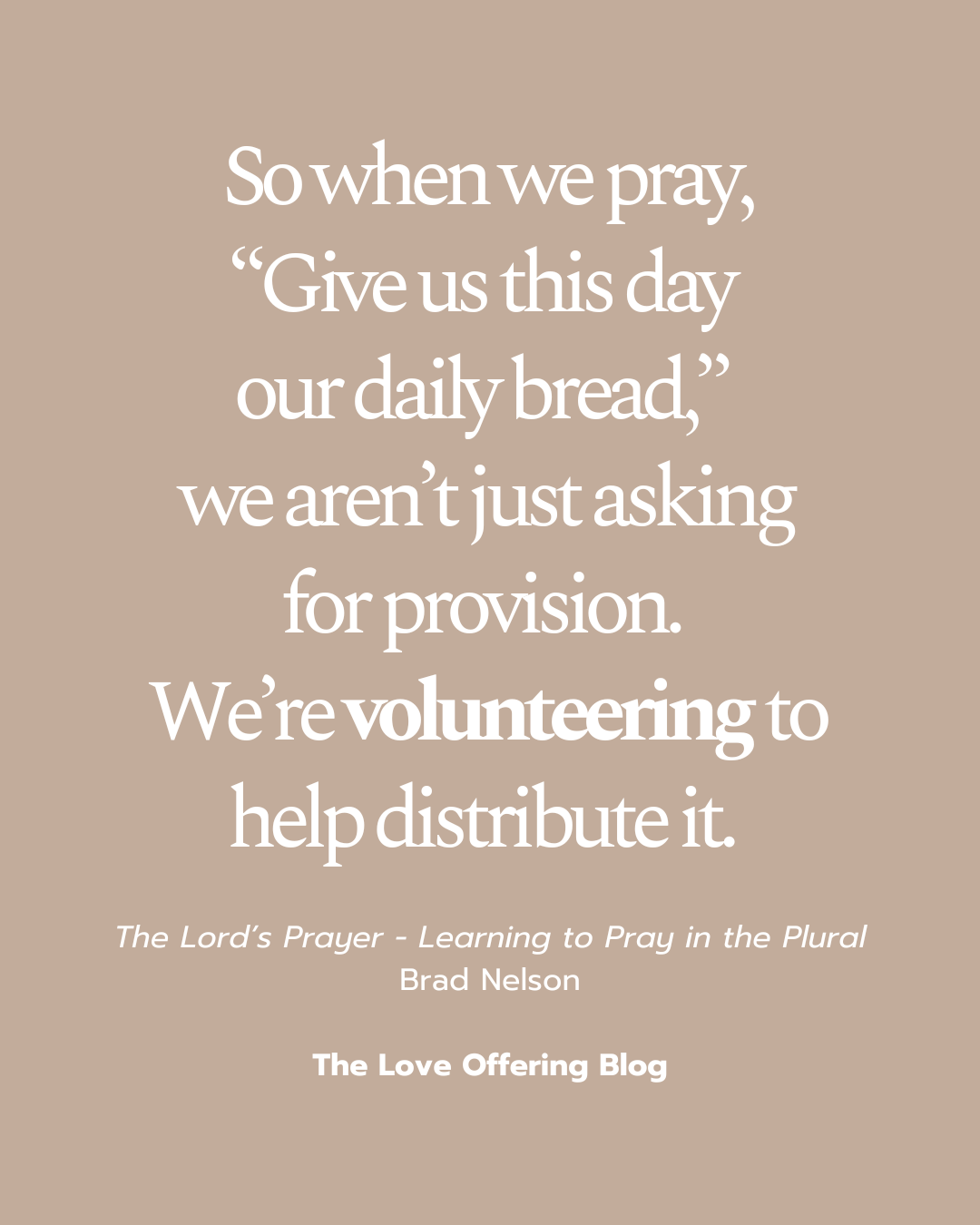
So when we pray, “Give us this day our daily bread” we aren’t just asking for provision. We’re volunteering to help distribute it.
None of us can see the future. But we can face it with confidence—not because we’ve figured it out, but because we remember who has been with us all along. The God who met you before will meet you again. He’ll be your bread. He’ll be your peace. And as you receive what you need today, however small, don’t forget: if heaven is breaking in through you, you might be someone else’s provision.
An excerpt from Chapter 11 of Bringing Heaven Here by Brad Gray and Brad Nelson.

{If you enjoyed this blog post, you might also like this episode of The Love Offering Podcast, where Rachael chats with Rachel Wojo who vulnerably shares her heartbreaking experiences of loss while pointing you to your Father. Her prayer journey and promising principles will guide you from frenzied desperation to dependent faith. You can listen to the episode here.}
About the Author:
Brad Nelson is the content director at Walking The Text, where he curates The Teaching Series, a biweekly podcast and video series, leads trips to Bible lands, and is a writer for The Sacred Thread. He is a national speaker, writer, and communication specialist. Prior to joining Walking The Text, Brad spent seventeen years in pastoral ministry serving the local church in Grand Rapids, Michigan, and planting Brick City Church in Ocala, Florida. Brad has a history degree from Cornerstone University (Grand Rapids, Michigan), a master of Divinity from Western Theological Seminary (Holland, Michigan), and has done additional graduate work at Jerusalem University College (Jerusalem, Israel). He and his wife, Trisha, live with their three daughters in Greensboro, Georgia.