
“Be truly glad. There is wonderful joy ahead, even though you must endure many trials for a little while. These trials will show that your faith is genuine. It is being tested as fire tests and purifies gold—though your faith is far more precious than mere gold. So when your faith remains strong through many trials, it will bring you much praise and glory and honor on the day when Jesus Christ is revealed to the whole world. 1 Peter 1:6-7
In the muddled middle, you have the opportunity to learn to see obstacles as gifts, which helps you tell a better and different redemptive story. This, too, is not simple or easy. We know from James 1 that trials produce perseverance. First Peter 1:6-7 reiterates that truth:
“Be truly glad. There is wonderful joy ahead, even though you must endure many trials for a little while. These trials will show that your faith is genuine. It is being tested as fire tests and purifies gold—though your faith is far more precious than mere gold. So when your faith remains strong through many trials, it will bring you much praise and glory and honor on the day when Jesus Christ is revealed to the whole world.”
I’ll be honest: This week, I have not been grateful for the trials I’m enduring. My husband’s job remains untenable, a health scare has me worried, one of my kids’ heartaches has become mine, and I feel harassed by all these things. In times when trials are more of a deluge than a manageable reality, I handle them until I can’t.
Are you walking through a season like that right now? You feel capable of handling one obstacle, then another, then another—but when ten obstacles hit you all at once, what can you do? How do you cope? How can you possibly see them as a gift?
I’m not suggesting you should be toxically positive, pretending that traumatic events and frustrating circumstances are easily wrangled. They’re not. And we need to acknowledge hard things and grieve them appropriately. It’s what comes next that helps turn the tide toward gratitude. Obstacles and trials will not last forever, but their impact will—if we let them. Perhaps that’s why Peter instructs us to be “truly glad.”
To pursue gratitude, you need to do a bit of excavating of the past. Chances are, you grew most through the obstacles you encountered. Your faith deepened and your walk with God strengthened because of those trials. Paradoxically, God uses those difficult times to grow us, to cause our roots to sink further into the soil of his love. The better our rooted structure is forged through the storms of life, the higher quality our fruit—our ability to love our enemies, trust God through trials, and find joy even when difficulties arise.
That is why we can thank God for the difficulties of our lives. Because each one comes with a hidden blessing. I’ve found that the harder the task, the more I really don’t want to face something, the more (in retrospect) I learn and grow. I have gotten on my knees just this week, tears in my eyes, telling the Lord, “Please, please hear me. I don’t want this trial. Please make it go away.” But now, after many tears, I have begun to feebly pray, “Okay, Lord, teach me how to glorify you as I endure this trial I’m not happy about.” It’s easier to see the blessing in the blight in retrospect, but it’s harder still to cultivate the discipline of thanking God for the stressor in the moment. This is a deeper level of discipleship.
Take note of the juxtaposition of Paul’s words in Philippians 2: “Dear friends, you always followed my instructions when I was with you. And now that I am away, it is even more important. Work hard to show the results of your salvation, obeying God with deep reverence and fear. For God is working in you, giving you the desire and the power to do what pleases him.” (Philippians 2:12-13)
Growing in this way requires hard work. But the latter part of that verse contains a promise—the Lord will give you the power to thank him for the trials. You cannot contrive that on your own. And there is a counterintuitive joy that comes from serving God through our trials. Paul tells us, “I will rejoice even if I lose my life, pouring it out like a liquid offering to God, just like your faithful service is an offering to God. And I want all of you to share that joy. Yes, you should rejoice, and I will share your joy” (Philippians 2:17-18). The quiet of the middle gives us the opportunity to see obstacles and trials as circumstances we pour out for the sake of our God. It is our service of worship—and, thankfully, the result is joy.
The restory journey God has us on is one of joy. Is it wearying being stuck in the ambiguity of a waiting season? Absolutely. Is it hard to look back on our stories? Yes. Is it difficult to work through relational difficulties? Of course. Does it take time to reframe obstacles as blessings? Totally. But God’s sovereign plan is for our good, for our flourishing—even when we have a hard time discerning that in the moment. These difficult tasks of our discipleship have dividends, thankfully. And the interest compounds beautifully. In John 1, we see tendrils of this promise: “From his abundance we have all received one gracious blessing after another” (verse 16). We walk on the cobblestones of God’s grace, skipping from grace to grace, as we move toward home in this muddled middle.
{If you enjoyed this blog post, you might also like this episode of The Love Offering Podcast, where Rachael chats with Pastor Justin Kendrick about how the storms of life can leave you feeling exhausted and weak. We need help when we feel stuck in our faith journey to realize our inner strength to navigate life’s challenges. You can listen to the episode here.}
About the Author:
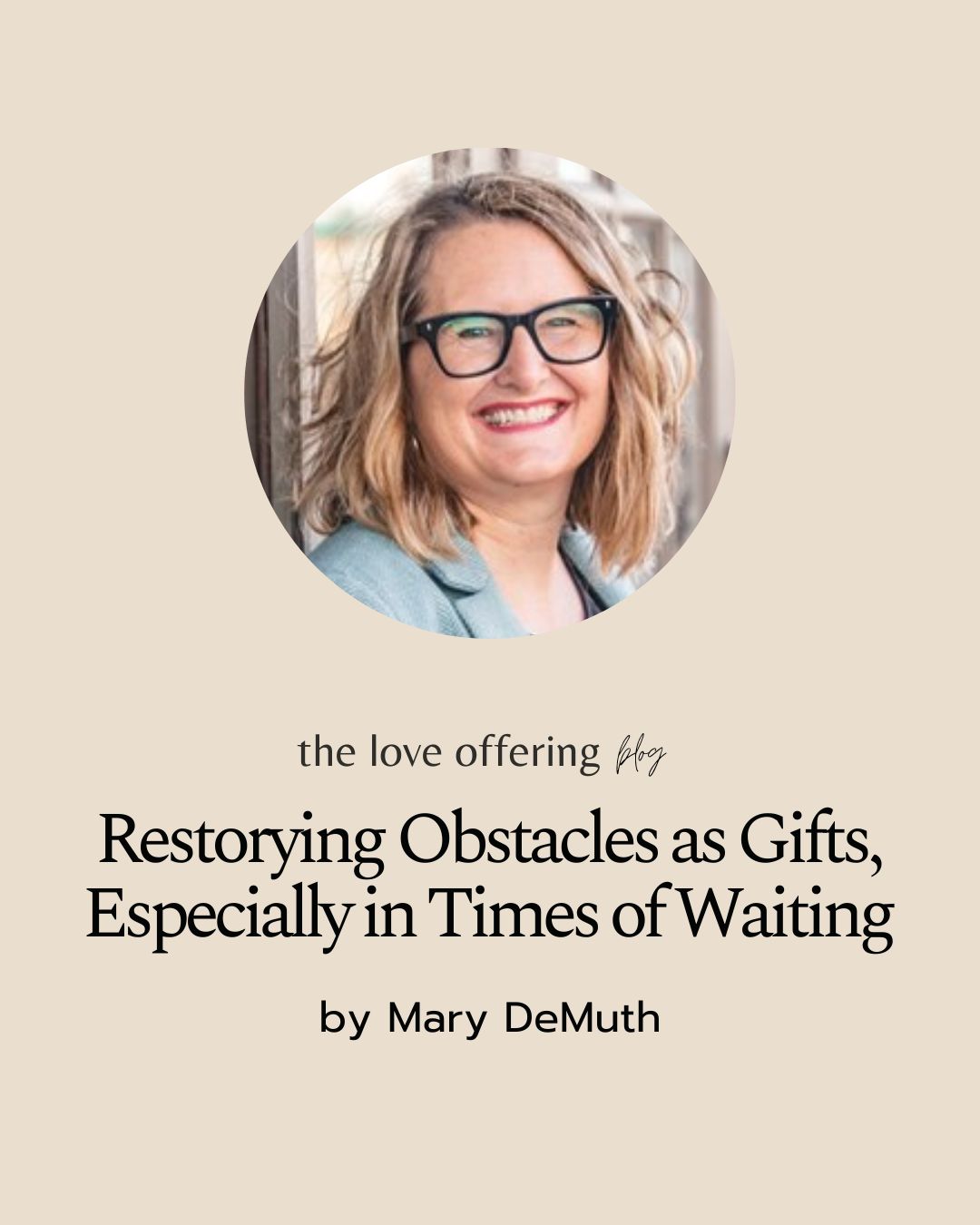
Mary E. DeMuth is an international speaker, literary agent, and the author of over 50 books, including We Too and The Most Misunderstood Women of the Bible. A survivor of childhood trauma, Mary has dedicated her life to helping others find healing and purpose through Jesus. As the host of the Pray Every Day podcast, she offers daily encouragement to listeners around the world. Mary’s writing has been featured in Christianity Today, The New York Times, The Washington Post, The Dallas Morning News, and more. She has spoken globally in countries like South Africa, Monaco, Switzerland, Germany, and Italy, equipping believers to embrace their God-given stories. As the founder of Mary DeMuth Literary, she mentors aspiring writers toward traditional publishing success. Mary and her husband, Patrick, have been married for over three decades and make their home in Rockwall, Texas. They have three adult children, a lively chocolate Lab, and a fuzzy black cat named Boo Radley.