
Da lifnei mi ata omed. This is what I heard from the Lord last Friday morning. In many synagogues, this phrase is written above the ark. It means, “Know before whom you stand.”
Earlier in the week, I had been wrestling with anger. I wasn’t just angry—I was livid with the Lord. He is the one in control of my situation, and yet here I am, angry, alone, and wearing a coat of grief and responsibility I never asked for.
“Take it, take it all,” I screamed one night. It was one of those guttural screams that shakes your entire body.
“Whatever you have planned, you can have it all back. I don’t want it,” my heart cried. I was ready to walk away from any blessings or callings because I felt the pain was far too great. I cursed the Lord and His so-called care for me. Then I sobbed, falling to my knees, exhausted and spent.
I stayed in that place for three days.
Then on Friday morning, He spoke. I was on my way to hear a Jewish believer speak at a women’s gathering.
The words came quickly as I traveled south on I-95. “Da lifnei mi ata omed.” I immediately straightened. The hair on the back of my neck stood up, and I was filled with grief—not the grief I’ve carried since Ryan got sick, but a deeper grief. The kind that comes with immediate repentance.
Tears sprang to my eyes, and I repented. I knew what the words meant in the depths of my soul.
He is God, and I am not.
Like Job, I felt as small as an ant, yet as loved as the only creature on earth. The God of the universe was reminding me of my place and His.
He is in control. He has a plan and a purpose. Like Job, my place is not to seek understanding, but to surrender to His way.
I’m a fighter by nature. I have grit, determination, and drive. And while God built those things into the fabric of my being, my lesson in this season is to use them to stay close to Him, not to replace Him.
He is God. I am not.
How comforting that sentence is when things are going well or when you are falling off a cliff with no ability to save yourself. But when you could work to make things happen and are instead told to be patient, to wait on the Lord, it is less comforting and more maddening.
Yet I wait.
I wait for something I don’t yet understand.
For a moment or a series of moments, I cannot see.
For a promise that feels vague and blurry.
Yet it’s a promise.
I have followed the Lord long enough to know that when I wait on Him, goodness follows. When I go about it myself, disaster follows.
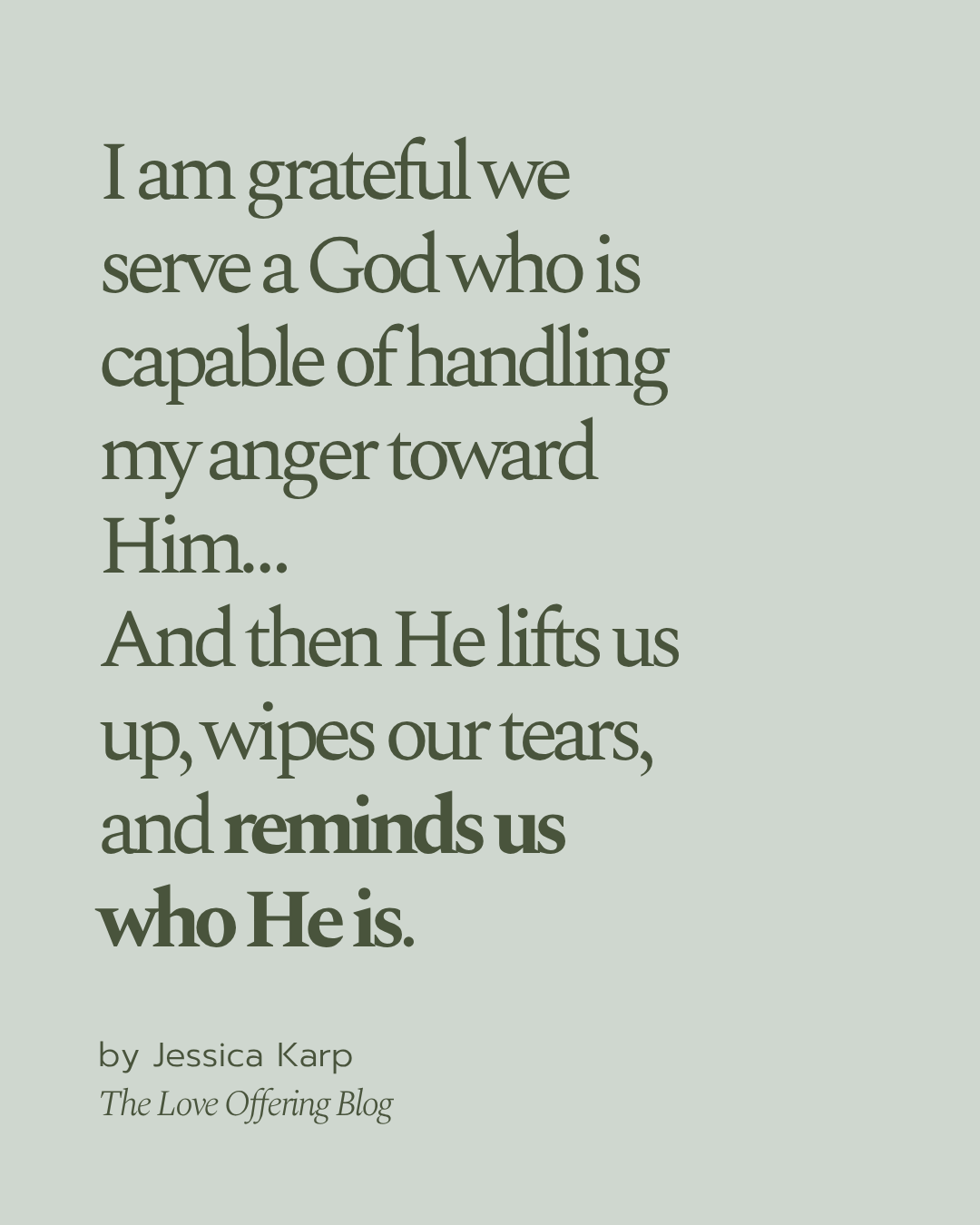
I am grateful we serve a God who is capable of handling my anger toward Him. He is a good Father who allows us to scream at Him until we collapse, exhausted and spent. And then He lifts us up, wipes our tears, and reminds us who He is.
He commands the stars in the sky. Surely He is capable of bringing beauty to even this.
I remember before whom I stand.
{If you enjoyed this blog post, you might also like this episode of The Love Offering Podcast, where Rachael chats with Jaime Jamgochian about her powerful story of faith through illness, disappointment, and uncertainty—and how surrender, worship, and gratitude led her to deep peace and healing. Jaime helps us see that waiting isn’t wasted when we’re waiting with God. You can listen to the episode here.}
About the Author:
Jessica Karp is a writer, speaker, and devoted follower of Yeshua. She is a mother to three incredible children and is walking through a deeply tender season of life following the recent passing of her husband. In the midst of grief and rebuilding, she is learning to hold sorrow and hope together, trusting God’s faithfulness in every step of the journey. Jessica carries a heart for encouraging women to encounter the Lord in life’s hardest places and to discover His nearness in both brokenness and beauty.