

“Those who cling to worthless idols
turn away from God’s love for them.
But I, with shouts of grateful praise,
will sacrifice to you.
What I have vowed I will make good.
I will say, ‘Salvation comes from the Lord.’” Jonah 2:8–9
I am both afraid and relieved to know that there is a God who will seek me out and forcibly extract the evil that wants me dead—even the evil I invite in, whether purposefully or in ignorance.
Being close to this good and holy God means the sin has to die. And when your identity is intertwined with that sin, its death will hurt. It may feel excruciating. What our deluded, deceived minds thought was a bloodthirsty predator coming to kill us has been the Lion of Judah all along, coming to carry us to a quiet place. When God tears you away from the sin that’s destroying you and carries you deep into the wilderness, it may look like a death sentence. But in the wilderness, we can finally rest in His love and peace.
This reminds me of Jonah. If anyone ever rebelled against God and His purposes, it was him.
The word of the Lord came to Jonah son of Amittai: “Go to the great city of Nineveh and preach against it, because its wickedness has come up before me.” But Jonah ran away from the Lord and headed for Tarshish. (Jonah 1:1–3)
Jonah doesn’t just disobey God, and he doesn’t just head to the next town over. Jonah beelines for the nearest port city and boards a ship headed to Tarshish, 2,500 miles away via sea voyage and at least a three-week journey. This man is so determined to be uninvolved in God’s specific plan for him that he decides to put Psalm 139:7 to the test: “Where can I go from your Spirit? Where can I flee from your presence?”
The answer, as the psalmist knew, is nowhere. And Jonah finds this out, too. The boat is ravaged by storms threatening to tear it apart. The group determines that Jonah, who is fleeing from his God, needs to get right with his deity if they are all to survive. Jonah knows precisely what is going on and insists they throw him overboard. They don’t want to—they try to find another way—but ultimately, they must.
And the seas calm instantly.
Now the Lord provided a huge fish to swallow Jonah, and Jonah was in the belly of the fish three days and three nights. (Jonah 1:17)
See that? God ordains and equips Jonah for evangelism, and it is going to happen, even in his rebellion. God proves Himself true and superior to other gods, even in this mess. The men in that boat encounter truth through Jonah, even in these harrowing circumstances.
Additionally, the whale is God’s provision; it saves Jonah from sure death. The terrifying vision of a gigantic whale closing its mouth over your body and the subsequent realization that you are still alive is the stuff of horror movies; nonetheless, being swallowed by the whale allows Jonah to survive. For someone like me with a slight and inexplicable fear of whales, this lands easily: Just like the young Lion that tears Gomer away from her false lovers and forcibly removes Israel from her idols, the mouth of the whale looks like death and brings true life.
God gives Jonah the opportunity to be obedient and responsive straightaway. Like so many of us, Jonah is so sure of his own insufficiency that it drives him to rebel and reject God’s limitlessness. God graciously doesn’t give up on him and find someone new. God refines Jonah in the storm he brought on himself. God reaches lost people despite and because of Jonah’s failure, and He uses a traumatic event to restore Jonah to his rightful calling and, ultimately, his true identity as a prophet of God.
Within the belly of the whale, Jonah says this prayer, which demonstrates his dramatic, counterintuitive restoration:
“Those who cling to worthless idols
turn away from God’s love for them.
But I, with shouts of grateful praise,
will sacrifice to you.
What I have vowed I will make good.
I will say, ‘Salvation comes from the Lord.’” (Jonah 2:8–9)
God lets Jonah out of the whale, and Jonah goes to Nineveh. The people are shockingly receptive to the call to reform their ways. They grieve and mourn before God. They repent.
Our own stories of God’s pursuit through our rebellion aren’t linear. Your testimony doesn’t end when you accept Christ. There will be ups and downs. You will fail God over and over. But that’s the point: He continues to come after you, and He continues to draw you into circumstances that will form you into the person He made you to be. Rinse and repeat. Once you are His, that’s the journey you begin.
All of this—the redirection when we wander, the forceful rescue missions when we rebel, the spiritual formation we experience in the pain that results from our own sin and in our liberation from it—is God’s discipline of us, His beloved image bearers.
When God disciplines you, God pursues you. God leads you from destruction into goodness. To get a clear picture of God’s pursuit, we need look no further than Psalm 23:
The Lord is my shepherd, I lack nothing.
He makes me lie down in green pastures,
he leads me beside quiet waters,
he refreshes my soul.
He guides me along the right paths
for his name’s sake.
Even though I walk
through the darkest valley,
I will fear no evil,
for you are with me;
your rod and your staff,
they comfort me.
You prepare a table before me
in the presence of my enemies.
You anoint my head with oil;
my cup overflows.
Surely your goodness and love will follow me
all the days of my life,
and I will dwell in the house of the Lord
forever.
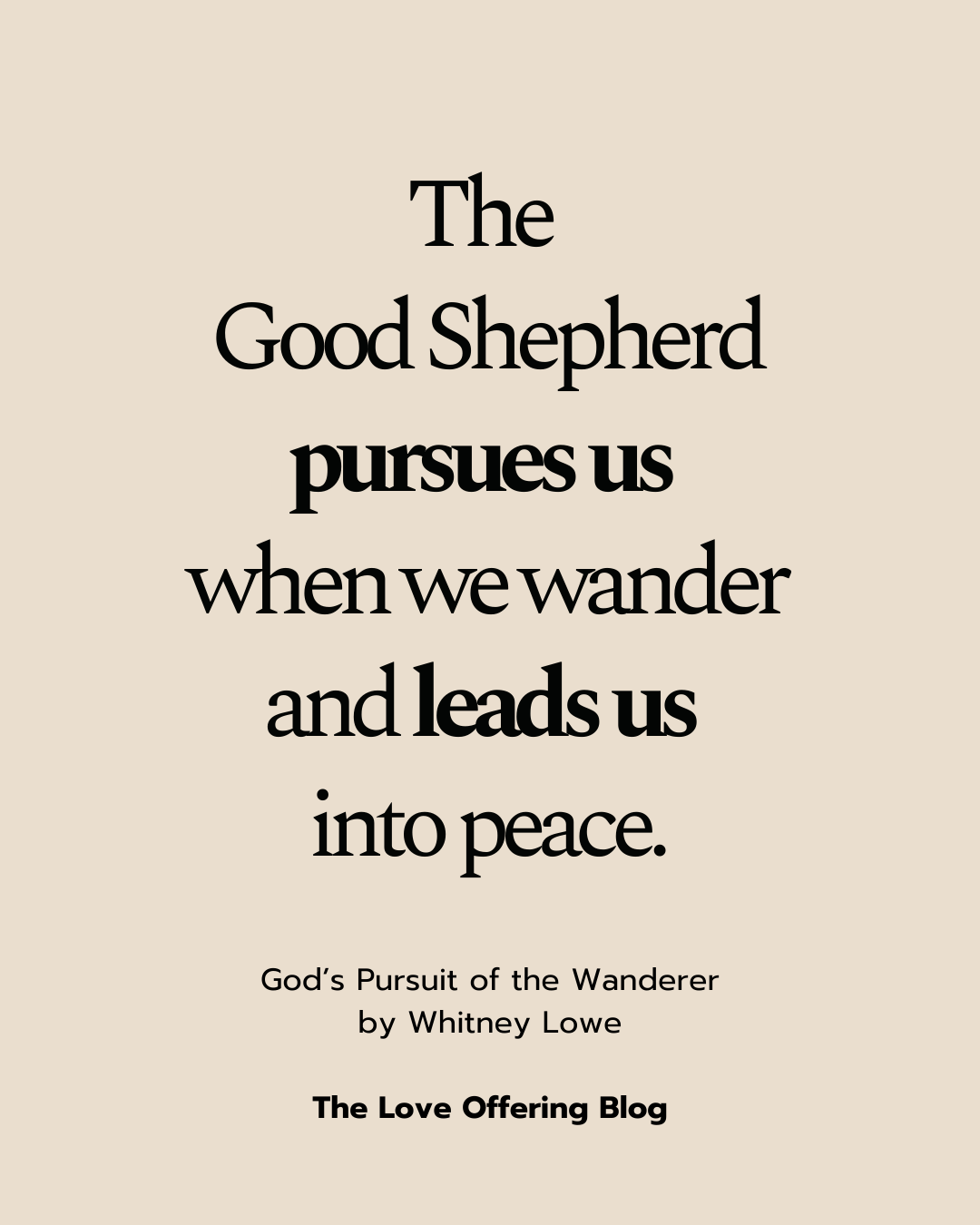
The Good Shepherd pursues us when we wander and leads us into peace. He makes us lie down (even when we would keep walking). His rod and His staff are instruments of comfort—as they prod and firmly direct, they offer protection and guidance.
God as our Shepherd leads as He follows. He is not only ahead, leading us without looking back, and He is not only behind, focusing exclusively on correction when we take the wrong step. No, the psalmist writes, “You go before me and follow me. You place your hand of blessing on my head” (Psalm 139:5 NLT). God’s pursuit means we are completely covered on all sides.
{If you enjoyed this blog post, you might also like this episode of The Love Offering Podcast, where Rachael chats with Jodie Niznik about the stories of Esther and Jonah, both appointed by God and placed in a certain time and space in history. Learn that you too are uniquely equipped and called by God for a particular assignment in a specific time and place. You can listen to the episode here.}
About the Author:
Whitney Lowe is a Christian influencer who wants to see young women excited about God’s work: in the Bible, in history, in the world and in themselves. She writes and creates on Instagram at @whitneypiersonlowe, an account born from the realization that young women simply do not interact with the Bible enough to be changed by its truth. Whitney is passionate about disrupting the toxic scroll of social media with hope, peace, and light straight from Scripture.
She released her first devotional, Set Your Eyes Higher: A 40-Day Reset to Slow Your Anxiety and Fix Your Focus on God, in September 24. Her newest book, Called Back to Who You Are: Finding Yourself in the Wild, Pursuing Love of God, released from Zondervan in January 2026.
Whitney grew up in Denver, Colorado, and graduated from Westmont College with a degree in Religious Studies. She now lives in Colorado with her husband Tanner, who is a pastor, and their three young children.